
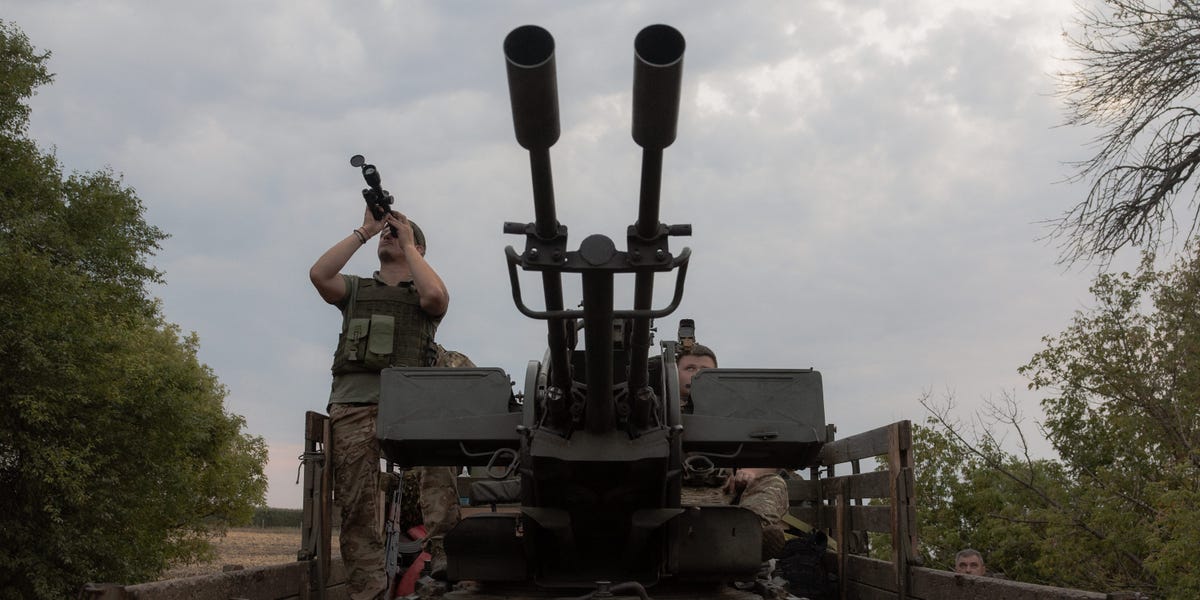
A NATO ally bracing for the Russian drone threat says finding them can be harder than taking them down Roman PILIPEY / AFP via Getty Images Detecting small drones is different from spotting missiles and aircraft, and in Ukraine requires layers of detection, including visual teams. A NATO ally on Russia's border is preparing to take down enemy drones, but a Latvian military officer says the bigger challenge can be spotting them in the first place.Latvia is building an automated anti-drone wall along its entire eastern border as it prepares for the threat of Russian drones.The defenses include low-cost interceptor drones inspired by Ukraine's fight against Russia, along with a network of sensors built to spot incoming threats. Maj. Modris Kairišs, the head of Latvia's Autonomous Systems Competence Center, told Business Insider that detecting drones can sometimes be more difficult than actually bringing them down.The small one-way attack drones pose a particular problem because of their size, flight characteristics, and ability to operate close to the ground.The Autonomous Systems Competence Center tests and integrates drones and counter-drone systems into Latvia's military and helps allies and partners, including Ukraine, test their tech.The center is helping Latvia build its growing network of air defenses and develop ways to detect incoming drones. Kairišs said other NATO nations face similar challenges and need to build capabilities, such as sensor networks, to detect these low-altitude threats.Why drones are harder to spotTraditional air defense systems were primarily designed to detect, track, and intercept missiles and fighter jets, which often have larger radar signatures, different material compositions, and different flight characteristics than drones.Missiles, Kairišs said, are "easier to detect."Many advanced Western systems can detect and engage drones, but they weren't necessarily designed with low-cost drone threats in mind. Using expensive interceptors against them can also be costly, with some air-defense missiles costing millions of dollars apiece. Low-flying drones can remain below the line of sight of ground-based radars until they are relatively close. Their smaller radar signature can also make them difficult to distinguish from background clutter. Ukraine's interceptor drones are among its defenses against Russia's drones. Beata Zawrzel/NurPhoto via Getty Images A Royal United Services Institute analysis previously argued that the primary challenge that drones present to traditional surface-to-air missile systems is that "as targets they are small, often slow, numerous, relatively cheap, and often operate at low altitude."Ukraine has built a layered air defense system with a mixture of gear, from air-defense missiles to interceptor drones to acoustic sensors that listen for incoming drones.Soldiers also watch the skies with binoculars and thermal imaging equipment, helping them spot incoming threats and alert air-defense teams, which might be a pickup truck with a mounted machine gun or something more advanced.The aim is to stop as much as possible without overwhelming Ukraine's air defenses.Investing in a mix of sensorsLatvia is adding drone detection systems to its border, including acoustic sensors, radars, and optical sensors. Kairišs said a big mix is key because "because every sensor has strong and weak points."Radars can mistake birds or other objects for drones, cameras can struggle in bad weather, and cheap acoustic sensors aren't always precise."In general," Kairišs said, "you need at least two, three different sources to be sure there is a target."Sir John Stringer, NATO's Deputy Supreme Allied Commander Europe, told Business Insider earlier this year that "for defensive air defense purposes, we need to get back to investing in the range of sensors that we need.""Some of those are most definitely novel for many Western nations," he said. The West needs "things like very cheap acoustic sensors" that Ukraine has, as well as more advanced sensors. Acoustic detection systems are among the means Ukraine uses to detect Russian targets. Anna Zubenko/Frontliner/Getty Images Kairišs said another problem NATO faces is that sensor data may be classified, complicating efforts to quickly share information with the dispersed units who need to act on it.He said the West's ability to stop drones isn't limited by technology. What's needed is "to change the mindset," act with a lot more urgency and speed, and scale capabilities.Preparing for the Russian threatLatvia has been rapidly adopting lessons from Ukraine as it prepares for the possibility of a confrontation with Russia.The country has faced incursions from drones that it says were Russian or came into its airspace due to Russia's electronic warfare, and it has faced direct Russian threats.Latvian defense minister Raivis Melnis told Business Insider that the aim of the defensive wall is to detect and neutralize "any drone which flies in," with fighter jets serving as a second line of defense.The system is also designed to leverage autonomous capabilities to reduce the number of soldiers needed by automating detection and tracking. Soldiers handle the final decision to neutralize a threat.Kairišs said Latvia is trying to find "this between peacetime and wartime to protect our borders.""We are currently in peace, and I hope it will remain forever," he said. But Latvia has to stop what's currently coming over its borders and be ready for any escalation. Read next Business Insider tells the innovative stories you want to know Business Insider tells the innovative stories you want to know Business Insider tells the innovative stories you want to know Business Insider tells the innovative stories you want to know Sinéad Baker is a Military and Defense Correspondent based in Business Insider's London bureau, writing about Russia's invasion of Ukraine and NATO actions.Sinéad most often covers soldiers' experiences, military strategy, battlefield developments, weapons systems, the defense industry's response, and the impact on NATO and European security, and geopolitical decisions that surround the Ukraine war. She has reported from NATO’s frontlines and around Europe, has interviewed multiple prime ministers and defense ministers, has appeared on BBC News and The Guardian's politics podcast, and has been cited by Congressional hearings.Sinéad has also extensively covered US politics and previously led Business Insider's breaking news coverage from London.Sinéad previously completed a master's degree in investigative journalism at City, University of London, and has written for The Guardian, The Observer, and TheJournal.ie. Sinéad is the former editor of the multi-award-winning The University Times in Dublin.ExpertiseExperiences of soldiers in Ukraine, including battlefield developments and tacticsWestern military responses to the war, and lessons they should learnNew weaponry built for and in response to the war Email Sinéad at sbaker@businessinsider.com or find her on X. Russia NATO Drones More
A NATO ally bracing for the Russian drone threat says finding them can be harder than taking them down
Full Article
Original Source
Read the full article at Businessinsider →KhanList aggregates and links to publicly available news content. We do not host full articles from third-party sources. Always verify important information with original sources.