
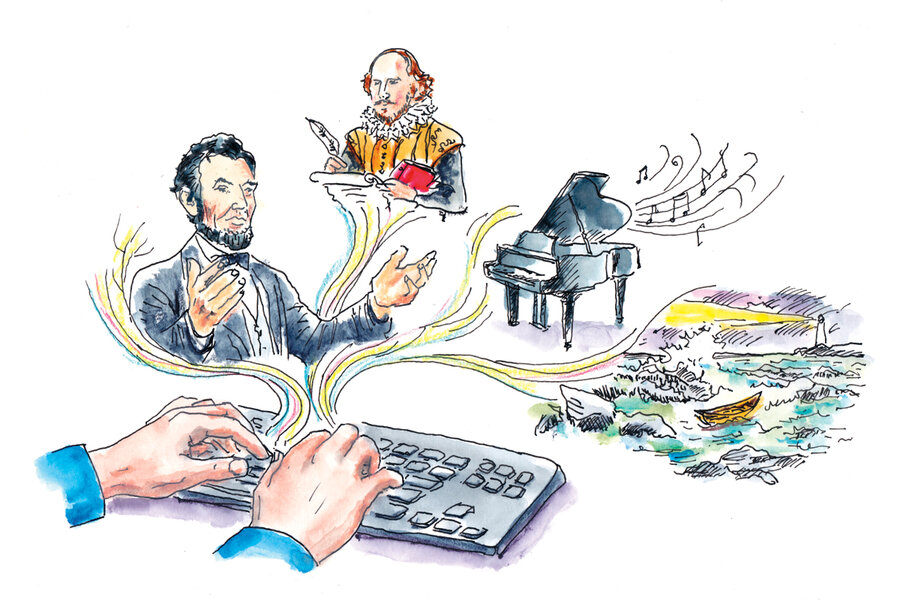
Fifty years ago, The Boston Evening Globe published a pair of essays written by two young men graduating from college. In those pieces, David Shribman, from Dartmouth College, and Marshall Brooks, from Boston’s Suffolk University, explored the purpose of higher education – what it meant to them, what they learned (and didn’t), and how they expected their collegiate experience might shape their futures. Mr. Shribman would go on to win the Pulitzer Prize for his writing on American political culture. He became executive editor of the Pittsburgh Post-Gazette and a nationally syndicated columnist. Mr. Brooks became an author and founded Arts End Books, a literary arts press.This year, coming off the 50th anniversary of their graduation, Mr. Shribman and Mr. Brooks updated those 1976 essays for The Home Forum in the Monitor. In the week after my transition from student to alumnus, readers of The Boston Evening Globe saw my first appearance on a newspaper op-ed page: a contemplation from a 22-year-old about the benefits of an education, and the difference between being educated and being trained.I graduated from the college that was the model for the raucous movie “Animal House.” My views about the value of education almost completely matched the motto of the madcap institution in the film: “Knowledge is good.” But it turns out that knowledge (the names of the geologic eras, who won the 1876 election, how a symphony differs from a concerto) can also be static. Wisdom, I have learned, is dynamic.Throughout a half-century in journalism, insights – and in many cases, direct quotes – from a course on Shakespeare, another on the King James Bible, a third on geology, and another on American diplomatic history found their way into my columns. But none of these courses was designed to shape a student’s career. They, like the course on music history and the French painters of the 19th century, were part of a menu intended to enrich the main course of life – then, and in the years beyond.I suspected that, back in 1976, for in my original essay I wrote, “The values of a liberal-arts education are ideas and values themselves. They won’t fit on a job resume, they can’t be converted into a pension, but they shape lives.”They were also preparing us for change.We had been steeped in the notion by the time we left campus that we would face relentless change in our postcollege lives – some of it congenial, much of it jarring, all of it life-altering.Three years after I left college, The Boston Evening Globe folded, an event I should have recognized as a harbinger of great change in my chosen field of journalism. A decade after graduation, the Challenger space shuttle exploded, a landmark I should have understood was a symbol of the fallibility of science and a fresh invitation to the suspicion of experts.A quarter century after our commencement, terrorists flew into the World Trade Center towers, an event that would have seemed inconceivable to those of us who proceeded across the College Green to the strains of a brass quintet.Forty years after we received our degrees, Donald Trump was elected president of the United States, an unlikely future for the young developer who, during our graduation year, was consumed with winning an unprecedented New York City tax abatement that permitted him to gut the Commodore Hotel next to Grand Central Terminal and develop the Hyatt that sits there now.These days, the college education that, in our time, cost about $20,000 for four years is under siege, regarded by some as a waste of time and money, by others as a perilous marination in dangerous ideas.But my education is the most precious possession I have. The fact that two of the most popular professors on campus in our years were devout conservatives (Jeffrey Hart in English, Vincent Starzinger in government) is part of why I value it. They introduced us to the challenge of deep thought and analysis, much the way I think the liberals who are said to have replaced them almost certainly do for contemporary students. Maybe I was naive, but I believed the preachings of former Dartmouth Presidents John Sloan Dickey (his admonition, “Your business here is learning,” was widely quoted even after his retirement) and John G. Kemeny (“All mankind is your brother, and you are your brother’s keeper”). I believe those things still, maybe more fervently than ever.My education has allowed me to know what Shakespeare said about all that “glisters,” what Abraham Lincoln preached at Gettysburg, how the piano music of Chopin sounds, and what the Maine seascapes by Winslow Homer look like.These might seem like bits of trivia, accessible on the web, but they are representations of truth and beauty that don’t require a keyboard. But over the years, when I sat down to write, they and the other things I learned – and to my astonishment, many of the things I thought I forgot – were there, guiding my fingers, molding my thoughts, shaping my stories and columns, even as the education I received shaped my values.– David ShribmanMy college education was an old-fashioned books-and-mortar one. My alma mater, Suffolk University, was then located between the Boston Public Library and the Boston Athenaeum. In that historic half-mile-or-so stretch between the two, I underwent a hybridized process of self-induced learning in tandem with the more traditional.When I first wrote about my college experience in a piece that found its way into the Boston newspapers 50 years ago, a liberal arts education was not summarily dismissed in favor of job placement. Affordability helped to make this possible, of course. My tuition payments were in the hundreds of dollars, not thousands.I came to Suffolk in what might be termed a personal maelstrom of bookishness. Having worked the previous year for a literary publisher in New York, I had been reading manuscripts – and rejecting most of them – at the ripe old age of 17 and selling my poetry to the likes of Harper & Row. Suffolk more than accommodated this corpus of experience while at the same time enabling me to refine my interests courtesy of its humanizing curriculum. A faculty member of the English department, Thomas Connors, described himself as a professional reader, which sounded exactly right to me as a calling. One of the benefits of going to college is to hear adults talk in new, unexpected ways, employing fresh language that embodies the quintessence of an idea or concept. Professor Connors gave the best exams, by the way, along with some valuable advice on how to ace them. Read the book once: Receive a C. Read the book twice: B. Read the book three times: an A. Professor Connors’ formula never failed.Back in the day, Suffolk was a commuter school favored by working people. Many, if not all, students were older, with jobs. A student in one of my journalism classes worked for Massachusetts Senate President Billy Bulger. He attended class on his statehouse lunch breaks, always attired in a black suit and white shirt, undertaker style. I had never heard of Billy Bulger before, but you immediately picked up on his presence.. Whether or not my classmate was much of a reader, I do not know. But he embodied territory – South Boston, I would have to assume – that no bookstack can easily replicate.I spent part of every day at the Boston Athenaeum at 10 1/2 Beacon St., one of America’s oldest private libraries. Reading tickets there were affordable, costing maybe $50 a year. While Suffolk’s undergraduate library back on Temple Street was congenial, the Athenaeum’s depth was something else entirely (current holdings now total 600,000 books). The Athenaeum was my secret weapon as a student. None of my classmates – save just one that I know of, Rosemary, from English honors class – availed themselves of the collection.Ralph Waldo Emerson was also an Athenaeum reader. Ditto Henry David Thoreau, through Emerson’s good offices.When I brought in a worn, 140-year-old copy of Ebenezer Elliott’s poems (1834) from out of the Athenaeum’s depths to show Professor Connors, he cooed with delight. I don’t think that he had ever heard of England’s “Corn Law Rhymer” before. I had discovered Elliott completely by accident, but that didn’t stop Tom from appreciatively quoting Elliott in class, the course being taught entitled The Literature of Poverty. The antiruling class rebuke “Caged Rats” had caught his eye.I have always regarded books as portals. Once they’re activated, you travel. You meet people – frequently people whom I have come to regard as investigative personalities. Artists, musicians, substitute teachers, and file clerks can all be investigative personalities. They’re people who are driven by curiosity. Novelist James T. Farrell was very much that way. Jim was also one of the best-read writers of his generation. We had bookishness in common and met.I did quite a bit of research for Jim while I was at Suffolk. When he wanted to know the title of the papal encyclical that Pope Leo XIII issued circa 1890 on socialism or what year Walter Eckersall made a 106-yard run for the University of Chicago football team against Wisconsin, the Suffolk library’s reference room handily bailed me out, pre-internet.The school environment, and the support that I received there, were critical aids. Education as a portal is to be cherished and celebrated. It is precisely this unpredictable atmosphere of exploration that is its glory.There is one more thing.The single largest contribution that Suffolk made to my life, though, was strictly nonacademic. I met my wife – this year marks the 50th anniversary of our meeting – through a summer newspaper internship advertised at the school. No Suffolk University would have meant no internship and, in turn, no wife-to-be. My wife was a reader as well, and, what’s more, came from a family of writers and book publishers. Bibliophiles, all of them. Be advised, then, of the unadvertised benefits, and quirks, of in-person learning.The Suffolk University that I attended is now a largely disappeared place; the rehabbed commercial printery where I took poet Annie Boutelle’s superb Canadian literature course in 1976 is now a concatenation of condos, as is the former School of Journalism just up the hill. Deepen your worldviewwith Monitor Highlights.Politics with respectGet political stories with respectful analysis.There‘s a world of new ideas in everyBooks newsletter.There‘s more to life, enrich yours withCulture & Learning weekly.Follow humanity‘s discoveries withScience & Nature stories in your inbox.Gain a spiritual perspectivefrom the stories in your inbox.Want to understand the deeper impact of critical events? Learn the Monitor‘s insight.Already a subscriber? Log in to hide ads. What I wrote 50 years ago performs as something of a welcome memory card in this respect. I also better remember, and see afresh, the young person that I was. He still exists – here and there. The past is an elaborate future.– Marshall Brooks ALREADY A SUBSCRIBER? LoginReal news can be honest, hopeful, credible, constructive.The Christian Science Monitor was founded in 1908 to lift the standard of journalism and uplift humanity. We aim to “speak the truth in love.” Our goal is not to tell you what to think, but to give you the essential knowledge and understanding to come to your own intelligent conclusions. Join us in this mission by subscribing.
A most precious possession
Full Article
Original Source
Read the full article at Csmonitor →KhanList aggregates and links to publicly available news content. We do not host full articles from third-party sources. Always verify important information with original sources.