
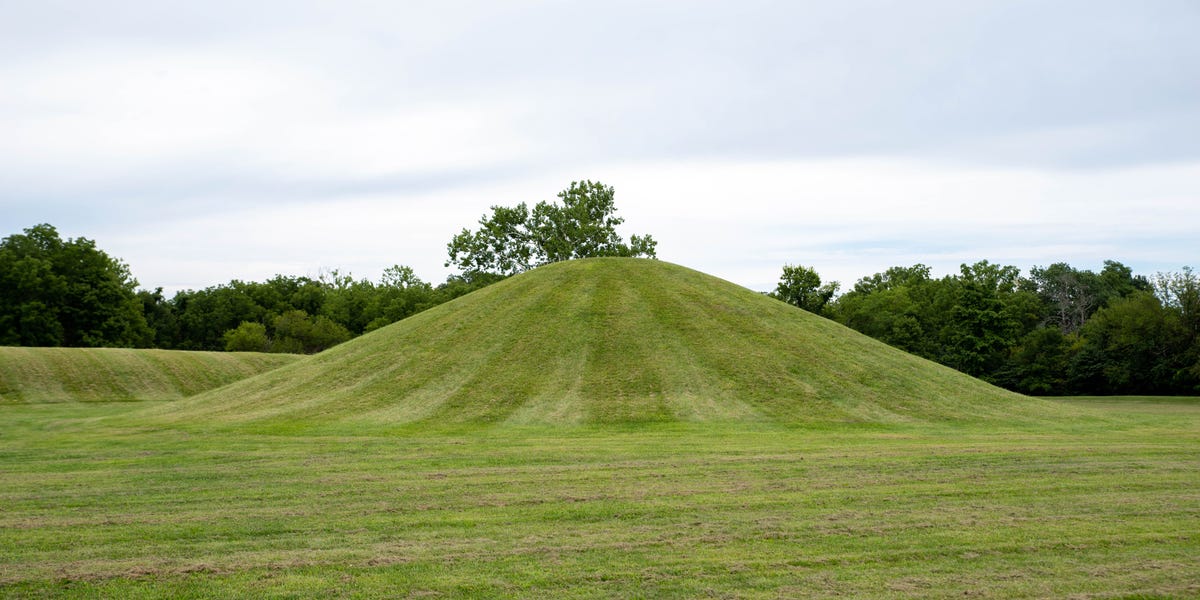
3 min readHere’s what you’ll learn when you read this story:In 1981, an amateur archaeologist observed that a complex of earthen mounds and ridges overgrown with roots and branches were arranged too intentionally to be random. This site, known as Watson Brake, was dated by archaeologists and later confirmed to be the location of a monumental structure that preceded agriculture. Built by nomadic hunter-gatherers, Watson Brake has overturned the usual thinking that settlements and agriculture need to have developed before monumental structures were built.We don’t typically think of Stone Age hunter-gatherers as being capable of monumental architecture. Wandering nomads during that era were supposedly too primitive for something that advanced, and they seemed to have no need for such structures when they were constantly on the move. But Mesolithic-era earthworks in Louisiana that predate even the pyramids of Egypt have had us questioning those beliefs for nearly 50 years.Archaeologists were initially baffled by the mounds that surfaced throughout the Watson Brake site in Louisiana’s Ouachita River Valley. Reca Jones, a local who moonlighted as an amateur archaeologist, had lived her whole life in the area and heard about the mounds, only three of which—nearly swallowed by swampland and dense woods—were even slightly visible through the tangle of roots. She became intrigued when more of the mounds surfaced after logging operations in 1981, and eventually identified eleven mounds (the largest of which was 25 feet tall) that were linked by ridges in a circular formation. This would eventually catch the attention of Joe Saunders (regional archaeologist for the Louisiana Department of Culture, Recreation, and Tourism), but by that time, the area had once again been reclaimed by the swamp.Saunders was determined to find out more about these mysterious mounds. He had been sampling material from nearby sites—which included Poverty Point, the (at the time) oldest and most expansive mound complex in Louisiana— by 1990, but when he sampled material from Watson Brake, the later site turned out to be almost two thousand years older. Radiocarbon dating soon revealed that the complex was built over the course of four centuries, starting around 3400 B.C.E., which would make it over 5,400 years old.“[Watson Brake] predates other known mound complexes with earthen enclosures in North America by 1,900 years,” Saunders and soil scientist Thurman Allen said in a 1997 study published in Science (which Jones also contributed to). “Evidence suggests that the site was occupied by hunter-gatherers who seasonally exploited aquatic resources and collected plant species that later became the first domesticates in eastern North America.”Further analysis of sediments suggested that the soil beneath the surface of the earthen mounds had been packed intentionally, which prevented biochemical degradation processes. But even more impressive was how they were arranged.The Evans culture of Paleoindians, who constructed the mounds, aligned them with the landscape and subsequently raised the rest of the mounds to follow the pattern, moving massive amounts of soil in only a handful of centuries. It was also inferred that these nomadic people had not been ordered to build such a structure by any deity or king, but that the site was simply the result of the masses working together for a common cause. It has been estimated that at least 100,000 hours of labor went into its construction (when the ridges are included).Most ancient peoples are assumed to have settled permanently in a region before developing agriculture, and the surplus that followed would lead to a social hierarchy, with those in the upper echelon managing labor for monumental structures. Turning this assumption on its head, Watson Brake proves that structures on this scale did not necessarily appear after agriculture was established.The site is now thought to have once been a seasonal gathering place, much like Stonehenge would be 2,000 years later. Blades and projectile points used for hunting were found at the site, along with buried animal bones and shells, gravel used for cooking stones, charred seeds from edible plants, and objects made of fired earth that could have been primitive forms of pottery.Since the 1997 analysis, the Watson Brake mounds have been dethroned as the oldest known mound complex in the Americas—in 2022, experts determined the Monte Sano mounds near Baton Rouge were even older, at 7,000 years old. But the archaeological goldmine of Watson Brake may have pushed experts to search for more ancient structures in the region, and it would have remained hidden by overgrowth if not for a curious local with an off-duty passion for archaeology.Elizabeth Rayne is a creature who writes. Her work has appeared in Popular Mechanics, Ars Technica, SYFY WIRE, Space.com, Live Science, Den of Geek, Forbidden Futures and Collective Tales. She lurks right outside New York City with her parrot, Lestat. When not writing, she can be found drawing, playing the piano or shapeshifting.
A Massive Complex of Mysterious Mounds Was Hiding in Plain Sight For Over 5,000 Years
Full Article
Original Source
Read the full article at Popularmechanics →KhanList aggregates and links to publicly available news content. We do not host full articles from third-party sources. Always verify important information with original sources.