
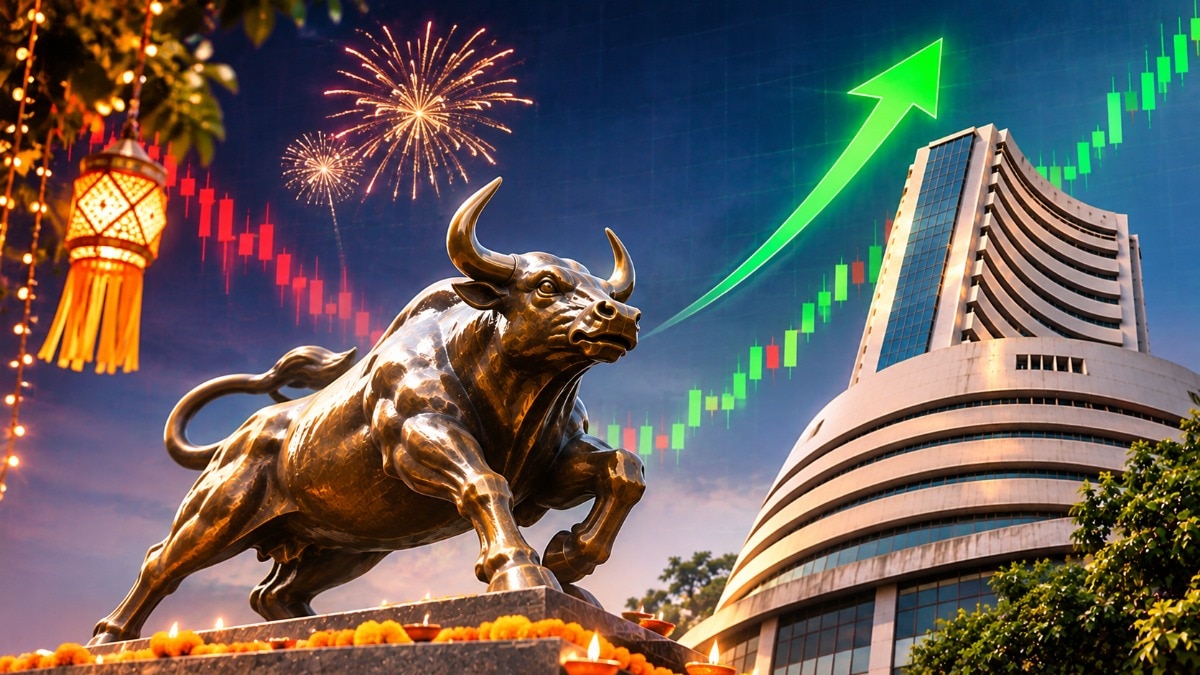
There is an unusual contrast playing out across Asian markets. While investors in Japan, South Korea and Taiwan are scrambling to deal with a brutal sell-off in technology stocks, Dalal Street is enjoying an early Diwali celebration.On Thursday, domestic equity benchmarks delivered their biggest single-day gains in seven months. The Sensex surged over 2,000 points, while the Nifty climbed nearly 600 points. Both indices extended their winning streak to six sessions.And the cheer held up on Friday morning, even as much of Asia was deep in the red. At around 11:00 am, the Sensex was up about 500 points and the Nifty had also registered strong gains.But this was not the case across other Asian markets. South Korea's Kospi plunged more than 8% in early trade, triggering a 20-minute trading halt, while Japan's Nikkei fell around 5-6%. Taiwan's technology-heavy market was also hit hard. The sell-off followed a sharp overnight decline on Wall Street. So, what is keeping Dalal Street in a celebratory mood when some of the region's biggest markets are reeling?THE RETURN OF FOREIGN MONEYOne of the biggest reasons is the sudden return of foreign institutional investors (FIIs), whose persistent selling had weighed on Indian equities for much of the year. On Thursday, foreign investors were net buyers of Indian equities worth nearly Rs 15,000 crore, according to provisional exchange data. Their purchases were particularly significant because domestic institutional investors (DIIs) were net sellers of more than Rs 10,400 crore on the same day.The reversal has been sharp. VK Vijayakumar, chief investment strategist at Geojit Investments Limited, said FIIs had bought equities worth around Rs 35,781 crore over the previous five trading sessions."The big blood bath in the US markets will impact most other markets today, but India is likely to be the least impacted," Vijayakumar said.The return of foreign money is important because it comes after months of heavy selling. It also suggests that global investors may be reassessing their exposure to Indian equities as the investment narrative shifts.However, one or two weeks of buying do not establish a sustained trend. Foreign flows can reverse quickly if global risk appetite deteriorates or investors find better opportunities elsewhere.WHY THE AI ROUTE COULD WORK IN INDIA'S FAVOURPerhaps the most interesting part of the current market divergence is the global sell-off in artificial intelligence stocks.Wall Street suffered a brutal session on Thursday. The Nasdaq plunged 5.5%, while the S&P 500 fell 4.4%. The sell-off wiped out trillions of dollars in market value as investors reassessed the enormous sums being poured into AI infrastructure and data centres.The concerns that triggered the market sell-off centred on the possibility that Democrats could subject the AI industry to greater scrutiny, potentially slowing the expansion of data centres. It may be noted that investors were already questioning whether the enormous sums being poured into AI would generate returns substantial enough to justify the investment.The shock spread across Asia, particularly to markets with significant exposure to the global semiconductor and AI supply chain. South Korea's chipmakers Samsung Electronics and SK Hynix came under heavy pressure, while Japanese and Taiwanese technology companies also saw sharp declines.India, meanwhile, has relatively limited exposure to semiconductor manufacturing and the global AI hardware supply chain. That has offered its stock market some protection from the immediate shock."The big rout in Nasdaq was triggered on concerns of a big slowdown in data centre spending since the Democrats are opposed to massive data centre investment. This tech rout, particularly the sharp deceleration in AI trade, will turn out to be beneficial for India," he said.The argument is that as global investors reassess expensive AI-linked investments, they could look for opportunities in markets and sectors less directly exposed to the technology trade. India could be one of the beneficiaries.However, that does not mean Indian technology companies are immune to the longer-term disruption from AI. Nor does it mean a global sell-off cannot drag Indian stocks lower.But in the current round of selling, India's relatively limited exposure to semiconductor and data-centre hardware has worked in its favour.EARNINGS SUPPORT BOLSTERS RALLYThere is another reason market experts are more optimistic about the recovery: corporate earnings.A market rally driven only by foreign inflows or a change in global sentiment can be fragile. For gains to last, companies need to deliver earnings that justify their valuations.Vijayakumar said the current rally had a stronger foundation. "It is important to recognise the fact that this ongoing rally has fundamental support from impressive earnings growth which has come better-than-expected," he said.If earnings continue to surprise on the upside, investors may have a stronger reason to stay invested even if global markets remain volatile.The recent recovery has also come after a period of prolonged weakness, which made valuations more attractive in parts of the market. Large-cap stocks, in particular, are drawing investor interest.THE PARTY IS LARGELY A LARGE-CAP AFFAIRThere is, however, a catch. Not every corner of the market is enjoying the rally.Vijayakumar pointed to the sharp difference between the performance of large-cap and small-cap stocks on Thursday. "The rally is driven by large-caps which had become attractively valued. Note that yesterday while the Sensex rallied 2.6%, the Smallcap 100 index crawled by a measly 0.67%. It is evident where money is going," he said.To put it simply, institutional money appears to be favouring larger, more established companies rather than chasing a broad-based rally across the market.Vijayakumar sees further upside in financial, technology and automobile stocks. These sectors, he believes, could benefit from the combination of improving earnings and more attractive valuations.This selective buying is worth watching. A sustained recovery in the benchmark indices is one thing; a broader rally that includes mid- and small-cap stocks would be a stronger indication that investor confidence is returning across the market.CAN THE GOOD TIMES LAST?For now, Dalal Street has reasons to celebrate. Foreign investors have returned as buyers, earnings have offered support and India's relatively limited exposure to the global AI hardware trade has helped it withstand the immediate shock.But the risks have not disappeared.Foreign flows can turn negative again if global investors retreat from emerging markets. A stronger dollar, geopolitical uncertainty or a fresh rise in crude oil prices could put pressure on the rupee, inflation and corporate margins. Friday's rebound in crude prices is also a reminder that the relief from lower energy costs may not last.The fireworks may have started early on Dalal Street. But the real test will be whether foreign investors keep buying, corporate earnings sustain their momentum and the global sell-off remains confined to the sectors most exposed to the AI trade.For now, India is enjoying the party while much of Asia nurses a market hangover.(Disclaimer: The views, opinions, recommendations, and suggestions expressed by experts/brokerages in this article are their own and do not reflect the views of the India Today Group. It is advisable to consult a qualified broker or financial advisor before making any actual investment or trading choices.)- Ends
A market meltdown in Asia, a Diwali party on Dalal Street
Full Article
Original Source
Read the full article at Indiatoday →KhanList aggregates and links to publicly available news content. We do not host full articles from third-party sources. Always verify important information with original sources.