
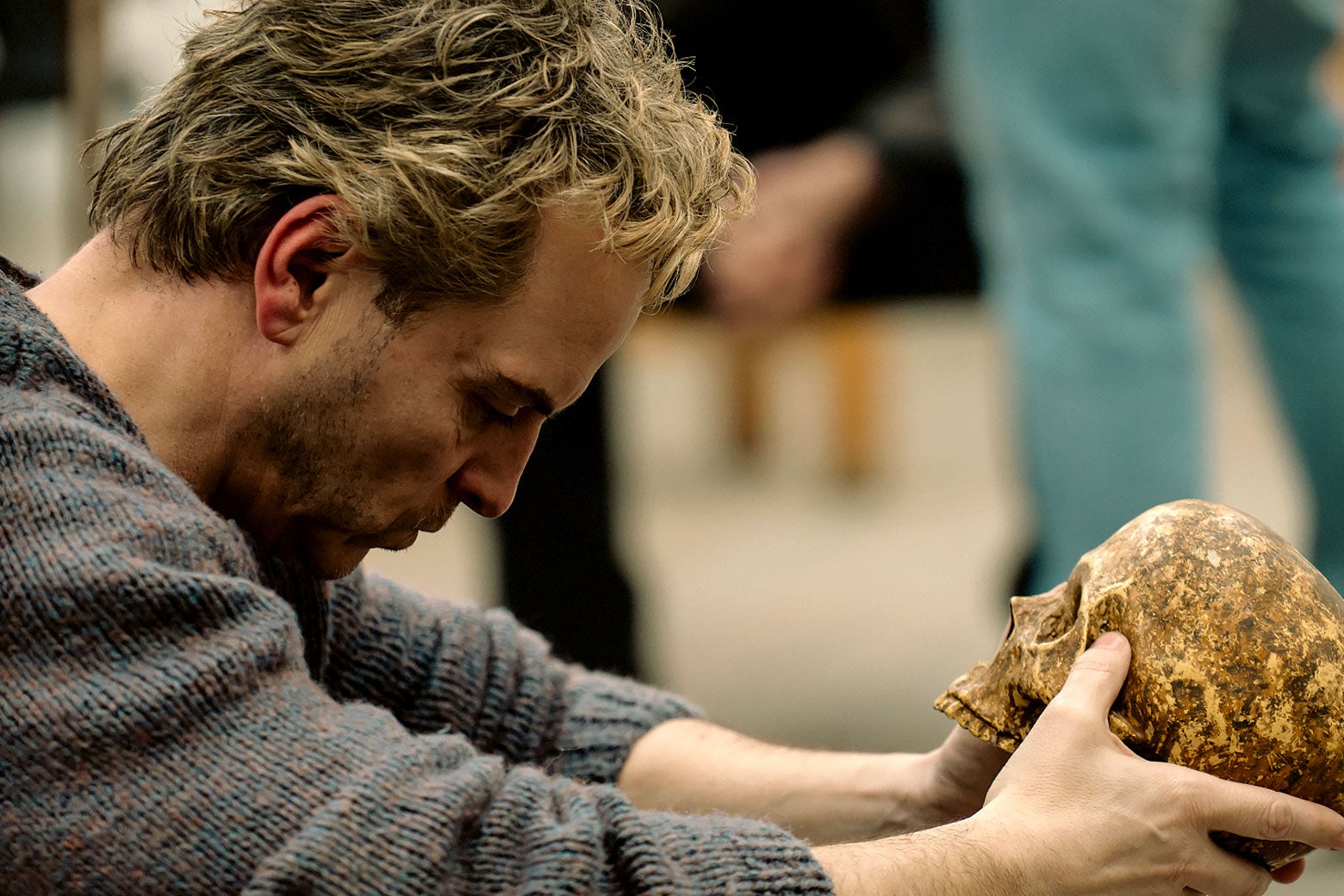
Movies For the second year in a row, a Shakespeare movie could get an actor their Oscar. By Enter your email to receive alerts for this author. Sign in or create an account to better manage your email preferences. Unsubscribe from email alerts Are you sure you want to unsubscribe from email alerts for Sam Adams? Sept 17, 20262:54 PM Focus Features Sign up for the Slatest to get the most insightful analysis, criticism, and advice out there, delivered to your inbox daily. For the second year in a row, the Toronto International Film Festival’s audience prize might go to a movie about putting on Hamlet. Last year, of course, the People’s Choice Award—a reliable, if not infallible, bellwether of a Best Picture nomination—was Hamnet, which doubled down on Shakespeare’s greatest fictional tragedy by fusing it with the real-life death of his 11-year-old son. This year, the movie that had TIFF-goers sniffling in their seats is Elsinore, starring Andrew Scott as actor Ian Charleson, who took the lead in a National Theatre production of Hamlet mere weeks before he died of AIDS-related complications. Building a tragedy around Hamlet is arguably the dramatic equivalent of starting on third base, but Elsinore doesn’t simply pop in a few lines of Shakespeare when it runs short on poetry. While Hamnet thrives on the parallels between the play and the grief that, at least in theory, inspired it, Elsinore drives at an unstated irony: Hamlet is about a man who wants to die, and the movie is about a man who is determined to live. Although Charleson played one of the leads in the Oscar-winning Chariots of Fire and a supporting role in Gandhi, which won Best Picture the following year, he never quite became a movie star, and by 1989, when Elsinore picks up the story, he’s openly envious of the meteoric rise of Daniel Day-Lewis, whose forthcoming Hamlet is already the talk of the town. But when Day-Lewis abruptly walks offstage in the middle of the performance—as legend has it, because he saw the ghost of his own father onstage—there’s a sudden opening, and director Richard Eyre (Johnny Flynn) wants Ian to fill the part. Ian, however, has just discovered his first Kaposi’s sarcoma, and his doctor (Olivia Colman) suggests it would be wiser to put all his energies into fighting the disease rather than taking on a four-hour play that climaxes with a swordfight. He can play the role of a lifetime, or he can prolong his own life. And as he tells her, “I’d rather die of Hamlet than AIDS.” The movie, directed by Simon Stone and written by Stephen Beresford, touches on Hamlet’s greatest hits: There’s Yorick, the nunnery, and eventually some “To be or not to be.” But it also circles back again and again to a line that doesn’t usually get as much attention: “Remember me.” Originally spoken by the ghost of Hamlet’s father and repeated by his son, it becomes Elsinore’s refrain, not just for Charleson but for the era he represents, when even the most enlightened clinics still burned the bedding after a patient died of AIDS and coming out of the closet could be a career-killer. Charleson, whose sexual orientation was not made public until after his death, is heavily criticized by the pioneering gay director Derek Jarman (David Dawson) for putting his Hollywood aspirations above the fate of his community. (The fact that Charleson apparently left his part in Jarman’s Jubilee off his résumé adds salt to the wound.) At the film’s Toronto premiere, Beresford admitted that after the two men’s friendship ended over Charleson’s decision to stay closeted, they never spoke again. But he invented an arc for them that plays out across several scenes and becomes the spine of the movie, two gay men living with AIDS who choose different paths and find a way to reconcile, although that arc has far more to do with the politics of 2026 than the way Jarman actually felt. Based on the lengthy ovation that greeted Scott when he returned to the stage after Elsinore’s screening, he’s a lock for a Best Actor nomination, but he doesn’t make Charleson into the kind of tortured, regretful gay man the Oscars tend to favor, especially when the character is played by a straight actor. The dying actor never blames himself for getting HIV or rages against the heavens at the cruelty of his fate, but neither does he accept the tradeoff of prolonging his life by diminishing it, whether that means accepting the side effects of AZT, which he derides as a failed cancer drug, or withdrawing from the rigors of doing eight shows a week. Instead he chooses to make what may be his final mark on the world, prepared for what comes next, because, as Hamlet himself puts it, the readiness is all. As a young stage actor, Scott drew comparisons to Charleson, and played a lauded Hamlet of his own in 2017. But in Elsinore, he reimagines the role through Charleson’s eyes, and the movie dwells on the moments when Hamlet works through his fear of death and comes out the other side. Stone gives us few prolonged moments from the play, using the rehearsal process to jump through the text and ending the film with an extended montage that freely intermixes Charleson’s life and his art. Some may regard the rush of images and Stefan Gregory’s swelling score as heavy-handed, but the sequence opens the floodgates as intended, and brings us to the moment when Hamlet realizes that the uncertainty he feared above all has been pierced; he sees his own death with clarity, and, at least in this telling, to a peace beyond it. The rest is silence. AIDS History Movies The Oscars Theater LGBTQ+
A Major New Oscar Contender Has Arrived. It Is Once Again About … Putting on Hamlet.
Full Article
Original Source
Read the full article at Slate →KhanList aggregates and links to publicly available news content. We do not host full articles from third-party sources. Always verify important information with original sources.