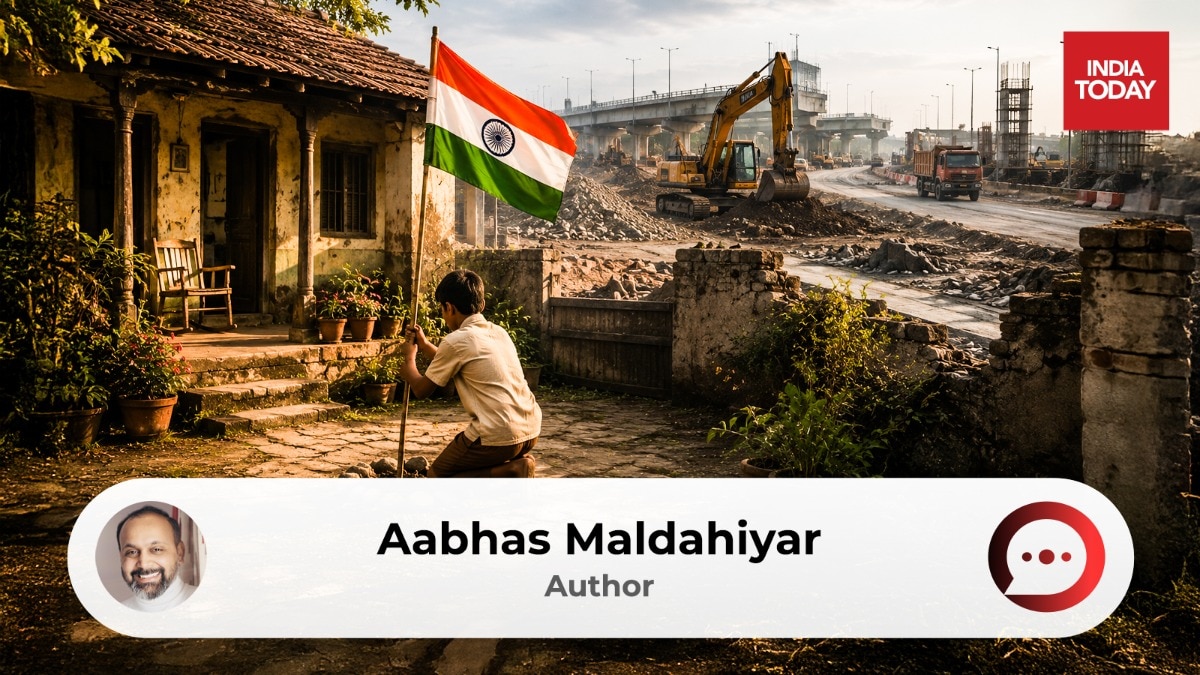
There was once a house called Nath Cottage.It stood on the outskirts of Hazaribagh, shaded by old mango trees and filled with the kind of memories only childhood can create. Every Independence Day, before the town had stirred awake, I would run into its sprawling front yard with a bamboo pole balanced on my shoulder. I would dig a small hole in the damp earth, plant the Tricolour with utmost care, step back, salute, and stand in silence. To a little boy, that patch of soil was no less than the Red Fort.Today, Nath Cottage exists only in memory and beneath a National Highway.The State acquired the land. Compensation came, but it could not even buy us a property one-third the size of the home we lost. A house that had sheltered three generations, witnessed my childhood and shaped my earliest understanding of India disappeared beneath concrete. Every August, as the Tricolour rises against the monsoon sky, I find myself thinking less about the road that replaced it and more about the home that never should have vanished so cheaply. That loss leaves me with a question far older than 1947.What did our ancestors truly mean when they fought for Swarajya? We often tell the story of India's freedom as though it began with the East India Company and ended at the stroke of midnight on 15 August 1947. It is a neat narrative, but it overlooks a much longer civilisational struggle. The British were not the first foreign rulers of this land; they were the last. Long before Plassey, generations had fought to preserve their freedom, faith and way of life. Medieval India witnessed repeated invasions, episodes of temple destruction, enslavement and forced conversions under some regimes. Historian KS Lal estimated that India may have lost as many as 80 million people between 1000 and 1500 CE.The Arab conquest of Sindh in 712 CE was not merely the fall of a kingdom; it marked the beginning of a new phase in India's civilisational struggle. Raja Dahir fell defending his realm. Contemporary accounts describe episodes of enslavement, temple destruction, and forced conversions under the conquerors. Yet conquest did not extinguish resistance. Indian tradition remembers Bappa Rawal of Mewar as among the earliest rulers to challenge Arab expansion into north-western India. Whether preserved in history or legend, his legacy embodied a powerful idea; that foreign domination would never go unanswered.That resolve endured through the centuries.Prithviraj Chauhan resisted Muhammad Ghori. The rulers of Mewar refused to reconcile themselves to subjugation. Rana Kumbha strengthened not only fortresses but the confidence of a civilisation under siege. Rana Sanga forged unlikely alliances against expanding powers, while Maharana Pratap chose exile, hardship and relentless struggle over submission.The same spirit found expression in the South. Harihara and Bukka founded the Vijayanagara Empire, creating a powerful indigenous state that stood for over two centuries as a political and cultural counterweight to the Islamic Sultanate. Vijayanagara became more than an empire; it was proof that Indian civilisation could recover, rebuild and flourish despite repeated invasions.The ideal reached its clearest political articulation in the seventeenth century with Chhatrapati Shivaji Maharaj. His call for Hindavi Swarajya was not the birth of a new vision but the revival of an ancient one. By issuing his royal seal in Sanskrit when the Persian dominated imperial courts, Shivaji asserted that sovereignty belonged not only to territory but also to language, culture and civilisational self-confidence. Through military brilliance, disciplined administration and unwavering resolve, he restored to millions the belief that foreign rule was neither natural nor permanent.The Marathas steadily dismantled Timurid (wrongly called Mughal) supremacy across much of India. By the time the British established themselves as the paramount power, they had wrested control largely from Indian powers, especially the Marathas, rather than from the mighty Timurid Empire. Yet the struggle for Swarajya was never confined to one region. Lachit Borphukan defended Assam, Marthanda Varma humbled the Dutch at Colachel, Kittur Rani Chennamma and Sangolli Rayanna challenged the East India Company, while Veerapandiya Kattabomman, the Marudhu brothers, Bakshi Jagabandhu, Alluri Sitarama Raju, Sidho and Kanho Murmu, Tantia Bhil and countless tribal leaders refused to bow before foreign rule. Among them stood Birsa Munda, for whom freedom was inseparable from identity. His Ulgulan was not merely a revolt against colonial exploitation but a defence of culture, faith and dignity. Perhaps that is why Indian nationalism so often drew strength from spirituality, for this civilisation never saw the nation as mere territory, but as Mother—Prithvi, Bhumi Devi, Jagadamba—worthy not only of loyalty, but of devotion.When Bankim Chandra Chattopadhyay wrote Anandamath, he gave India's freedom struggle more than a song—he gave it a soul. From its pages emerged Vande Mataram, transforming the nation from an abstract political idea into a living Mother worthy of reverence and sacrifice. Bharat Mata was not imagined merely as territory enclosed by borders, but as Shakti herself; Durga's courage, Lakshmi's prosperity and Saraswati's wisdom embodied in one sacred image.It is no coincidence that many of India's foremost revolutionaries emerged from regions where the Shakta tradition ran deep. Before undertaking perilous missions, many bowed before Kali or Durga. Initiation into revolutionary societies often took place with the Bhagavad Gita in one hand and a revolver in the other. To them, there was no contradiction between spirituality and armed resistance; defending the Motherland was itself an act of worship.That conviction echoed through the freedom struggle. The Revolt of 1857 proved that the Empire could be challenged. Rani Lakshmibai, Tatya Tope, Kunwar Singh and Begum Hazrat Mahal inspired a generation that refused to accept British rule as permanent. Their legacy was carried forward by Vasudev Balwant Phadke, the Chapekar brothers, Anushilan Samiti, Jugantar, Khudiram Bose, Bagha Jatin, Madan Lal Dhingra, Ram Prasad Bismil, Ashfaqullah Khan, Chandrashekhar Azad, Bhagat Singh, Rajguru, Sukhdev and Surya Sen, each convinced that freedom demanded sacrifice.Vinayak Damodar Savarkar's The Indian War of Independence rekindled revolutionary nationalism, while Sri Aurobindo's early writings gave it intellectual force. Across continents, the Ghadar movement and the tireless efforts of Rash Behari Bose, who organised revolutionary networks before finding refuge in Japan and later laid the foundations of the Indian National Army, kept the dream alive. Netaji Subhas Chandra Bose transformed that vision into a fighting force. Though the INA did not defeat Britain on the battlefield, its campaigns, the INA trials and the Royal Indian Navy Mutiny of 1946 profoundly shook imperial confidence. Many historians regard these developments as important factors that hastened the end of British rule after the Second World War.None of this diminishes Mohandas Karamchand Gandhi. His unparalleled ability to awaken millions, transform a political struggle into a people's movement, and place India's cause on the moral conscience of the world changed the course of history. Yet to remember only the spinning wheel is to forget the sword that guarded the same dream. India's freedom was not secured by a single strategy or a single leader. It was forged by constitutionalists and revolutionaries, by lawyers and soldiers, by saints who embraced suffering and young men who embraced the gallows, by satyagraha on the streets and armed resistance in the shadows. Together, they carried the burden of a civilisation that refused to surrender.That is why Independence deserves more than ritual celebration. Political freedom was never meant to be the destination; it was the beginning. The greater challenge has always been preserving its spirit.It is here that I sometimes find myself uneasy. A healthy republic must inspire confidence that every citizen will be heard through constitutional means. Yet too often, governments appear quicker to respond to prolonged public disruption than to those who choose dialogue, institutions and peaceful persuasion. Whether one looks at debates surrounding farm laws, higher education reforms or recent protests with contrasting tones at Jantar Mantar and in Jharkhand, the larger question remains unchanged: does our democracy reward constitutional citizenship with the same seriousness that it accords street anarchy? A Republic worthy of its freedom cannot afford different standards for different citizens.Every Independence Day, my thoughts return to Nath Cottage. The house is gone. The courtyard where I first planted the Tricolour survives only in memory. The compensation we received could not even buy back a property one-third its size, but what has stayed with me is not the loss of a house. It is the feeling of standing powerless before the State. And whenever that thought crosses my mind, I shudder. If this is how helpless one can feel in a free India, what must our ancestors have endured when the rulers were not even their own? How much courage did it take to leave behind home and family, to embrace exile, mount a horse, walk to the gallows, or march into battles from which there was no return, so that future generations could live as free citizens in their own land? Every Independence Day reminds me that freedom was not gifted to us. It was purchased, one sacrifice at a time.Perhaps that is why the memory refuses to fade. It reminds me that freedom is never inherited. Every generation must earn it anew.Bappa Rawal defended it. Maharana Pratap chose exile for it. Shivaji Maharaj gave it a voice through Hindavi Swarajya. Birsa Munda carried it into the forests. Bhagat Singh walked smiling towards the gallows. Netaji crossed the oceans believing it was still within reach. They did not sacrifice their lives so that Independence would become an annual ceremony. They fought so that every Indian could live with dignity, justice and the confidence that this nation belonged equally to him.As the Tricolour rises this August, I will remember Nath Cottage. The house is gone, but the question it left behind remains.Have we merely inherited freedom, or are we proving ourselves worthy of it?(Aabhas Maldahiyar is the author of Babur: The Quest for Hindustan. This is the second article in a three-part series.)Read the first part Pakistan: A 300-year-old project that Jinnah completed with Partition here- Ends(Views expressed in the piece are those of the author)Published By: Sushim MukulPublished On: Aug 15, 2026 13:22 IST
A lost home and the question India must ask every August 15
Full Article
Original Source
Read the full article at Indiatoday →KhanList aggregates and links to publicly available news content. We do not host full articles from third-party sources. Always verify important information with original sources.