
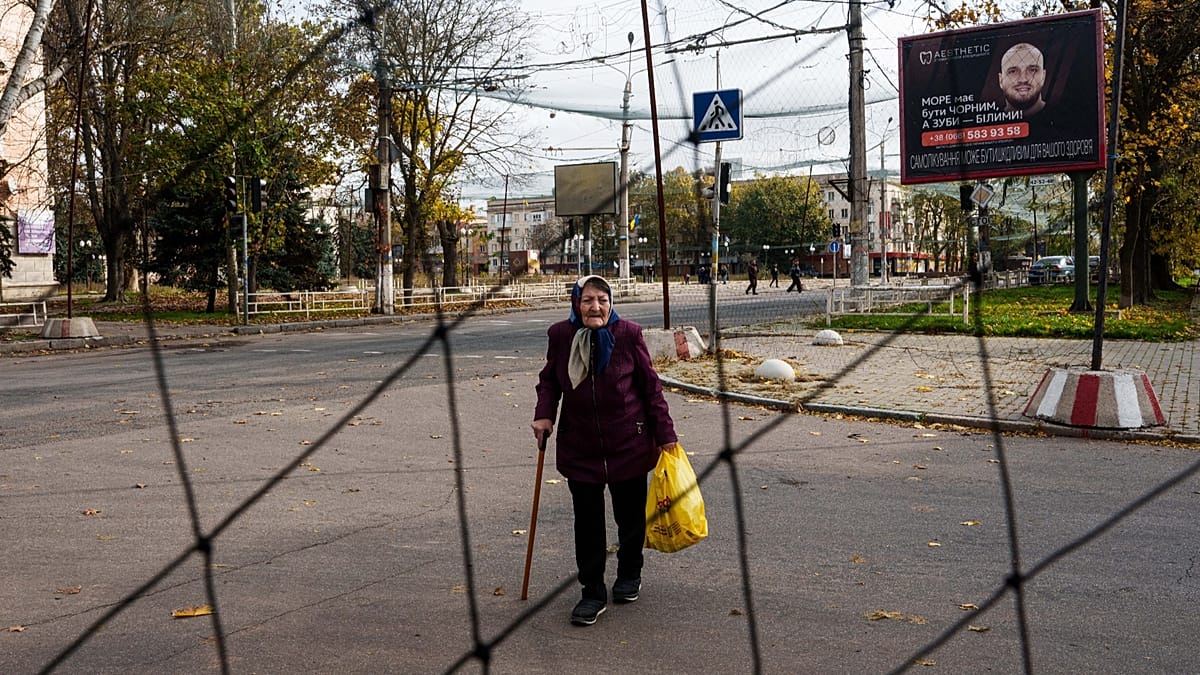
But first some news: Former Ukrainian Prime Minister Arseniy Yatseniuk just told Europe Today that “there is no way to trust Russians” over an ongoing temporary ceasefire between Ukraine and Russia focussed on one small town. ADVERTISEMENT ADVERTISEMENT “What is happening right now in Oleshky is a humanitarian disaster and it's actually a living hell,” he said of the Russian-occupied community on the morning programme. Watch. As Sasha Vakulina writes, a rare humanitarian mission is expected to reach the Russian-occupied Oleshky, the town Yatseniuk is referring to, on Friday to change this. It would mark the first operation of its kind in years, with evacuations of residents and aid distribution scheduled to last until the afternoon. An accompanying ceasefire for the town to make this operation possible lasts until Sunday. But for around 2,000 residents, the deadline presents a frightening choice: risk leaving through Russia or occupied Crimea, without assurances they can reach Ukrainian-controlled territory, or remain in a town where basic necessities are increasingly scarce. Tetiana Hasanenko, head of the Oleshky city military administration, previously painted a frightening picture to Euronews of the situation on-the-ground. “People have been forced to eat weeds,” she said. “The city is practically destroyed.” Help from Washington? The humanitarian mission was agreed to with the involvement of US First Lady Melania Trump. Despite the good tidings, however, the former Ukrainian prime minister has accused Moscow of using civilians as "hostages" and staging the humanitarian operation to portray itself as their rescuer. All eyes will be on Oleshky to see if the operation goes off without a hitch. Another bloody conflict: "We're not leaving. We're going to stay. We will resist," said Mustafa Barghouti, General Secretary of the Palestinian National Initiative, speaking about Palestinians living under the immense weight of far-right Israeli sentiment. The United Nations Independent International Commission of Inquiry found Israel committed genocide in the Gaza Strip. Barghouti was speaking on Europe Today in the wake of the Israeli legislative elections on Tuesday, which, among other things, showed Arab parties making immense gains. But does this win forebode any future for the two-state solution, and hope for peace? "The only way to save the two-state solution is to remove the illegal Israeli settlements from the West Bank," he said. This has been made more challenging due to the the "lack of response" from the international community to apply sanctions on Israel for these actions, Barghouti said. Watch. Meet me in Montréal: The second day of the EU-Canada summit kicks off Friday with a meeting between European Commission President Ursula von der Leyen, European Council President António Costa and Canadian Prime Minister Mark Carney. The love-in is expected to expand cooperation across multiple areas, including trade, investment, supply chains, AI, quantum, and other topics, most notably support for Ukraine. Context matters: Much of the meeting will occur in the long shadow of US President Donald Trump, whose abrasive “America First” policies and turbulent policies towards Kyiv have brought the two sides closer, making this summit possible, Jorge Liboreiro writes in a curtain-raiser. What's noticeable, however, is that von der Leyen dug her heels in and renewed her push to make Canada the bloc’s first-ever “associate member”. This is despite a forceful push by Germany that killed the wording from the joint declaration. Speaking at an event in Montréal, the Commission president described her pitch as a “new frontier together”. “Our idea is simple: it is an association without accession,” von der Leyen said. Try to keep up: In the hours following, German Chancellor Friedrich Merz published a cryptic tweet endorsing the “alliance for the future” concept instead. But then Carney threw a spanner in the works by declaring that “we’re in the process of forging a new alliance for the future, with Canada as an associate member”. So, is the idea of “associate membership” dead, and should it be resuscitated? Luca Bertuzzi explores. The summit’s concluding press conference is scheduled for 5:25pm CET, which should hopefully answer these questions. Did the EU just get its own ICE? The EU's border and coastguard agency, Frontex, is set to gain unprecedented powers to deport irregular migrants, monitor social media and respond to mass arrivals at EU borders under a sweeping reform proposed by the European Commission. According to reporting by Vincenco Genovese, the overhaul would significantly expand Frontex's mandate, triple its workforce and give it a much greater role in deportations beyond EU territory. How’s that for a Halloween scare? But the proposal has already sparked controversy, with critics warning that the agency's expanded powers and budget could lead to further fundamental rights violations and intrusive surveillance. For Member of the European Parliament Cecilia Strada, it inches closer towards resembling Trump’s controversial ICE operation. Trouble in Albania: Albania introduced heavy fines on Wednesday for people present at demonstrations that turn violent. It comes as officials in Tirana try to manage daily protests demanding the resignation of Prime Minister Edi Rama in the capital. The fines — which can go as high as 500,000 leks (€5,500) — are not limited to people directly engaged in violence and will be imposed on "anyone who chooses to remain in a crowd" that is carrying out acts of violence or looting in a public space, or that is "concealing their identity". Important to note: The average monthly salary before tax in Albania stands at €930. Albania has seen months of anti-government protests, with demonstrations in recent days escalating into clashes between protesters and security forces on the streets of Tirana. It follows trends of similar public demonstrations gripping France, Spain and Belgium. Taking a leaf out of Paris’ note: Rama said he had drawn inspiration from a French bill passed by the upper house of parliament on Wednesday, which would hold protesters financially responsible for damage caused during demonstrations. In France, the proposed legislation would require protesters to pay up to €10,000 for damage caused during demonstrations. This is important because: Next week the Commission will deliver scorecards for each EU accession country, such as Albania. Will the elephantine fines factor into the report, and is the bloc’s enlargement boss, Marta Kos, taking stock? Time will tell. Brussels hopes unspent defence loans may help plug Ukraine’s budget hole The European Commission has opened a new round of low-interest defence loans and is urging member states to spend them on joint ventures with Ukraine, as Kyiv faces a €70 billion budget gap. On Thursday, €21.3 billion of unspent funding under the Security Action for Europe (SAFE), the EU’s financing programme for strategic defence investment, was made available, with the Commission hoping to steer some of it towards Ukraine. “Using the remaining funds from SAFE, we will be setting up a new programme for joint projects with Ukrainian companies,” Commission President Ursula von der Leyen said in her annual State of the Union address to the European Parliament last month. Is this hot air, or will Kyiv actually get the defensive capabilities it has been promised? Luca unpacks it all in this story. More from our newsrooms Deadly train crash puts Sánchez on the ropes a month before elections. Wednesday's accident happened in the middle of the pre-election campaign, adding pressure to Sánchez's government. With a month to go, parties are locked in a blame game. Christina Thykjaer has the analysis. ‘I cannot remain neutral’: Lagarde finally explains her early ECB exit. Christine Lagarde is leaving the European Central Bank (ECB) early because she no longer wants to stay silent. Piero Cingari explores why. EU countries push back against Brussels plan to tax gas more than electricity. More than a dozen EU countries are challenging Brussels' plans to favour electricity over gas, warning that the proposals would undermine national control over energy taxation and grid charges. Marta Pacheco has more. We’re also keeping an eye on The final day of the EU-Canada summit wraps up in Montreal. Press conference to be expected at 5:45pm CET. European Commissioner for the Economy Valdis Dombrovskis represents the EU at the NATO Fuse event in Riga. European Commissioner for Equality, Preparedness and Crisis Management Hadja Lahbib visits Brussels’ famed Manneken Pis and Jeanneke Pis ahead of the European Civil Protection Forum. That’s it for today. Sasha Vakulina, Jorge Liboreiro and Vincenzo Genovese contributed to this newsletter.
‘A living hell’: The occupied town of Oleshky captures the world’s attention — including Melania Trump’s
Full Article
Original Source
Read the full article at Euronews →KhanList aggregates and links to publicly available news content. We do not host full articles from third-party sources. Always verify important information with original sources.