
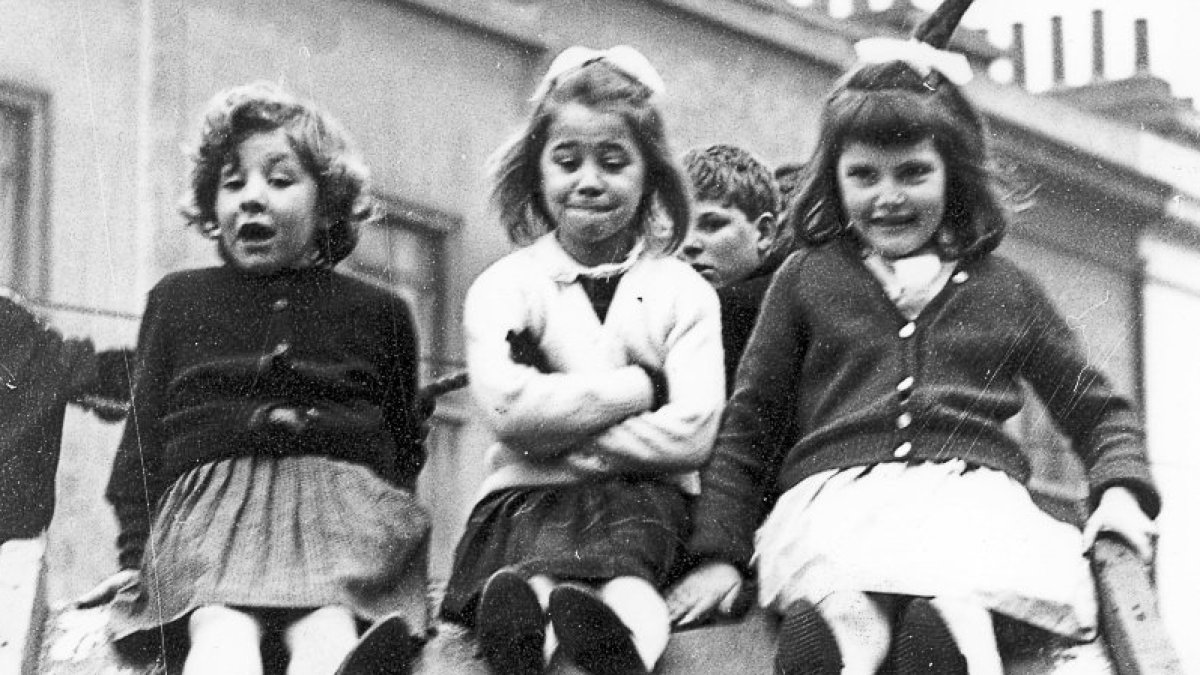
This week, the greatest TV documentary ever made comes to an inevitable, poignant end. 70 Up is the concluding chapter of the ITV series that began back in 1964 as Seven Up! with one simple intent: to take the philosophy of “Give me the child until he is seven, and I will show you the man” and explore whether it remained true in progressive 60s Britain. How much of an impact does our youth have on the rest of our lives? “I do feel that, by now, we can sort of say that it is true, yes,” says series producer Helen Houston, who has been working on the programme for 20 years. “Life does happen along the way, of course, and things do change, but those first seven years really do shape us.” The documentary, initially planned as a one-off, selected 14 children – 10 boys, and just four girls – from different social backgrounds, and asked each what they thought lay in store for them. Would the prep-school boys – one of whom was already reading The Financial Times aged six – end up at Oxbridge as planned? Would cockney wide boy Tony Walker end up in prison simply because he, however notionally, fulfilled the artful dodger stereotype? How would they live, and love? Would life be kind, and would they take an opportunity when an opportunity presented itself? This was an intriguing social experiment, and one with evident long-term potential. After that first programme, ITV commissioned a second, seven years later, to be directed by Michael Apted, a researcher on that first episode and later a Hollywood filmmaker who would direct the James Bond film The World is Not Enough. Apted would continue to return every seven years for the next four decades. The cast of ’70 Up’: John, Bruce, Symon, Andrew, Suzy, Jackie, Tony, Sue, Peter, Paul and Neil (Photo: Nick Wall/MultiStory Media/ITV1) Also returning, although not always quite so willingly, were its participants, on through adolescence and into adulthood. One cast member, Charlie Furneaux, a future BBC documentarian, bailed out at 21. Another, Peter Davies, stepped down at 28. “Oh, I’d had enough by then,” Davies tells me. He returned in 56 Up for reasons we will come to, and features in 70 Up, too. “I was teaching at a secondary school at the time of 28 Up [in 1985], and my interview in the show broadened out into a discussion about the state of education in general, and politics.” Davies, who is from Liverpool, made some cursory, derogatory comments about the then-prime minister Margaret Thatcher. This was hardly unusual for the 80s, Thatcher being a particularly Marmite PM. “But the tabloids really went for me, and were quite vitriolic. I was taken aback by that, and so I left.” Others had to gird themselves each time Apted came calling, even those that stayed the course. “It’s a little pill of poison in my life,” said John Brisby, who grew up to become a barrister. Nevertheless, the documentaries would prove so very compelling, its participants people we came to know deeply over the years – or at least believe we did. They were versions of us all: from wealth, and from the council estate; from loving families, and from care homes. We watched them grow up, and then grow old, each dealing with the vicissitudes of what it is to be alive. Peter Davies left the programme when he was 28 (Photo: Granada Television) And now, with 70 Up, it’s coming to an end. “There’s a nice circularity to it, I think,” says Houston. “It did have to finish eventually,” she adds. In 2021, Apted died aged 79. The producers asked fellow documentarian, Oscar-winner Asif Kapadia (Amy, Senna) if he might take over the reins for the finale. Kapadia, a lifelong admirer of the project, has called it “the ultimate portrait of human life”. Kapadia’s programme faithfully follows the intent of the original in the first of two episodes. It begins, as ever, with an extensive recap, then catches up with the remaining participants (one of the cast, Lynn Johnson, died in 2013; another, Nicholas Hitchon, in 2023). They appear remarkably robust and healthy, sanguine about what might lie ahead in their twilight years. Neil Hughes, who always came across as one of the more reluctant participants, has had the most compelling narrative arc. At seven, he was happy and effusive. “I want to be an astronaut when I grow up,” he told Apted. But later in life, he would struggle with depression and experience bouts of homelessness before becoming a local councillor, and later a preacher. Kapadia finds him living alone in a house in France filled with books and clutter. “I look like a hoarder, I know,” he tells the director. “I’ll clean it soon.” John Brisby didn’t like being presented as the series’ token toff (Photo: Nick Wall/MultiStory Media/ITV) Davies, meanwhile, is now a writer and musician. It is for these pursuits that he agreed to return after a 28-year absence. “I’d been moaning about my involvement for years, until my wife told me to view it as an opportunity,” he says. Davies was in a folk band, and had written a novel, and realised he could use the show for marketing purposes. “Some did suggest it was cynical, yes, but is it really?” he argues. “This is my life, after all, and it’s what I was doing at the time of filming. So I make no apologies.” And did it help? He grins. “It did, yes. We had a spike in record sales.” Kapadia’s climactic episode abruptly switches the focus to build on the dissatisfaction that Davies – and others – have felt over the years, and turns the tables on an absent Apted. In 49 Up, broadcast in 2005, the brilliantly forthright Jackie Basset argued with the director, on camera, about the way the latter dealt with the women in the series, speaking to them only of men, sex and babies, while with the male contingent he was more likely to focus on their careers. “I think I’m actually more intelligent than you thought I would be,” she told him. One of those men, meanwhile, the aforementioned John Brisby, hated that Apted had cast him as the token toff, conveniently overlooking his immigrant roots, and the fact that he spent much of his time away from barrister work raising funds for orphanages in Bulgaria. In 70 Up, Brisby admits that “I never liked Michael”. Jackie Bassett (left, with Lynn Johnson and Suzy Davis) wasn’t happy with how the women were portrayed by original director Michael Apted (Photo: ITV/Shutterstock) We see again the time Apted asked a 21-year-old Tony – who at seven had dreamt of becoming a jockey, and later drove a taxi – whether he ever feared he’d end up a criminal, simply because he came from working-class stock. Tony’s shock reaction (“How can I become a villain?” he shot back) reveals just how embedded Apted’s own prejudice was throughout the entire project. Has it been a flawed portrait all along, then, the director having long ago decided the story he wanted to tell? Houston suggests not. “We have always maintained a fantastic relationship with the cast. There’s always been trust,” she insists. Nuance, of course, was always going to end up on the cutting room floor. Any manifestation of life on screen – boiled down to a couple of hours every seven years – was going to feel compromised. “Inevitably, you’d look at yourself on the programme,” Davies says, “and just think, ‘Well, there’s more to me than that’.” Nevertheless, it remains a fascinating snapshot into the lives of others. And now, we will never see these faces again, and I, for one, shall be sorry to see them go. Presumably, I say to Davies, the cast feels similarly? He shrugs. “You’d have to ask them, but I don’t feel any sadness. Not yet, at least. It’s finishing at the right time, I think. None of us want to stagger on until it’s the last man standing.” But is he glad, ultimately, to have taken part in such a unique experiment? “I am, yes. I really don’t think there will be anything like this on TV again.” ’70 Up’ returns tonight at 9pm on ITV1
‘A little pill of poison’: Why the cast of 70 Up came to resent it
Full Article
Original Source
Read the full article at Inews →KhanList aggregates and links to publicly available news content. We do not host full articles from third-party sources. Always verify important information with original sources.