
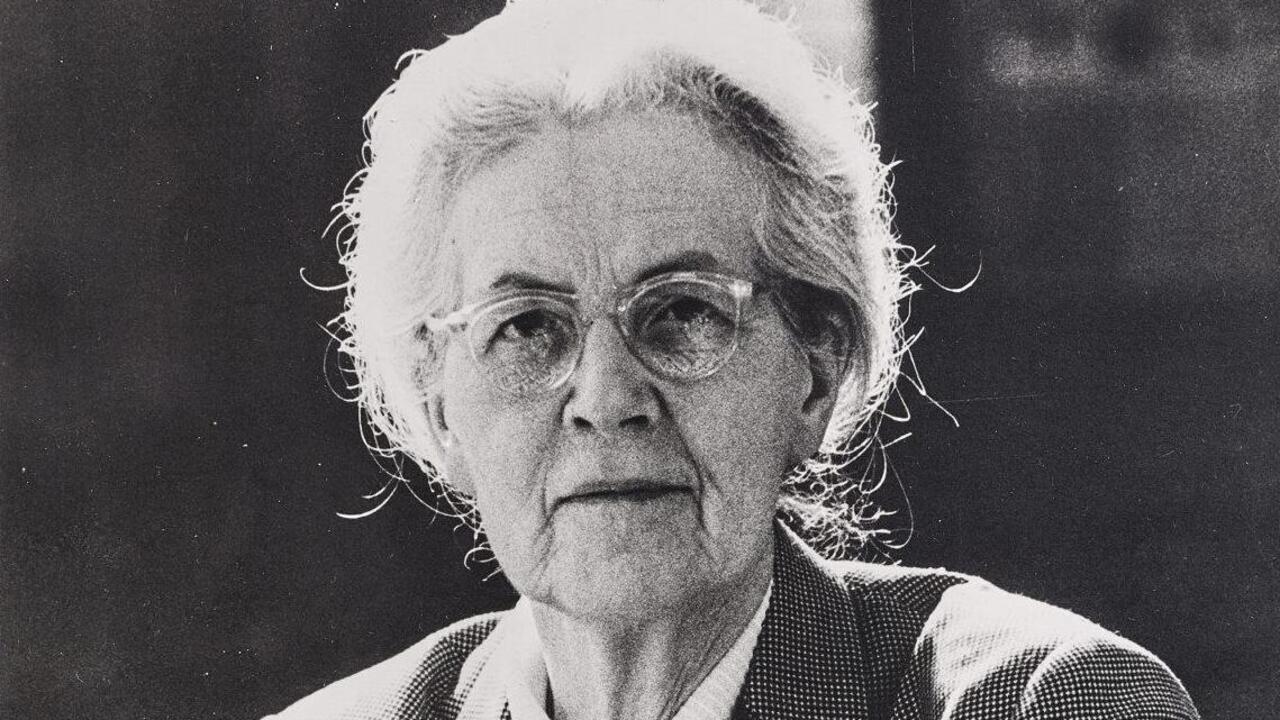
By the time she died, 47 years ago this week, Nadia Boulanger had taught some of the 20th century’s greatest musicians. Generations of composers, conductors, performers and arrangers passed through her apartment in Paris. More than a midwife to male genius, she was an exceptional talent in her own right. Any discussion of Nadia Boulanger typically begins with a list of famous men. Aaron Copland, Virgil Thomson, Elliott Carter, Philip Glass, Daniel Barenboim, Burt Bacharach, Quincy Jones – she taught them all. “I would challenge folks to find another teacher in history who has had the kind of track record and success that she has had with teaching composers and sending them out in such a wide variety of styles,” says Kimberly Francis, a feminist musicologist at the University of Guelph in Canada. “It’s almost unheard of.” Boulanger’s achievements are staggering, but they do not begin or end with her best-known male students. In between those names lies another story, one that academics like Francis are helping to uncover. It is the story of the barriers women continue to face in the arts and, in spite of them, of a life lived through almost a century of music. Listen to this story on the Spotlight on France podcast: Spotlight on France, episode 151 © RFI Born into music Boulanger was born in Paris in 1887 into a family of musicians. Her father, the son of a cellist and a mezzo-soprano, composed comic operas and taught singing at the Paris Conservatory. His connections would open the door to her career in music. But it was Boulanger’s mother, one of his voice students, who defined for her what being a professional musician meant, according to Francis. A Russian émigrée who claimed to be a princess, Raissa Myshetskaya demonstrated “the attention to detail, the incredible discipline, the need to work very hard at your practice” that would become the hallmarks of Nadia’s approach. Nadia started at the Conservatory aged nine and was playing piano and organ professionally by the time she was a teenager. “She was 16 when she graduated from the Conservatoire with a number of first prizes,” says Francis. “Even one of those for a man would have been enough to secure the position of your choosing.” Yet at a time when women soloists were rare, women conductors rarer and the Conservatory had only recently allowed female pupils to study composition, “it was extraordinary for her to choose the path that she did. It was extraordinary she had the talent that made it undeniable she should be allowed to at least attempt it". Boulanger set her sights on the Prix de Rome, a prestigious composing prize once claimed by her father. No woman had ever won it. Nadia Boulanger and her fellow entrants for the Prix de Rome in July 1907. She competed in several years, never taking first place. © Geneva Conservatory Library / public domain Headstrong as well as ambitious, in 1908 she caused a scandal by disregarding the judges’ instructions to write a piece for voices and instead submitted one for a string quartet. She ended up placing second. Boulanger nonetheless made a name for herself and was soon achieving a renown few female musicians ever had. She was helped by a creative – and romantic – partnership with the pianist Raoul Pugno, a family friend and established composer. They wrote an opera and other works together, as well as giving concerts that featured her compositions alongside his. Sometimes she played next to him, sometimes she conducted. In 1913, the Prix de Rome went to a woman for the first time – not Nadia but her younger sister, Lili Boulanger. The two had a close relationship, personally and creatively. The prize included a residency at the Villa Medici in Rome, and Lili invited Nadia to join her. “One of my favourite letters is a letter that Nadia Boulanger writes home, I think it’s to her mother,” says Francis. “And she’s describing her and her sister sitting in the villa in Rome and writing their operas together – these two women who were going to have their operas staged professionally. I can’t imagine another moment in time in the history of music where that was a possibility.” Nadia and Lili Boulanger pictured in 1913. © Bibliothèque nationale de France Change of key Within a few years, however, the strides the Boulangers had made would be interrupted. In 1914, Pugno died unexpectedly while on tour in Russia with Nadia. Months later, the First World War broke out and put much of cultural life in Europe on hold. Shortly before it ended, Lili died from chronic health problems at the age of 24. These upheavals changed Nadia Boulanger’s trajectory irrevocably, says Francis. Without them, “we would be talking about a very different person in a very different career. And instead we end up with the Nadia Boulanger that we know". A plaque now marks the family apartment shared by the Boulanger sisters at 36 rue Ballu in Paris. © Wikimedia Commons / Mu - CC BY-SA 3.0 Among the after-effects of the war was the founding of two new music schools in France: the École Normale de Musique de Paris, aimed at attracting foreign students and counterbalancing German cultural influence, and the American Conservatory in Fontainebleau, born out of ties established during the conflict. Boulanger began teaching at both. Soon she was inviting her students to group classes every Wednesday at her apartment on Rue Ballu, where musicians from around the world would be put through their paces. “She really did want you to be able to speak the music fluently,” says Francis. “There are stories of her having you play a Bach fugue where you sing one line and play the others, and then once that was good enough, she’d have you switch which line you were singing – really challenging ways of getting you to be truly fluent with what you were trying to write.” With an “insatiable appetite for styles”, Boulanger was also at the cutting edge of modern music, incorporating the work of contemporaries such as Igor Stravinsky – a close friend of hers – on her curriculum. “For Americans especially, this was eye-opening,” Francis says. Aaron Copland and Virgil Thomson, two composers who would go on to define American classical music, were among her earliest pupils. “And then they come back to the United States and it becomes this perpetuating cycle – I think Virgil Thomson calls her a one-woman graduate programme for composers. You do your undergrad in the US and then you go and you study with Boulanger in Paris, and that becomes the tradition.” After the Second World War, as musicians began to experiment more radically, Boulanger lost her reputation for being at the vanguard. But her insistence on the mechanics of music continued to mould talents as singular as Quincy Jones, the producer who crafted Michael Jackson’s sound. Jones, who studied with her in the 1950s, recalled a lesson that continued to guide him years later: “You don’t have freedom in music until you have total restriction. Restrict yourself and establish a periphery, and then you have freedom.” An example despite herself Over the decades, Boulanger taught hundreds of musicians from around the world, including more than 600 from the US alone. For her pupils, the benefits could be professional as well as artistic, Boulanger continued touring internationally as a performer, lecturer and, increasingly, a conductor, and would use her concerts to promote the work of composers she admired – including her students. If few women feature on the roll call of her most famous graduates, it speaks to a centuries-old imbalance in classical music, where men have historically dominated and where, as Francis points out, “it’s still tough to be a woman on an orchestral podium”. Battling the weight of history as a female conductor Yet Boulanger’s own biases have also come under scrutiny. The first woman to conduct major orchestras, from the Royal Philharmonic Society to the Boston Symphony, she blazed a trail – but did not necessarily encourage other women to follow it. Several of her female students reported she seemed to take their work less seriously, telling them to prioritise their duties as wives and mothers over a career in music. According to Francis, in this and other respects, Boulanger could be contradictory. In some cases she supported female students “vociferously” – and her own life she dedicated to her work. Nadia Boulanger pictured around 1950. © Philharmonie de Paris collection Boulanger toured and lectured well into her seventies, and continued teaching even as her eyesight and hearing began to fade. She died on 22 October, 1979, at the age of 92. She is buried in Montmartre Cemetery with her grandmother, parents and sister – five musicians, four of them women. Her legacy for women in music, Francis suggests, may be her life itself. “I often think back to these letters that I found of a student of hers,” she says. Writing to Boulanger after returning to the US, “she says, ‘Mademoiselle’ – everyone called her Mademoiselle – ‘I know that you encouraged me to be a wife and mother. But just by your very example, I know that it’s possible to be more. And I know that it’s possible to be more as a musician. You’ve shown me that."
A life lived in music: Nadia Boulanger, the musicians' mentor
Full Article
Original Source
Read the full article at Rfi →KhanList aggregates and links to publicly available news content. We do not host full articles from third-party sources. Always verify important information with original sources.