
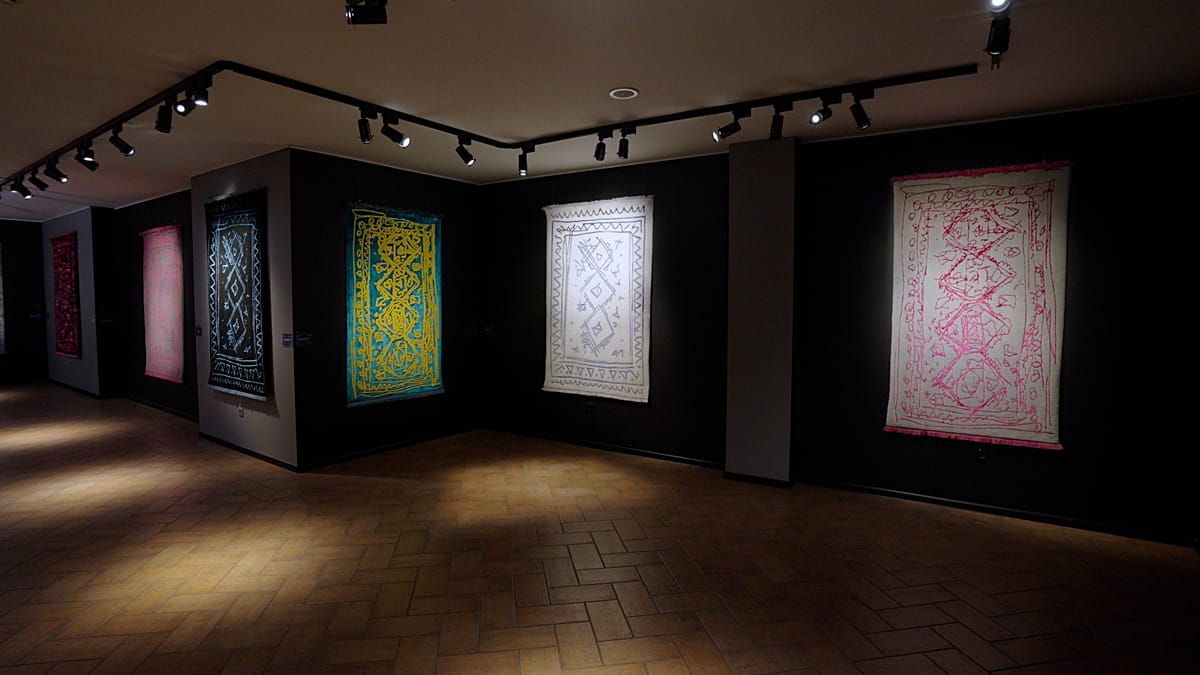
How can a carpet be transformed into contemporary art? What happens when a painter uses a syringe instead of a brush? And how can a photograph capture beauty and destruction in a moment when the human eye might miss the details? ADVERTISEMENT ADVERTISEMENT At "Fly to Baku" art weekend, these questions came to life through painting, sculpture, photography, digital art and film. Artists from around Azerbaijan and abroad brought their artistic offerings to the city, raning from Karabakh carpets to experimental painting. Themes and threads Nature was one of the event’s central themes. The Caucasus “Wild Five”, an Eastern imperial eagle, a Caucasian leopard, grey wolves, a goitered gazelle and a brown bear-all featured as a reminder of the region’s rich biodiversity and highlighted the importance of protecting them. From the Karabakh carpet to the Maiden Tower For Azerbaijani artist Farid Rasulov, the starting point was a traditional practical artform familiar to generations of people within the country - the carpet. Born in Shusha, Rasulov grew up surrounded by Karabakh carpets, particularly those decorated with images of animals, plants, and nature. He breathed new life into his series Karabakh Carpets 2.0. “I was born in Karabakh, and from my childhood I was playing on these Karabakh carpets,” he said. “After so many years, I became an artist and decided to make new types of these carpets.” His work brought an object associated with everyday domestic life into a contemporary art setting. For him, tradition was not something to ignore. “Tradition is not something frozen in the past, but something that can evolve and develop,” he explained. Sculptor Aydan Salahova drew inspiration from one of Baku’s best-known landmarks- the Maiden Tower. Her installation revisited the legend of a young woman associated with the tower. Rather than simply retelling the familiar story, she applied her imagination which came up with a woman flying away in search of freedom and a life of her own. “This project is about choice, how to live, how to find freedom,” said Salahova. Dividing her time between Italy and Azerbaijan, Salahova works with Carrara marble in Italy and local Aglay limestone in Azerbaijan. “Different materials and different textures need different languages,” she explained, describing how the character of the stone shaped her sculptures. The paintbrush metamorphosis Chinese artist Zhang Ji took an unconventional approach to painting, using syringes instead of traditional brushes to apply paint to his canvases. His work also drew on religious architecture and the ways different civilisations understand truth. Architectural patterns from religious traditions around the world featured in his sculptures, without singling out any particular belief. But he does not expect visitors to analyse every reference. “I just want you to feel it,” he said. Zhang sees art as a form of communication that did not depend on a shared language. “People from different countries and different cultures can understand art through experience, not through translation,” he explained. Nature takes back the buildings Dutch-Canadian artist Ryan Koopmans has sent time examining what happens when human architecture is left to nature. His digital images shows abandoned buildings gradually covered by vegetation, including trees and plants reclaiming spaces once shaped by people. “The message that I want to portray to the audience is this notion of the cyclical nature of time,” he said. “Architecture takes the place of the natural world, and then nature slowly takes over the architecture, and the cycle continues.” He told Euronews that Azerbaijan’s architectural landscape also attracted him. He was drawn to the way Azerbaijani, Persian, Ottoman and Soviet-era influences met across the country’s buildings. The weekend offered photography as another perspective on what people see – and what they might otherwise miss. London-based artist Ori Gersht used his camera to capture fleeting moments beyond the limits of ordinary human perception. His work explored the relationship between beauty and destruction. “I find that beauty and destruction are interconnected,” he said. “Every moment of destruction is also a potential new creation.” He was particularly interested in how technology expanded the possibilities of photography, allowing the camera to reveal details that the human eye could not register. A leopard’s story, told through film Filmmaker Harriet Pratten brought wildlife conservation to the screen with "Europe’s Last Leopard". She first came to Azerbaijan more than a decade earlier to film the Caucasian leopard in Hirkan National Park. The documentary offered audiences a chance to discover the elusive animal and the challenges facing its survival. The problem, she explained, was making people care about an animal they might never encounter themselves. “It’s difficult to care about something that you can’t see,” Pratten said. “A film and visual storytelling allows us to bring the story of the leopard to people. Then they know how beautiful it is, they know what an icon of Azerbaijan it is.” The documentary also showcased the cooperation between Baku Art Weekend, IDEA and WWF Azerbaijan. “I just love that blend of art and science and conservation,” she said. Exhibition curator Lesley Gray looked at what animals could reveal about the health of their habitats. “Today animals still play a similar role, but as oracles of our world’s future – they are often the first warning sign of environmental degradation,” she explained. The exhibition included portraits of Baku residents with their rescued pets, alongside large-scale installations and interactive pieces using light to explore human relationships with animals. Baku on the international art map Among the international guests was Simon de Pury, auctioneer and art curator, whose career in the international art market was explored in the documentary "The Hammer", also screened during the event. Often described as the “Mick Jagger of art”, the former Sotheby’s chairman had worked with artists and collectors across the world. He saw Baku’s appeal in the opportunity to discover something beyond the familiar international art circuit. “Baku has a very vibrant art scene,” he said. Behind-the-art scenes Organised by the Heydar Aliyev Foundation and IDEA (International Dialogue for Environmental Action) Public Union, the event also attracted international visitors interested in discovering Azerbaijan’s contemporary art scene. Goncha Darabzada, representative of Heydar Aliyev Foundation, said that art should create opportunities for “reflection, participation and personal connection”, particularly when addressing nature, responsibility and the future. Laura Acosta, Creative Director and Chief Curator of Barcelona-based "ARTTYCO" contemporary art platform, explored the exhibitions, met artists and shared her discoveries with an international audience. “What impressed me most was the diversity of artistic voices and the strong connection between personal narratives, cultural identity and contemporary expression,” she said. "Fly to Baku" art weekend offered no single definition of contemporary art. Instead, it gave visitors the chance to encounter unexpected techniques, revisit familiar stories and see the world from different perspectives.
A licence to create: Inspired carpets and religious brushstrokes shine at Baku Art Weekend
Full Article
Original Source
Read the full article at Euronews →KhanList aggregates and links to publicly available news content. We do not host full articles from third-party sources. Always verify important information with original sources.