
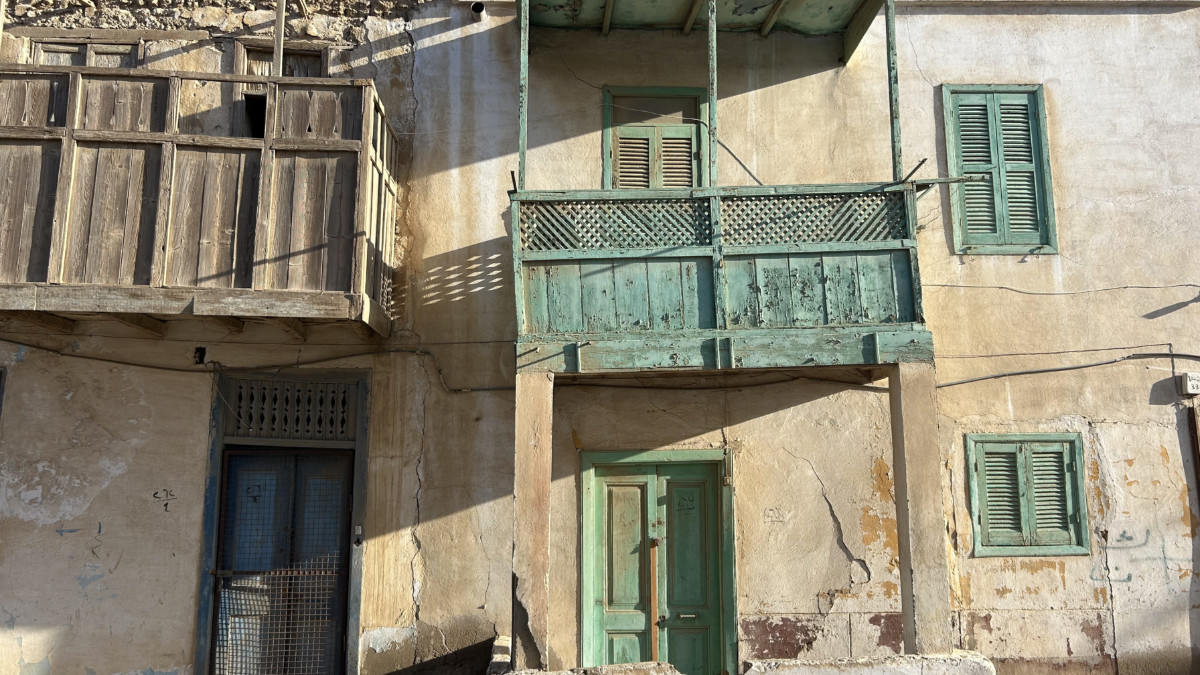
El-Quseir is pitch black at night. The only light inside this decaying labyrinth of a port comes when a battered Bajaj motorcycle purrs down the odd alley, casting a headlight on one of the town’s many stray dogs, or a passerby flashes a phone, lighting up a decaying wooden balcony. The old mayor’s house is easy to find in the darkness. It emits a warm, golden light. When I arrive, a crowd is already gathered on the colonnaded veranda; some men in djellabas, others in the uniform skinny jeans of the Middle East. I spot the odd Cairo hipster among them. The women attendees are especially radiant in make-up. Why shouldn’t they be. Tonight is a Hazz night, the name, which in Arabic means luck, given to soirees down Egypt’s Red Sea coast, where the simsimiyya, a triangular lyre, is played to ballads about old ports, friendships and legendary seafarers. The simsimiyya looms large over El-Quseir. New MEE newsletter: Jerusalem Dispatch Sign up to get the latest insights and analysis on Israel-Palestine, alongside Turkey Unpacked and other MEE newsletters “The men here would be at sea for four months at a time. They would save a spot on their dhow just for a simsimiyya player to entertain them,” Aly El-Sayed, the founder of Bahar, a community organisation working to preserve the city's heritage and marine ecosystem, told me. Aly is the host of tonight’s gathering. The old mayor’s house, a butter-yellow bungalow built in 1888, has been repurposed as Bahar’s home. “We tried not to change much. We were even careful not to paint too much,” El-Sayed said. 'They sang all the time' I knew that music was central to life aboard dhows, traditional wooden sailing boats, that plied goods, including slaves, between East Africa and Arabia up until the mid-20th century. Australian explorer Alan Villiers noted in his 1940 travel classic, Sons of Sinbad, the pride his dhow’s nokhada (captain) took in having a musician aboard ship . The crew was musically inclined, Villiers said: “They sang continually…they sang all the time they worked and when the jobs were really big - such as hoisting the lateen yard - they stopped occasionally and danced.” But I had only recently learned about the simsimiyya, an intimidating looking instrument made of five or six strings whose shape recalls the head of a horned gazelle. Sayed and his team have spent months collecting and recording songs that the seamen of Sons of Sinbad would have recognised. Posters are arranged on the veranda that display songs with titles like Ras Gharib, Oh So Many Nights and Our Coasts Sing. Sayed spends some time working the crowd, nearly all of whom he knows from El-Quseir. Eventually, we take our seats. The musician enters, dignified in a white djellaba and cradling an understated simsimiyya. This is a far cry from the touristic players of Cairo with their microphones and flashing lights. Our musician tucks the instrument under his arm and the crowd goes silent. His hands reach to opposite sides of the simsimiyya, as if he is holding a rifle, then they begin to dance. His fingers are nimble but taut as he plucks and strums the strings. The notes tumble liltingly one after another and he starts his rhythmic, nasally chant about El-Quseir and the sea. A simsimiyya player in El-Quseir, Egypt. The simsimiyya is played across the Red Sea region. (Sean Mathews/MEE) My journey started a long way from El-Quseir. I was at a dinner with a group of Egyptian writers and Yemeni expats in Cairo’s Le Bistro, a semi-subterranean, French restaurant cloistered from the chaos of downtown Cairo. Steak frites and red Beausoleil d’Egypte wine were flowing when I asked the group, “Is Egypt more of a Mediterranean or Red Sea country?” “Of course, Mediterranean!” one Egyptian art critic replied, almost offended. “I’d say Red Sea, don’t forget we share the simsimiyya,” a Yemeni friend said. The table unanimously nodded in agreement. The humble simsimiyya had silenced a cultural dispute that, in reality, has no right answer, as Egypt is an amalgam of both seas. Nevertheless, I wanted to learn more about the instrument. My Yemeni friend recommended meeting one of the world’s leading experts on Red Sea music who happens to live in Cairo, Nizar Ghanem. Ghanem, a Yemeni physician turned ethnomusicologist, is as much a product of the Red Sea as the simsimiyya. Born in the port city of Aden, he spent more than two decades teaching musicology at a university in Khartoum, Sudan. The only two countries he has called home are now ravaged by Red Sea wars. I met him at a bright apartment in Dokki where our chat was interrupted by the crack of Egyptians shooting clay pigeons at the nearby sporting club. Port dances For more than an hour, as I sipped delicious kiwi juice, Ghanem regaled me with the intricacies of the simsimiyya, its songs, and dances, all while explaining how they are unique to Red Sea states. “The earliest form of a lyre we know was discovered in Mesopotamia or modern-day Iraq,” Ghanem told me. Ancient Egypt also had lyres, but the simsimiyya as it is known today likely originated in Sudan and the Nile valley basin of Upper Egypt. By the mid 1860s, it had moved north to Suez with migrant labourers building the canal. Between 1967 and 1982 the simsimiyya was a symbol of resistance to Israel’s occupation of Egypt’s Sinai Peninsula. “The simsimiyya belongs to the Red Sea,” Ghanem said. “The lyrics to the songs are similar across Red Sea ports." For example, Suakin and Yanbu both have songs about merchants from Hadhramaut,” he told me, referring to the historic ports of modern-day Sudan and Saudi Arabia respectively, and the Yemeni region whose merchants are renowned for their business acumen. “The dances that accompany the simsimiyya in coastal areas are feminine dances. You can expect to see them in Port Sudan but not Khartoum, and in Mocha but not Sanaa,” he said. “They are port dances. Some symbolise the struggle between man and fish." I was already planning to visit a friend’s hotel on the Red Sea coast. Without knowing about my interest in the simsimiyya, he put me in touch with Sayed from Bahar, who, as luck would have it, was arranging a simsimiyya night. An image of El-Quseir published in 1809 but dating from the French occupation of the port. (New York Public Library Public domain) El-Quseir is passed over by visitors to Egypt’s Red Sea coast in favour of monstrous resort hubs like Sharm el-Sheikh or Marsa Alam, but that wasn’t always the case. In the 1st century AD, the port’s name was Myos Hormos. An unknown Greek-speaking traveller records it in the Periplus of the Erythraean Sea, a historic account of the region's ancient trading ports. El-Quseir’s place as a trading hub was due to its geography. The port sits at the eastern terminus of a series of wide, flat wadis, which were thoroughfares connecting the fertile Nile Basin to the Red Sea. The Nile juts eastward at the same latitude as El-Quseir, which makes it the shortest distance to the river along the coast. The Nile is the rich hinterland - in food and people - of Egypt’s unforgiving Red Sea coast. Still today, many hotel workers on the coast hail from Luxor. Egypt’s economy is heavily indebted and it has been hit by external shocks, including on the Red Sea, where Yemeni Houthi attacks have hurt traffic through the Suez Canal, which contributes precious hard currency to Cairo's coffers. But real-estate development - in part as a hedge against inflation - is booming. To get to El-Quseir from Cairo, I flew to Hurghada. The highway south out of Hurghada is peppered with billboards offering down payment plans on beachside resorts, beckoning buyers with crystal-clear water. Driving south, the Red Sea hills to the west rise like shards of brownish-red glass. There is no natural transition between the desiccated, Eastern Desert and the shore. Mushrooming villas and hotels are surrounded by country-club green grass and imported palm trees. The busiest stretch of road between Hurghada and El-Quseir is at Safaga, a key Red Sea port, where lorries stretch for hundreds of metres. James Bruce's Red Sea journey There are few redeeming qualities to El-Quseir’s outskirts. The city is ringed by red-brick tenements framed in concrete whose rooftops are peppered with plastic water tanks. But on Port Said Street leading to the corniche, the old El-Quseir appears. We drive by coral stone shops with painted wooden shutters and I peek down alleys covered by precarious timber balconies. The whole city appears to be melting away in the hot, humid Red Sea air. I drive by the white-washed governor's palace and Sheikh el-Farran mosque, named after a holy man from modern-day Saudi Arabia who locals later told me is a patron of Red Sea sailors. My hostel boasts the finest architecture in the port. The El-Queseri hotel is three stories of rough-hewn, honey coloured coral stone. For $28 per night I get a whitewashed double room with two large windows looking out at the sea and a shared bathroom. The finest feature by far is a double-decker mashrabiya, or fully enclosed balcony with paned-glass windows and louvered shutters to catch the sea breeze. The El-Quseir hotel on the corniche where rooms with a shared bathroom can be had for $30 per night (Sean Mathews/MEE) The house was built in 1907 by a prominent Ababda sheikh, Tawfiq Ali Mustafa. The Ababda are a Cushitic Red Sea people who belong to the Beja tribe - nomads who live across modern-day Egypt, Sudan and Eritrea. Today they claim Arabian descent and many have assimilated into town life. The British explorer James Bruce came across the Ababda when he travelled to El-Quseir from the Nile city of Aswan in 1769. Bruce is best remembered in history for being ridiculed after he returned to Britain and reported, factually, that the diet of modern-day Ethiopia’s inhabitants, then as now, includes raw meat, although in his time, hunks of meat were cut directly from living cattle. Bruce described El-Quseir as "a small mud-walled village, built upon the shore, among hillocks of floating sand”. He arrived with a caravan of one thousand camels loaded with wheat destined for Mecca and guarded by 400 Ababda warriors armed with javelins. El-Quseir’s trade was at the mercy of Ababda Bedouin who could attack caravans from the Nile. “The whole town was in terror at the influx of so many barbarians who knew no law whatever,” Bruce wrote. I left the hotel for a meeting with a local historian, Taha Elgohary. We agreed to meet at El-Quseir’s Heritage Preservation Association, which is housed in an old hospital built by an Italian company that mined phosphate here between 1910 and 1945. Elgohary's family came to the city from Upper Egypt to work in the mines. After the company was nationalised and the Italians left, the management had trouble finding local workers. “The Quseir people were merchants and the Ababda were Bedouin. They didn’t want to work in a mine,” he said. “I was born underground, in a phosphate mine,” Elgohary tells me, proudly, when we meet. “The Italians did good things for the local economy here. The people of Quseir got along well with them. King Farouk and his father King Fuad visited Quseir.” A traditional house in El-Quseir with a projecting balcony and lattice work. (Sean Mathews/MEE) The Red Sea is littered with ports whose fortunes ebbed and flowed with the rise and fall of one empire or commodity. Phosphate mining revived the city after it fell into a period of steep decline following the opening of the Suez Canal which rewired Egypt’s coastal trade flows. Before the canal, El-Quseir’s prospects were intimately tied to the spread of Islam. Because of its geography, El-Quseir was a hub for the export of grain from Egypt to Mecca and Medina, as well as a departure point for Hajj pilgrims. When the rulers of Cairo were established and could ensure security in Upper Egypt, the city benefited, as it did under the Ayyubid dynasty and early Mamluk empires. The Ottoman conquest of Egypt in 1517, and maritime rivalry with the Portuguese made Red Sea ports strategic assets. But when Bruce arrived, El-Quseir was in one of its periods of decline. Napoleon in Egypt Egypt, although nominally part of the Ottoman Empire, had drifted back into Mamluk control. The Mamluks were a strange class of white slave-warriors taken from the Caucasus at boyhood and converted to Islam. By the late 1700s, as the writer Alan Moorehead observed in his classic The Blue Nile, the Mamluks were a “worn-out military clique of medieval backwardness”. Their vulnerabilities tempted Napoleon, who invaded Egypt in 1798 in a daring bid to threaten the British in India via the Red Sea. El-Quseir’s strategic importance emerged during the war when Ottoman Janissaries began landing there from Jeddah to attack Napoleon’s forces. The French conquered El-Quseir in 1799 and remained there until 1800. Battle of the Pyramids, July 21, 1798 by Antoine Jean Gros (Wikimedia/Public Domain) Elgohary told me that the best period of time in the city's modern history was when Mohammed Ali Pasha, an Ottoman merchant from the city of Kavala in modern-day Greece, consolidated power in Egypt in the early 1800s. “The city of Quseir today is a legacy of Mohammed Ali. He built new markets and houses. He promoted business and trade with Mecca and Medina,” Elghohary told me. Mohammed Ali tamed the Bedouin tribes and renovated an Ottoman fortress that dates back to the late 16th century. When his son, Ibrahim Pasha, went to fight Wahhabis in modern-day Saudi Arabia, he departed from El-Quseir. At the peak of its success, 30,000 pilgrims transited through the port each year on Hajj. Religion and music molded by the Red Sea After my meeting with Elghoray, I wandered the old town in a circuitous route back to my hostel. I stumbled upon whole walls of collapsed coral stone and plaster facades weather-beaten by the scorching, salty sea air. Above me, many buildings still retained their timber balconies in faded shades of turquoise or emerald. Their humble lattice-work is just high enough to hide the women-folk of the household who would sit outside and catch the sea breeze. One of the legacies of being a Hajj port is that El-Quseir attracted pilgrims from across the Islamic world. Some died here or left offspring behind, contributing to the town’s street-level cosmopolitanism, one that is a far cry from the Red Sea’s new globalised touristic cities like Hurghada. El-Quseir is home to 20 Sufi shrines. I walked to Nana cafe on Port Said Street to have a coffee, and passed a group of old men in djellabas sitting outside the shrine of Abd El-Qadir El-Jilani, a Persian religious wanderer. In El-Quseir, religion, as well as music, was moulded by the Red Sea. Even today, an element of folklore and local tradition survives in the city. In the month before Ramadan, a camel parade takes place called Al-Mahmal. The camels are outfitted in cloths from the shrine in the port and paraded through the centre. The event commemorates the arrival of the Kiswah, the black silk fabric that covers the Kaaba in Mecca, to the port. Until the 1960s the cloth was made in Cairo and was transported via ship to Mecca. In Mamluk and Ottoman times its sea journey often started in El-Quseir. “This celebration isn’t religious or political. It serves no purpose other than celebrating the community of El-Quseir,” El-Sayed at Bahar told me the night of the simsimiyya performance. As the simsimiyya was strummed, I thought about the similarities between tonight and that event. “The people make Quseir unique. This is the effect of the port,” El-Sayed told me.
A journey down Egypt's Red Sea coast to find Sufi saints and a mystical lyre
Full Article
Original Source
Read the full article at Middleeasteye →KhanList aggregates and links to publicly available news content. We do not host full articles from third-party sources. Always verify important information with original sources.