
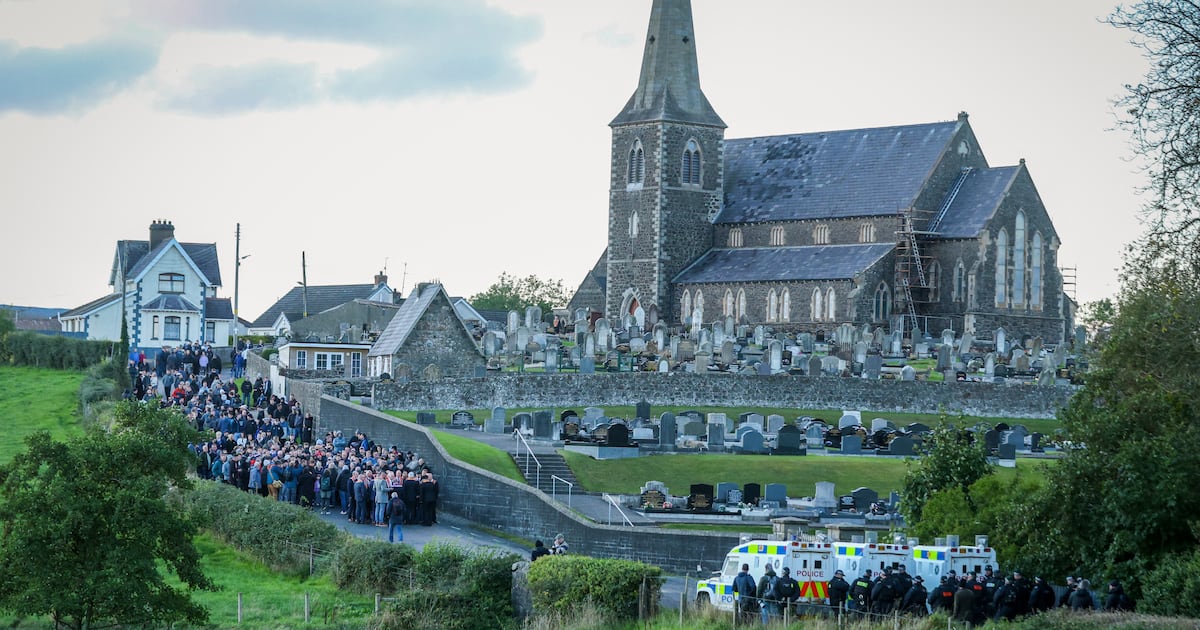
There are many places you might expect to see a Jesuit priest around the Garvaghy Road this week, but praying in Drumcree’s Church of Ireland church is not one of them.That’s where Fr Brendan McPartlin, one of two Jesuits in the order’s Iona Centre in Church Hill Park, off the Garvaghy Road, was to be found on Tuesday night, alongside local rector Rev Gary Galway. “They even called me up to say a prayer,” says McPartlin.The Drumcree prayer service had no connection with the small number of Orangemen and their supporters still on Drumcree hill, determined to march down the Garvaghy Road.READ MOREIt shows how not everyone on the Protestant side in Portadown is enthused about the return of a 30-year-old parade problem.Galway’s invite came after clergy members of all faiths in the Portadown area met to resurrect a long-dormant clergy group.Jesuit priest Fr Brendan McPartlin at the Iona Centre in Portadown, Co Armagh “I didn’t go to Drumcree with my priestly collar, and I confess I was a little bit nervous. I hadn’t been inside the church before, but it was lovely,” says Dublin-born McPartlin.A resident here since 2009, the 82-year-old priest partly jokes he was sent here because he expressed “horror” to his superiors at talk of closing the Iona Centre. “So they told me to come here to keep it going,” he says.In 1997, the late Ian Paisley accused the Jesuits of being in league with Sinn Féin, especially after priests said Mass on the road when locals were blocked from getting to St John the Baptist church.Today, there are just two Jesuits left here, McPartlin and Fr Frank Brady, who worked for years in Ballymun in Dublin. Most of their work now is with Portadown’s large immigrant community.McPartlin set up the Migrant Support Service in the community-owned Mayfair Business Centre in 2009. The centre is where local residents’ leader Breandán MacCoinnaith is the office manager.For 30 years, McPartlin worked in the College of Industrial Relations. He says he still thinks “like a trade unionist”, believing in people negotiating on their differences.The Migrant Support Service in the Mayfair business centre on the Garvaghy Road in Portadown Today, he sees little sign of compromise from either side in the standoff over the parade.“Breandán MacCoinnaith has the leadership, but he’s just so immovable. People like him for that; that’s the way they feel he should go,” says the priest, sitting in his small livingroom.“But I really don’t think you can make things work without negotiation. I am a trade unionist, aren’t I? You’ve got to make some compromises.“Breandán will make none. Locals just follow him, and he’s no compromise, and they’re happy with no compromise,” says McPartlin, who says other opinions exist, but they are rarely heard.The Terenure-born priest had not expected Drumcree to erupt again, but now thinks there were signs last year that this year would be different.Every Sunday for 28 years, Orangemen “did their little march” from Drumcree and “presented their little protest”, but McPartlin picked up signals from his contacts last year suggesting Garvaghy residents were “very closed in there and that if only they would open up a little bit, there’d be more money projects”.“I couldn’t find the source of it, but I do think it was coming from the other side. Now, looking back, I thought what they were really thinking is that they want to do that march,” he says.[ What next amid tension in Drumcree? It’s complicated ...Opens in new window ]McPartlin says he knew Garvaghy was “a divided place” when he first moved here but adds: “Until now, I had no sense how deep it goes.“I have no problem saying that you’re in a ghetto here,” he says – “surrounded by roads and bridges and the river, and the other side; that’s not accidental” – but he adds it is a “nice” and “very liveable ghetto”.He worries about the future. “Lots of families were and are very protective of their children. Many grew up on both sides knowing very little, experiencing very little and only learning about it later. Now they will,” he says.Portadown is a very different place from how it was in the 1990s. More than a quarter of its 22,000 population were not born in Northern Ireland, according to the last census, in 2021. That year, 16 per cent were from EU states, mostly Eastern European ones, while nearly 7 per cent came from elsewhere. In 2026, these numbers are significantly out of date.Many immigrants live in the Garvaghy Road area, attracted by cheap rents but these have “really shot up”, says McPartlin.Many immigrants – Timorese, Bissau-Guineans, Portuguese, Eastern Europeans – have struggled to understand the history behind the parades issue over recent weeks.The priest, a Jesuit since 1962, says he has been “impressed” by the number of immigrants who have said what has happened on the road is “unfair”.“Before that, their general approach was to say nothing. They don’t really understand what this Catholic/Protestant thing is,” he says.“When asked to fill out forms, and quite often they are, they leave sections blank.”In long-divided Portadown, even immigrants have adopted Northern Ireland’s Troubles dictum of “whatever you say, say nothing”.
A Jesuit priest at Drumcree church: ‘They even called me up to say a prayer’
Full Article
Original Source
Read the full article at Irishtimes →KhanList aggregates and links to publicly available news content. We do not host full articles from third-party sources. Always verify important information with original sources.