
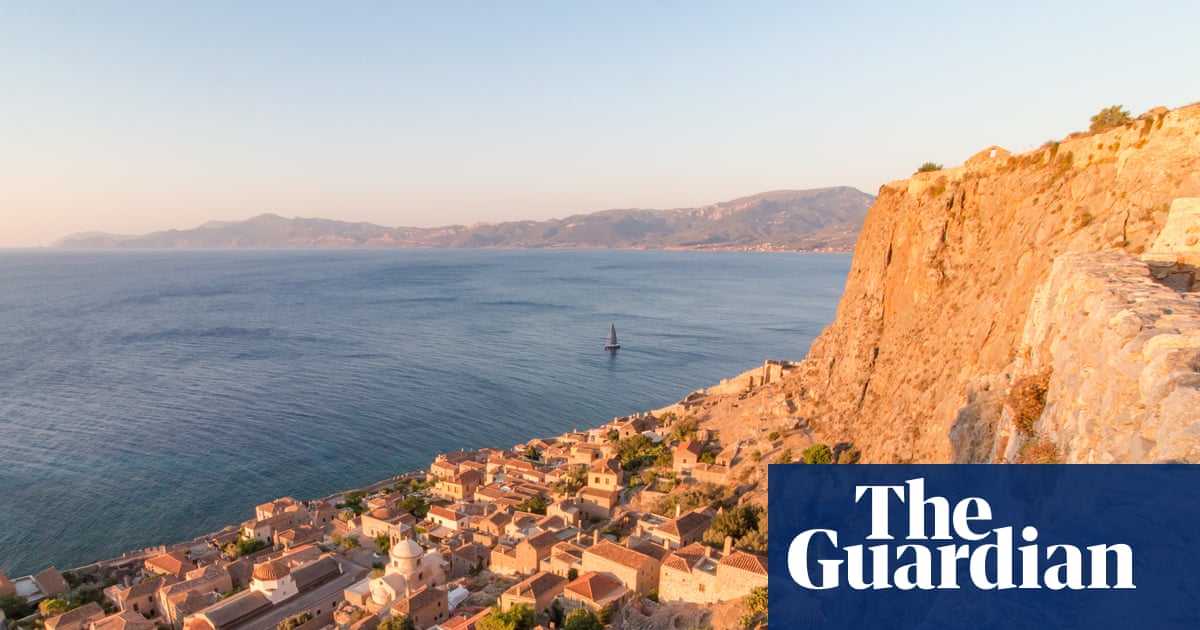
As I drove across the causeway which links the tiny fortress island of Monemvasia to the south-eastern coast of the Peloponnese, the Aegean sparkling on all sides, I recalled a line by Yiannis Ritsos, one of Greece’s greatest 20th-century poets. Ritsos lived in Monemvasia, in a house that is today a museum on a cobble-stretch by the tawny castle walls. A favourite passage goes: “The voyage is neither a leave-taking nor a home-coming – an ethereal bridge …”The excuse for my trip to the Peloponnese’s deep south – Messinia, the Mani, and Laconia – fell between those two ideas. My mother has roots in the Peloponnese – a sort-of homecoming that I’ve long wanted to explore – and with the summer over and greedy for an adventure to myself, I set out by car, leaving Kalamata, the leafy port city and gateway to the area, on a coastal road circuit.Autumn in the Peloponnese is another Greece. Forget the Cycladic white and blue; mountain valleys are carpeted in pine forests and wildflowers, a great stretch of green studded with rustic limestone houses. These villages, relieved by the end of a scorching summer, celebrate boisterous harvest festivals for wines, oranges and chestnuts in Laconia, figs in Messinia, and olives near Kalamata. This is the Greece the diaspora yearns for: the chorio – a word that snaps us back to our relatives and Greek rural life, villages where the air is healthy, eating depends on what is grown metres away, and tavernas are alive with locals rather than tourists. In the shoulder season, the weather is cool enough for long walks along the region’s spectacular trails but, at about 25C, is also still good for swimming.The two-hour drive to Monemvasia began with the Taygetus pass, winding through villages and cliffside tunnels as golden eagles soared above the firs. On the far side of the Taygetus, the road opened to Mystras, an archaeological Byzantine site stacked up its hillside. I climbed to the Paleologian Palace and its chapels, then descended, hungry, to the village of Parori, where Taverna Ores was serving syglino, the local cured pork, and an okra stew. I practised my flimsy Greek with the waitress and her mother, who kept one eye on a television gameshow while stirring the stew pots.The Byzantine Greek architecture of Monemvasia. Photograph: Kisa_Markiza/Getty Images/iStockphotoAfter lunch I stopped at Sparta – site of the ancient city state and modern metropolis. Beneath the Taygetus, in the spectral hush of the olive groves, there is an acropolis, an agora and little else. Yet the air carries something over the ruins, and it’s a short but necessary stop. A statue of Leonidas, hero of Thermopylae, stands facing the new city with the ruins at his back.This is still the Greece of the Spartans: locals remain fiercely attached to their ancient ancestry. Monemvasia has a thrilling connection: in AD600, a bishop is said to have led the Spartan population to the rock to fortify themselves against invading tribes. Set on to a slope inside the castle walls is a town of tight passages and medieval Orthodox churches. It is a vivid encounter with Byzantine Greek architecture, as well as traces of Venetian trade: the sweet, fortified wine malvasia was once a prized export. Even my guesthouse, Kelia (rooms from €70), began as a monks’ residence on the sea-facing Chryssafitissa Square.Leaving Monemvasia, I took a detour south for the golden sand dune beaches in Elafonisos. Reaching this island requires taking a 10-minute ferry ride from Pounta. The turquoise waters of Simos beach are deserted in the off-season – a necessary respite before my hour drive north-west to spend a night in Gythio. This working harbour town has neoclassical pastel mansions and waterfront restaurants provisioned by local fishers. Here the Mani begins.Simos beach is reached by ferry from Pounta. Photograph: Constantinos Iliopoulos/Alamy“Victory or death” reads the Maniot banner, above the Spartan motto “With the shield, or on the shield”. The region has a reputation for a conservative way of life that might seem unfashionable in modern Greece, but I find it seductive. The Mani’s beauty comes partly from its insularity. Driving an hour to Vathia, rugged mountains are crowned by labyrinthine stone tower villages that Maniot clans built to protect themselves during periods of vendetta or skirmishes with the Ottomans. Some are now ghost towns. Others have been converted into guesthouses.But it was in Gerolimenas that a Greek friend suggested I stay for a few nights. The seaside village is an easy base for touring both western and eastern coasts. Along the latter, I hiked to mainland Greece’s southernmost point, Cape Tainaron lighthouse and went for an impromptu dip. The Mani’s water is so gin-clear the boats appear to hover above the surface.The Akroyiali hotel (doubles from €80 B&B) opened in the 1970s, before most of the region’s roads. It is built on Gerolimenas’s shore, so I dozed to the pulse of waves and chatter from the hotel’s taverna below, where owner Mr Theodorakakis and his family entertained guests.skip past newsletter promotionafter newsletter promotionKardamyli, a popular village on the Mani that quietens in autumn. Photograph: Stephen Hughes/Alamy“The Mani is changing at its own rhythm,” Theodorakakis told me. “This is a special place. We can’t keep hiding from the world.” Most Greeks prefer to visit off-season, he said. “You can actually explore the region without burning. But be careful of the north-eastern wind. It cuts through!”Leaving Gerolimenas, I drove 30 minutes up the western coastal route, entering the busy town of Areopoli, where I shopped for hand-harvested sea salt and wild oregano. Pretty Limeni and Kardamyli – the home of British writer Patrick Leigh Fermor (who popularised the region) – get the Mani day-trip overspill from Kalamata. Regardless, it’s quieter in autumn. Every hairpin bend opens on to sea views, flowers and limestone.I was lunching over one such view of a grassy cape when the taverna owner mentioned a woman in the village who knew miralogia. These are wailing Maniot lamentations sung at funerals, which are heard rarely these days. After two days of asking around, I found Kaiti Braimi in a small chapel where she agreed to sing. “In a way, they’re less necessary,” the octogenarian told me. “No more vendettas.”The Polylimnio waterfalls in Messinia. Photograph: PitK/AlamyThe haunting rhythms of the miralogia were in mind as I left the Mani to enter Messinia – cutting through Kalamata again, but this time heading west. Here, the villagers were celebrating. Clarinets hummed in taverna gardens at Sunday family parties and relatives joined hands in circles to dance the kalamatianos. Passersby stood and clapped before being dragged in.On the hour drive from Kalamata to Pylos – which would be my base – the Maniot mountains flattened into lush forests. Wildflowers bloomed on the roadside. Yet in Messinia’s expansive green are traces of ancient civilisations, including the bronze age palace of Nestor, north of Pylos.My route sidetracked to the Polylimnio waterfalls. You can sidetrack easily in Messinia; there are unspoiled beaches (like Tsapi on the south coast, where mountains tumble into the sea), as well as areas for canyoning, cycling and kayaking. After a small hike, I bathed in clear pools surrounded by pines, alone mostly, apart from an Athenian couple. “We’re here for my birthday,” the man said. “Messinia is the best place in Greece for outdoor activities.” They pointed me to a canyoning trail north of the Bay of Navarino – a tip for my next visit.That evening in Pylos’s port, only an hour from where I began my voyage in Kalamata, I paused for an ouzo at a kafenion. A group of lads were watching Greece play Germany at football on the television. They wailed their own miralogia with every missed shot, but when the game ended in a win the cafes along the harbour roared.I thought back on my drive through the Peloponnese’s deep south, a journey that revealed a rural Greece I’d grown up romanticising from family, and believed was slowly disappearing. But not here. In the mountains and shores of Messinia, the Mani and Laconia, I found a Greece for all seasons.
A Greece for all seasons: my autumn roadtrip through the Peloponnese
Full Article
Original Source
Read the full article at Theguardian →KhanList aggregates and links to publicly available news content. We do not host full articles from third-party sources. Always verify important information with original sources.