
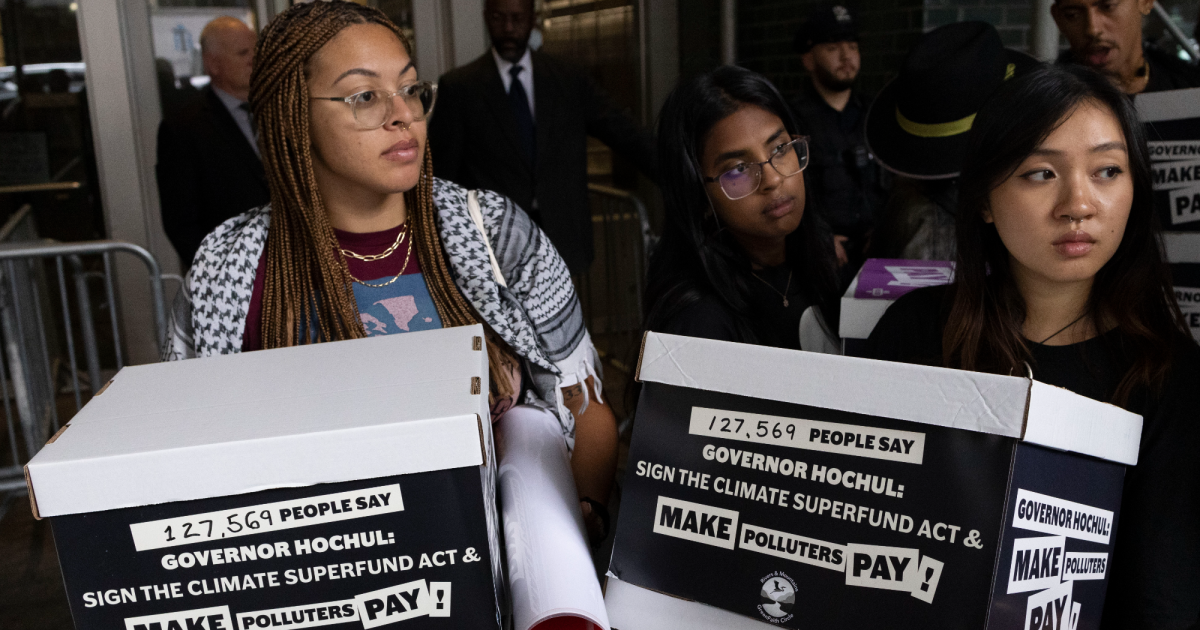
A coalition of climate organizations held a rally to deliver more than 125,000 petitions calling for Governor Hochul to sign the Climate Change Superfund Act into lawGina Randazzo/ZUMA Press Wire Get your news from a source that’s not owned and controlled by oligarchs. Sign up for the free Mother Jones Daily. On Monday, an Obama-appointed federal judge ruled that New York State could not enforce its 2024 Climate Change Superfund Act, a landmark law that would have charged fossil fuel companies $75 billion over 25 years for climate damages from cumulative greenhouse gas emissions. In a 63-page opinion, Chief Judge Brenda Sannes of the U.S. District Court for the Northern District of New York sided with 22 Republican state attorneys general, as well as industry groups including the U.S. Chamber of Commerce, American Petroleum Institute, and National Mining Association, saying the state’s “sprawling” superfund act was preempted by the federal Clean Air Act and outside the jurisdiction of New York. “The Climate Act is an unusual and sweeping statute, designed to address the effects of climate change–a ‘uniquely international problem of national concern’,” Sannes wrote. “Thus, the Court finds the Climate Act is ‘simply beyond the limits of state law.’” Her decision follows a July hearing where Sannes sharply questioned whether she was constrained by an earlier 2021 decision in which New York sued five fossil fuel groups for climate damages from climate change, such as sea level rise. Her August 31 opinion relied heavily on this case. New York’s climate superfund legislation, passed in 2024, required fossil fuel companies to pay for climate change adaptive infrastructure projects, like upgrades to roads, transit systems, the electric grid, stormwater drainage, and sewage treatment plants, as well as design solutions to mitigate extreme heat. Climate litigation experts criticized the legal rationale behind Sannes’ decision. “The [2021] Second Circuit NYC decision is not binding precedent in this case,” said Patrick Parenteau, a law professor and Climate Policy Fellow at Vermont Law School. “It has been severely criticized by other federal and state courts. Judge Sannes should not feel bound by it.” Meanwhile, the Trump administration, which over the last year and a half has enacted its deregulatory “energy dominance” agenda and has rolled back a host of environmental rules, like the 2009 endangerment finding, commended the ruling. “The Department of Justice is delivering on President Trump’s order to protect American energy from state overreach,” said Principal Deputy Assistant Attorney General Adam Gustafson in a Department of Justice press release. “New York’s law would have expropriated $75 billion from energy companies around the world during an energy emergency and in direct defiance of American foreign policy and federal law. We will continue to fight for affordable, reliable energy for all Americans.” Gustafson is head of the recently rebranded Energy and Natural Resources Division, and under his watch, the DOJ filed a similar lawsuit last year supporting attorneys general in New York as well as Vermont, which passed the very first state climate superfund legislation in May 2024. Vermont was first sued by the U.S. Chamber of Commerce and the American Petroleum Institute in December of that year. In 2026, 13 other states have considered passing similar “polluters pay” laws. Despite wide public support, organizers in blue states considering their own bills are seeing opposition from state Republicans, business groups, and trade associations. New Jersey Senator Michael Testa released a statement saying his state “should pay close attention” to New York’s ruling. “Our state’s similar bill should go no further. It’s a waste of time and resources.” At the time of publication, New York’s Attorney General Letitia James has not yet filed an appeal over Sannes’ ruling. Separately, it is unclear when and how Vermont’s case will be decided, but both decisions may inform how other states draft and pass future climate superfund laws. Environmental advocates stress that New York’s ruling “doesn’t bind” other states from passing their own superfund laws, and that the burning of fossil fuels will continue to cause mounting climate damages. “The floods will still come, roads will still wash out, and communities will still need billions to protect themselves,” said Make Polluters Pay Communications Director Cassidy DiPaola in an emailed press release. “Those costs don’t disappear just because fossil fuel companies don’t want to pay them.”
A Federal Judge Just Killed New York’s $75 Billion Climate Bill for Polluters
Full Article
Original Source
Read the full article at Motherjones →KhanList aggregates and links to publicly available news content. We do not host full articles from third-party sources. Always verify important information with original sources.