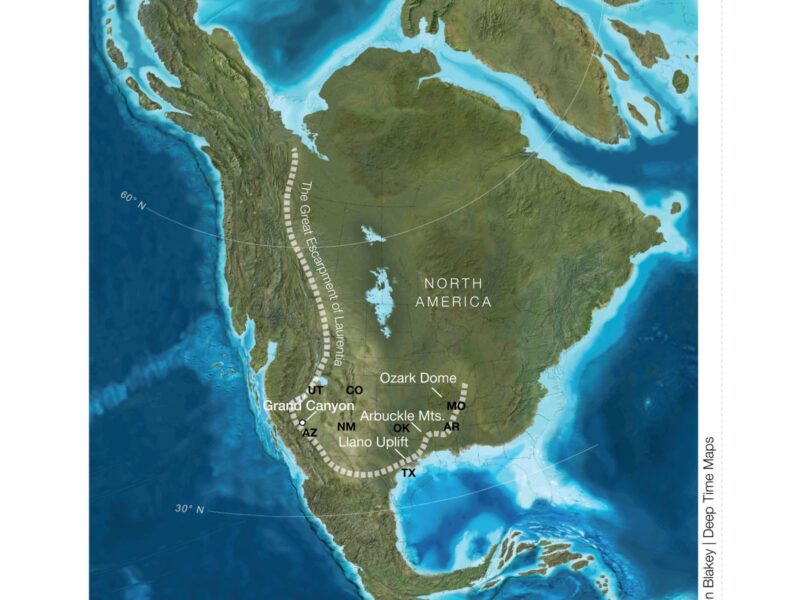
The ancient cliffs may have reshaped much more than the Grand Canyon.(CN) — Long before the Colorado River carved the Grand Canyon, a massive wall of cliffs may have exposed some of the ancient rock now visible at the bottom of it.Researchers have found evidence that a roughly half-mile-high escarpment stretched for thousands of miles across ancient North America after the supercontinent Rodinia began breaking apart about 800 million years ago.As the cliffs gradually eroded and retreated, they may have stripped away miles of rock, leaving a billion-year gap in the Grand Canyon’s geological record.The findings, publishedTuesday in the journal Geology, could help explain why more than a billion years of geological history appears to be missing in parts of the canyon.The gap is part of what geologists call the “Great Unconformity.” In the Grand Canyon, extremely old crystalline rocks sit beneath much younger layers, with rocks that should record an enormous stretch of time in between either missing or eroded away.Thomas Gernon, a professor of Earth science at the University of Southampton and lead author of the study, said the canyon contains rocks spanning about 2 billion years of Earth’s history, even though more than half of that record appears to be absent.“Our paper suggests the canyon’s basement rocks were progressively brought to the surface as part of an immense escarpment that developed during the breakup of an ancient supercontinent,” Gernon said in a news release.To piece together what the landscape may have looked like, researchers combined reconstructions of ancient plate tectonics with data modeling how landscapes evolve.Their work suggests the escarpment formed as Rodinia broke apart and would have extended through areas that are now Arizona, Utah, Idaho, Wyoming, Colorado, Texas, Oklahoma, Arkansas, Missouri and Illinois.The Grand Canyon, according to the researchers, sat in a similar position relative to the edge of the ancient continent as major escarpments found today in places including South Africa and Brazil.Over tens of millions of years, the towering cliffs slowly retreated inland. Researchers estimate that the process could have removed as much as 5 miles of rock in some places.That is consistent with other evidence indicating that roughly 3 to 6 miles of rock disappeared from the region well before the modern Grand Canyon took shape.“This long-lived tectonic landscape provides a missing piece in understanding why erosion associated with the Great Unconformity varies so dramatically across the southwestern U.S.,” Gernon said.The researchers say the breakup of Rodinia would have caused tectonic uplift, creating steep slopes and high terrain that could then be worn down by rivers and glaciers.The effects may have stretched far beyond the rocks eventually exposed in the Grand Canyon.The escarpment could have formed a mountainous rim around western Laurentia, the ancient core of North America. That landscape may have affected the paths of rivers, where sediment accumulated and when rising seas moved across the continent before the Cambrian explosion, a period when complex life rapidly diversified.Researchers say the findings could also help geologists make sense of similar gaps in the rock record elsewhere. Modern escarpments offer a way to study how landscapes created during the breakup of continents can continue evolving for hundreds of millions of years.“Today’s escarpments in Africa, Brazil, India and Antarctica provide windows into the forces that shape continents over hundreds of millions of years,” Gernon said.“By comparing Grand Canyon’s ancient history with active landscapes like the Great Escarpment of South Africa, we’re able to see North America’s most iconic geologic landmark in an entirely new light.”Categories / History, ScienceSubscribe to our free newslettersOur weekly newsletter Closing Arguments offers the latest about ongoing trials, major litigation and rulings in courthouses around the U.S. and the world, while the monthly Under the Lights dishes the legal dirt from Hollywood, sports, Big Tech and the arts.Additional Reads
A discovery may explain the Grand Canyon’s missing billion years
Full Article
Original Source
Read the full article at Courthousenews →KhanList aggregates and links to publicly available news content. We do not host full articles from third-party sources. Always verify important information with original sources.