
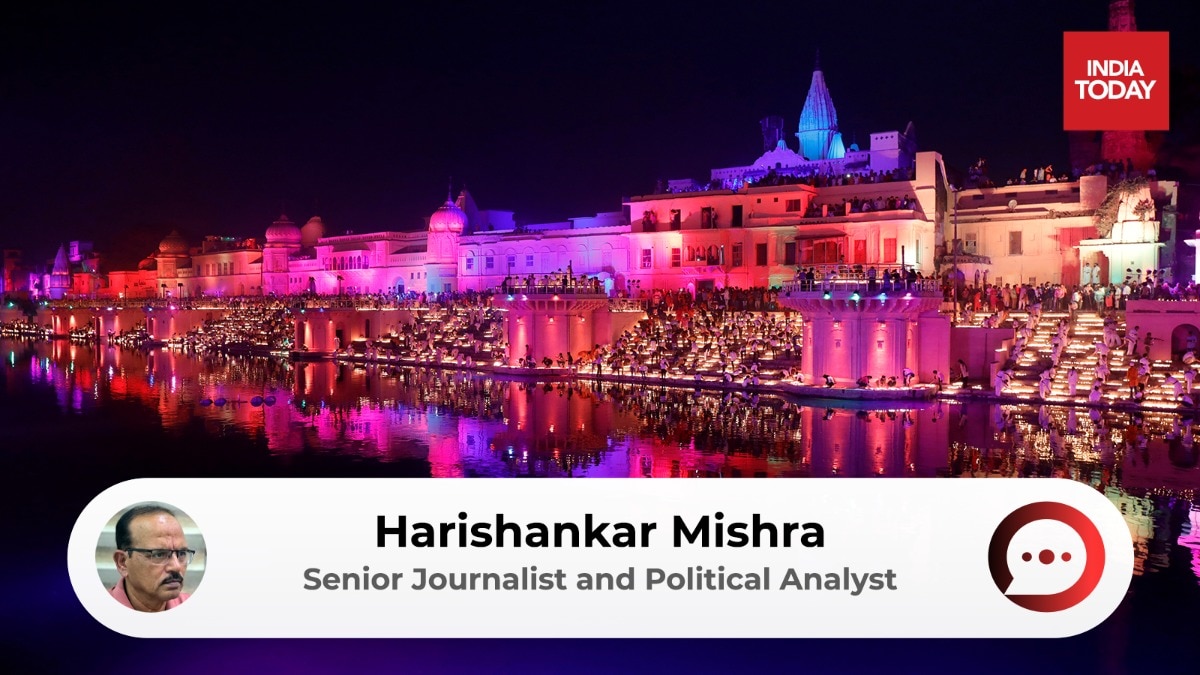
Ayodhya is preparing to light 30 lakh lamps across 56 ghats for its tenth Deepotsav. The elaborate planning combines faith, public participation, administrative coordination and livelihood opportunities.This time, arrangements for the lamps will be made across fifty-six ghats, whereas earlier they were limited to fifty-five ghats. (Reuters photo)In the Ramkatha, Ayodhya is described as a city where the people live without anxiety because the state understands its responsibilities. It is against this very benchmark that the preparations for Deepotsav should be viewed.Imagine the scene of a decade of Deepotsav celebrated in Ayodhya. The crimson hues of dusk will deepen along the banks of the Saryu, and millions of lamps will shimmer simultaneously, ghat after ghat, transforming Ayodhya into a living prayer. This is the tenth edition of Deepotsav, and the target this time is thirty lakh lamps. However, this event cannot be assessed merely by numbers. In a city whose soil is steeped in the memory of Ram Rajya, every lamp that is lit symbolises that very ideal. It can be said that wherever administrative will and efficient management work together, and where faith is complemented by the discipline of orderly execution, the concept of Ram Rajya ceases to remain merely a narrative and begins to take the form of a method of governance and a way of working.Let us look at the divine journey of Deepotsav. In the first Deepotsav in 2017, fifty-one thousand lamps were lit. Thereafter, the number increased year after year, and the festival went on to create world records while becoming deeply embedded in people’s hearts and minds. Every year, millions of devotees visit Ayodhya to etch in their memories the sight of lamps glowing along the banks of the Saryu and at Ram Ki Paidi. The rising number of lamps is no coincidence. It is the outcome of Chief Minister Yogi Adityanath’s devotion to Lord Ram and his effective leadership. A living example of administrative efficiency and effective management can be witnessed here.This time, arrangements for the lamps will be made across fifty-six ghats, whereas earlier they were limited to fifty-five ghats. A block-based layout is adopted to arrange the lamps in uniform rows, and the target is to complete the marking work within three to four days. Thirty lakh lamps are not simply piled up in an open field. They must be placed step by step and row by row in such a manner that, by evening, they form one continuous line of light. This is an exercise in geometry, coordination and time management. An important aspect of foresight lies at the heart of this entire event. The target is thirty lakh lamps, but thirty-three lakh lamps have been ordered to compensate for those that may break during transportation. This is not an approach that seeks to resolve a crisis after it occurs, but one that anticipates and accounts for it in advance. The kingdom of Lord Ram was one in which Nishadraj, Shabari, the vanaras and the bears all considered themselves stakeholders. The same spirit is evident in this event. Approximately thirty-five thousand volunteers from thirty degree colleges, forty intermediate colleges and the university campus will be deployed. They will be assigned responsibilities on a ghat-wise basis and provided with identity cards along with training. The university and the district administration are jointly managing arrangements for the lamps, ghat management, deployment of volunteers and security standards. A student who arranges lamps on a ghat today is not merely a spectator at this festival but one of its creators. This triad of educational institutions, administration and society demonstrates that governance here is not a machine that issues orders from above, but a coordinator that brings everyone together. Placing a lamp in the hands of the younger generation means teaching them that the light of society shines through the collective efforts of all. The spiritual essence behind this is embodied in the flame of the lamp itself. The fundamental message of Deepawali is the triumph of light over darkness, a manifestation of the prayer in which a seeker pleads to be led from darkness to light. In Ayodhya, this sentiment acquires a deeper, twofold significance. This is the very land to which Lord Ram returned after fourteen years of exile, when the residents of the city expressed their joy by lighting lamps in every home. The light of that day was not merely a celebration of the king’s return. It was a celebration of the belief that the rule of dharma, justice and propriety would now be restored. After centuries of waiting, when Ramlalla took his place in his grand temple, that memory became a living reality in the present. In the picture of Ram Rajya painted by Tulsidas, no one suffers from physical, divine or material afflictions. That ideal remains relevant even today and also serves as a benchmark for a high standard of governmental administration.The message conveyed by the government through this event is also clear. The first message is that the aspiration for Ram Rajya must not remain confined to the walls of a temple; it must be reflected in the working style of good governance. Even a celebration of faith demands discipline, and only a disciplined celebration truly honours faith. The second message is that cultural renaissance and modern management are not contradictory; they complement each other. A society that takes pride in its traditions can also enrich and preserve them through the language of technology, planning and transparency. The third message is that Ram Rajya means ensuring that the celebration and its opportunities reach the person at the very end of the social and economic spectrum.The livelihood dimension is also connected with this. The event strengthens the local economy, promotes local businesses and creates employment opportunities. Millions of devotees and tourists arrive in Ayodhya. The hands that mould earthen lamps, the traders who arrange oil and wicks, the families managing accommodation and food, and the workers engaged in transportation - all find warmth from this light in their hearths. When a festival becomes connected with livelihoods, the meaning of social justice also becomes part of the purity of faith. Finally, let us return to the central subject of this discussion: the lamp. The greatest lesson of a lamp is that it burns itself to illuminate the path for others. This is the essence of Rajdharma: that those in power must undergo their own discipline and sacrifice to become a source of light for the people. When the first wick is lit at dusk and, in no time, the steps of the ghats are filled with a golden glow, that light will embody months of preparatory labour, the enthusiasm of thousands of young people, the sleepless nights of officials and the centuries-old anticipation of a city. When thirty lakh lamps see their reflections in the waters of the Saryu, the light will be doubled - one rising towards the sky and the other descending into the water. It will be as though the entire city of Ram is declaring that Ram Rajya is not a distant dream, but a resolve to be kept alight like a lamp in every home, at every ghat.- Ends
A Decade of Deepotsav: An exceptional confluence of efficiency and management
Full Article
Original Source
Read the full article at Indiatoday →KhanList aggregates and links to publicly available news content. We do not host full articles from third-party sources. Always verify important information with original sources.