
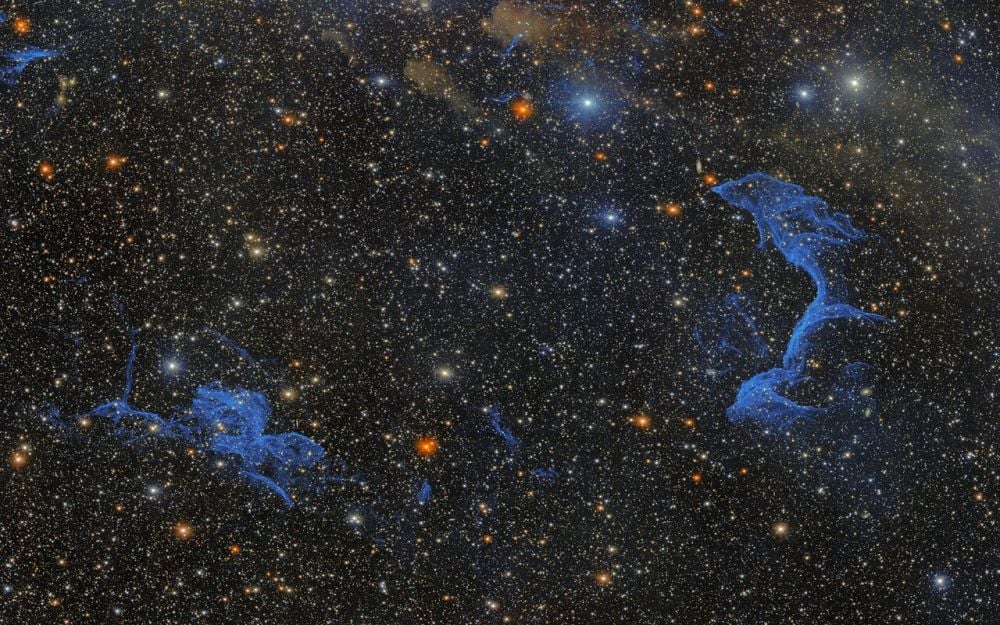
This is the Betta Fish Nebula, a supernova remnant (SNR) around 6,800 light years away in the Centaurus constellation. This display of illuminated gas came into being when a massive star exploded between 7,000 and 10,000 years ago. When it exploded, it expelled its outer layers. Those layers slammed into the interstellar medium, and are lit up by the energy from the shock, and that's what we see today. Astronomers love studying SNRs because they can learn a lot about how heavy elements are spread out into the interstellar medium (ISM). These explosions shape the dynamics in the ISM, including how stars form there. SNRs also reveal a lot about their progenitor stars. For these and other reasons, they're rich astronomical targets. This image is brought to us by a powerful telescope whose main job it is to study dark energy. But that telescope also has a side hustle: capturing stunning images for the rest of us that don't necessarily add anything to scientific understanding. One of the main efforts to understand dark energy, the puzzling force that drives the expansion of the Universe, is the Dark Energy Survey. It uses a special, purpose-built camera to do its work, called the Dark Energy Camera (DECam.) DECam is a powerful, 570 megapixel, wide-angle camera mounted on the Víctor M. Blanco 4-meter Telescope at Cerro Tololo Inter-American Observatory (CTIO) in Chile. It used its power to capture this image of the Betta Fish Nebula. Like many telescopes, DECam sometimes takes a break from its main job and captures images purely for public interest. It's a way for the professional astronomy community to share some celestial wonder with the rest of us. The latest DECam images of the Betta Fish nebula are in that category. Only part of the nebula actually looks like a Betta, the popular and colourful aquarium fish. They're also known as Siamese Fighting Fish, but whatever name is used, they're popular for their brilliant colours and flowing fins. This close-up view shows one portion of the Betta Fish Nebula, the part that most closely resembles its namesake. Image Credit: CTIO/NOIRLab/DOE/NSF/AURA. Image Processing: T.A. Rector (University of Alaska Anchorage/NSF NOIRLab), D. de Martin & M. Zamani (NSF NOIRLab) Creative Commons Attribution 4.0 International License What's left of the exploded star is a collapsed, ultra-dense stellar core called a neutron star. It's tiny, only about 20 km across, and is invisible in this image. It's actually a pulsar with unusual properties that has been studied extensively. It's radio-quiet and can only be detected in x-rays, and also lacks a pulsar wind nebula. It's so unusual that some researchers think it may be an example of what's called a 'low-mass bare strange star.' This is a less visually interesting, more scientific x-ray image of the central portion of the Betta Fish nebula. It shows what's left of the progenitor star that exploded, labelled in the center. Image Credit: Eppens et al. MNRAS 528, 2095–2111 (2024) But those scientific details take a back seat to the image's visual interest. These images have been 'dumbed-down' for internet use. There's a version of the image here that lets you zoom-in and explore it in much greater detail. This zoomed-in image highlights the part of the nebula that gave it its name. A cooperative orange/red star even serves as the Betta Fish's eye. Image Credit: CTIO/NOIRLab/DOE/NSF/AURA. Image Processing: T.A. Rector (University of Alaska Anchorage/NSF NOIRLab), D. de Martin & M. Zamani (NSF NOIRLab) Creative Commons Attribution 4.0 International License DECam has been observing for more than a decade, and over that time its created a nice catalogue of fantastic images. Here's a few of them. Here are three DECam images the camera has captured over the years purely for public interest. From left to right: the cometary globule CG4, the Rosette Nebula, and the Corona Australis Molecular Cloud. Image Credits: NSF NOIRLab DECam Creative Commons Attribution 4.0 International License To see more, go here.
A Dark Energy Camera Portrait of the Betta Fish Nebula
Full Article
Original Source
Read the full article at Universetoday →KhanList aggregates and links to publicly available news content. We do not host full articles from third-party sources. Always verify important information with original sources.