
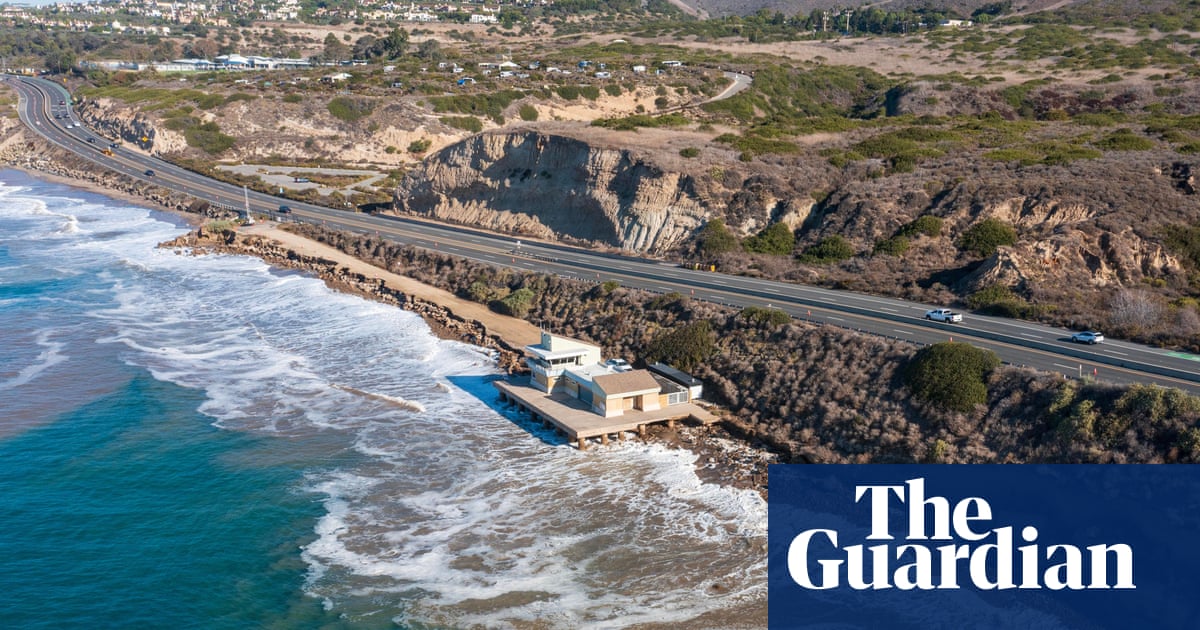
San Clemente is one of southern California’s most picture-perfect beach towns – a capital of American surf culture since the 1950s. In two years, 2028 Olympic surfers will compete at Lower Trestles, a world-class surfing beach.But the town’s longtime cultural and economic driver, its beaches, are now under threat. As pounding waves driven by late-summer storms in the Pacific devour chunks of the California coastline, some of San Clemente’s beaches are growing narrower, the sand increasingly eaten away.Beach erosion has become a crisis all along the southern California shoreline this year, with towns from Dana Point and Long Beach to Malibu sustaining dramatic damage. But San Clemente is a particular flash point. It’s the place where the major regional train line, which carries $1bn in freight a year and is the nation’s second-busiest passenger line, runs right along the edge of the Pacific Ocean. Severe waves and high tides during big storms at the beginning of September forced the repeated closure of the tracks.Experts say California’s current season of extreme weather is just getting started. “We’re in for a run of pretty exceptional erosion events if this Super El Niño develops as it’s expected to,” said Sean Vitousek, an oceanographer with the US Geological Survey (USGS).An Amtrak Pacific Surfliner train passes a worker moving fresh sand during an emergency replenishment project on 15 August 2024 in San Clemente, California. Photograph: Mario Tama/Getty ImagesAs the potentially historic El Niño season overlaps with a massive surge of warm water called a Kelvin wave, residents worry it will leave coastal infrastructure in pieces, beachfront properties leveled and more beaches carved away to crumbling slivers of gravel and bare rock.Donald Trump has continued to deny climate change as a “hoax”, “con job” or scam”. But in southern California, a historically conservative area, the effect of extreme weather events linked to the climate crisis have suddenly become very, very real.“We’ve been anticipating rising sea levels50 years from now,” said Hallie Jones, the mayor pro tem of Laguna Beach, California. “This summer proved that sea level rise is already here.”‘A game of attrition’On a hot, clear day, Cameron Cosgrove, a San Clemente beach restoration activist, took me to the state beach on the south side of town, where swimmers and sunbathers ambled over the major rail line’s tracks to perch on a very narrow strip of sand that descends steeply into the deep blue water.“You can see, when it gets steep like this, then you’re just at a game of attrition,” Cosgrove told me. “It’s just a matter of time before the next big wave event will start moving and start taking some of this.”Big storms at the beginning of September already saw the erosion of some of this coastline creep up to the train tracks. “Severe waves and high tides overtopped the tracks,” according to a spokesperson for the Orange County Transportation Authority (OCTA). The local commuter rail posted a video of sediment next to the tracks crumbling into the sea as waves slammed the shore.After nearly a century of reliable service, the coastal rail line has been shut down seven times since 2021 for repairs after landslides and surging tides on stretches of the line in San Clemente and further south down the coast. Over the past five years, the closure times “have totaled more than one year”, an OCTA spokesperson confirmed.Allow Instagram content?This article includes content provided by Instagram. We ask for your permission before anything is loaded, as they may be using cookies and other technologies. To view this content, click 'Allow and continue'.There’s no relief ahead. Once considered a gradual problem, coastal erosion is now being discussed more urgently, as the risk of California’s beaches simply disappearing, said Charles Lester, a former head of the California Coastal Commission who now leads an ocean policy center at the University of California, Santa Barbara. California scientists warned in 2023 that sea level rise sped up by the climate crisis threatens to erase between 25% and 75% of California’s beaches by 2100.This is posing a massive challenge, particularly for leaders of smaller beachside towns whose appeal is built around their ocean access. Orange county, a collection of suburbs clustered between Los Angeles and San Diego, is famous as the birthplace of the Reagan Revolution. Today, the county is more politically purple than deep Republican red – more voters backed Kamala Harris than Donald Trump in the 2024 presidential election. Some of its most famous beach towns, such as Newport Beach, remain Republican strongholds, favoring conservatism and as little government regulation as possible. But extreme weather and the growing threat to beaches is putting pressure even on Republican political orthodoxies.Waves crash into damaged homes as a powerful ocean surge and high tides generated by Tropical Storm Rachel batter the southern California coastline on 11 October 2026 in the Capistrano Beach community of Dana Point, California. Photograph: David McNew/Getty ImagesSouthern California’s wealthy coastal towns are used to breezier weather and lower temperatures than Los Angeles, or the scorching cities of the Inland Empire. But record-breaking heatwaves are changing that.“It’s October 5 and it’s 90 degrees in Dana Point. Unless there’s Santa Ana [winds], it’s unheard of,” said John Gabbard, Dana Point’s Republican mayor. “The ocean temperature is high. There’s no wind. And that’s not happening just by happenstance. Nobody’s using the words ‘global warming’, but everybody is recognizing that it’s warmer and it continues to be warmer through the past few seasons than it’s ever been in the past.”In San Clemente, where a majority of residents voted for Trump in 2020 and 2024, Cosgrove, a retired IT executive, is advocating a radical move: he authored a ballot measure that will go before voters in November, asking local residents to voluntarily impose a 1% sales tax on themselves to fund beach restoration and wildfire prevention efforts. A large portion of that tax revenue would be dedicated to replacing what he estimates is the city’s deficit of 4m to 6m cubic yards of beach sand.Nobody likes taxes, Cosgrove said, but voters need to face what he believes is the stark reality all along the California coast: if local residents don’t pay to protect public beaches from vanishing, it’s not clear that anyone else will.Shifting sandsSouthern California’s wide, sandy beaches are not exactly a natural resource. Many of them were created or expanded with sand dredged up by major midcentury construction projects.San Clemente’s beaches, for example, were fortified with an estimated 2m cubic yards of sand removed during the creation of Dana Point’s harbor in the late 1960s, Cosgrove said. “We’ve been living off that ever since,” he said.Since those midcentury construction projects, further development and infrastructure, especially dams on California’s rivers, has blocked the flows of sediment that would naturally restock the beaches with sand, while competition for the available supply of dredged-up or trucked-in sand has grown more intense. This has made the erosion of California beach sand an ongoing issue for decades – but it’s a problem that is now escalating rapidly.Much of California’s coastline development was completed during the state’s population boom from the 1940s to 1970s – years that happened to be an unusually “calm climate period” along the Pacific Ocean – “not many big El Niños, not a lot of storm damage”, Griggs, the coastline expert, said. “People built on the cliffs, they built on the bluffs, they built on the dunes.”Since then, stronger El Niño seasons have returned – and this year threatens to be the worst on record.Beach town residents such as Jones, the Laguna Beach mayor pro tem, who has lived there for much of her 48 years, are used to seeing sand migrate throughout the year. Beach sand is not a static amenity, but a complex system that can shift onshore and offshore, north and south. Scientists refer to each sand system as a “littoral cell”.During winter storms, Jones said, Laguna’s beaches typically lose sand, but later storms tend to bring it back, a kind of natural restoration. What’s happening now, though, is “not business as usual”, Jones said.Vitousek, the USGS oceanographer, said the intensity of this year’s coming tropical storms may disrupt beaches’ natural cycles: “You can get this thrashing, where the beach gets fully eroded on the south end, and then fully eroded on the north end,” he said. While beaches can sometimes recover “in a lot of cases, the damage is done. You’ve lost a beach. The waves are now breaking right on the infrastructure, causing damage.”An oceanfront home shows extensive damage from powerful swells generated by Hurricane Marie. The home was eventually demolished. Photograph: Allen J Schaben/Los Angeles Times/Getty ImagesA few miles north of San Clemente, in Dana Point, the same ferocious Labor Day waves that paused train traffic through San Clemente ripped through a row of coastal residences, leaving 10 homes red-tagged as uninhabitable.“The damage that we have seen this year has been extraordinary,” Gabbard, the mayor, said. He estimated there had been $33m in damage to private property, and another $25m in damage to the public beach.Up and down the coast, lesser beach damage in early September served as a warning of what might be coming in the next months: a beachside parking lot was seriously damaged by waves in Laguna Beach, big sections of sand vanished around Balboa Pier in Newport Beach, and a sinkhole opened in the driveway of Nicholas Cage’s coastal mansion in Malibu.In October, abnormally high tides flooded a low-lying neighborhood of Newport Beach, with local news outlets sharing footage of someone paddling on a surfboard through the streets. Huge waves damaged more homes in Long Beach. A dramatic crack in a cliffside bluff near Laguna Beach forced the continuing closure of part of the Pacific Coast Highway.Though San Clemente’s Lower Trestles was not one of the hardest-hit beaches in early September, local news outlets have already begun speculating over whether future Super El Niño damage could cause problems for the beach as a major Olympic venue.‘People don’t want to retreat’The most common short-term response to pounding waves that wash away local beaches and threaten beachside homes is to armor the shore with sea walls, revetments or simple piles of rocks. This has been a popular tactic, especially in southern California, where an estimated 38% of the coastline is now armored in some way. Half a century ago, in contrast, only 2.5% of California’s total coastline had armoring.But armoring, though relatively fast and simple, has a hefty long-term cost. Environmentalists, beach-loving residents and California’s powerful coastal commission all warn that building walls to guard the coastline serves as a death knell to the beaches next to them.Impermeable barriers block sediment from restocking the beach, while waves pounding on the barriers drag existing sand away, said Gary Griggs, a professor at University of California, Santa Cruz, who has been studying the California coastline for more than 50 years. In time, he said, any beach caught between the armoring and the sea disappears.For beach restoration activists such as Cosgrove, a fully armored, fully beachless California shoreline is the future dystopia they are trying to avert. From San Clemente’s state beach, Cosgrove showed me what the future shoreline might look like, if coastal communities continue to respond to erosion with short-term crisis management of throwing down rocks and putting up walls. He pointed south towards Cypress Shores, one of San Clemente’s gated oceanfront communities. Beneath the clifftop homes, the waves pounded directly onto a revetment, a rocky barrier shielding the rail line and the foot of the cliffs. “They had a 200–ft beach,” Cosgrove said. “They had volleyball courts. They had barbecues. Now there’s no beach. It’s all armor.”“If we never did sand replenishment, if we just don’t do anything at all, that revetment is the future of San Clemente,” Cosgrove told me. “From one end to the other. It may take 35 years to get there, but it will be that way.”Environmentalists and some coastal experts say the only viable long-term strategy for the California shoreline is “managed retreat”. That means moving homes, roads and other infrastructure inland from the eroding coast – a response that requires huge amounts of planning, logistics and consensus building, and is about as popular with coastal homeowners and developers as one might expect.“Most people don’t want to be managed, and most people don’t want to retreat,” said Griggs, the coastline expert. But, he added, “they’re not going to have a choice at some point”.Heavy machinery adds boulders to the protective sea wall along Beach Road in Capistrano beach on 29 September 2026. Photograph: Allen J Schaben/Los Angeles Times/Getty ImagesThe centrist option, the one with the most support from across the political spectrum, is simply replenishing the sand on California’s eroded beaches – what Cosgrove is hoping to fund with his San Clemente ballot measure.“It is a softer option than putting rock down, and it provides some more of that habitation and recreation space,” said Kelsey Ducklow, a coastal resilience coordinator at the California Coastal Commission.Beaches are “the best natural buffer we have from waves”, Griggs said. “If the beach is narrowed or gone, the waves attack the cliffs directly.”The problem is that hauling and dumping tons of sand on existing beaches is extremely costly and planning intensive – and not at all guaranteed to last, coastal experts said. Grigg described it as “a very, very temporary fix”.“One big storm can remove hundreds of thousands of cubic feet [of sand],” Griggs said. At Torrey Pines beach in San Diego in 2001, he recalled, officials brought in 200,000 cubic yards of sand – equivalent to 20,000 dump truck loads, at a cost of more than $2m for that beach alone. “It stayed there for about eight months, during the spring and summer. Right around Thanksgiving, a storm hit, the waves came up, and [it] was gone overnight.”What does the future hold?In San Clemente, Cosgrove argued, the city’s beaches, which run between the protective arms of Dana Point and Cottons Point, are more sheltered, allowing new sand to stay within the system of beaches longer. An infusion of sand from 2024, placed with the help of the army corps of engineers, is still providing some cushion for the town’s beaches, he said. In the months he spent collecting signatures at the farmers’ market and local grocery store to get his sand-replenishment measure on the ballot, he heard widespread support for continuing to restock San Clemente beaches with new sand.What people want to know, he said, is “Can someone else pay for this? Do we have to pay?” Residents want to know why the federal or state government isn’t funding beach replenishment with the taxes they already pay.One might think that a state as known for government bureaucracy as California might have a statewide beach commission, or at least a state sand fund, to keep one of the state’s primary economic engines from disappearing. It does not. The California Coastal Commission has regulatory power up and down the shoreline and can provide small planning grants to local jurisdictions, but it does not have the kind of money necessary to fund big sand projects, a spokesperson said.For that, Lester said, coastal cities usually need to go to the federal government and get a congressional appropriation for sand – a process that can easily take a decade, or even two, between when the state approves a replenishment plan and when federal money actually comes through.In Dana Point, where a majority of voters also supported Trump in 2024, Gabbard is hoping the president will step in to help with emergency funds to help the coastal town’s continuing storm damage.“Through back channels, I’ve been trying to get to the president to voice our concerns about, not just the homes themselves, but our beaches writ large, to make sure there are funds available to repair what we need to repair,” he said.One of the many projects needed, he said, is to create a more natural buffer for future storm damage at Capistrano beach by building a sand berm – a single project estimated to cost $16m.Even when federal funding is approved, cities are usually expected to provide matching funds for a big beach restoration project, Cosgrove said, which is why he thinks the most reliable option is for local residents to raise the money they need for beach restoration themselves, through a 10-year local sales tax. He said he is cautiously optimistic that San Clemente’s tax-skeptic voters will make an exception in November and vote to support wildfire prevention and the town’s beaches.While the Orange county transportation administration recently pledged to expedite the placement of 690,000 cubic yards of sand to protect the crucial rail line through San Clemente, the timing of the project remains unclear, in part because the project will require “specialized marine dredging equipment”, and, of the US’s few existing machines, “many are committed to other projects months in advance”, an OCTA spokesperson said in a statement.The state government is currently examining whether the rail line should simply be moved inland to a new location – a project already estimated to cost more than $5bn. The rail runs dangerously close to the ocean in both San Clemente and Del Mar, a town closer to San Diego.Passengers on an Amtrak Pacific Surfliner train look out over San Clemente state beach. Photograph: Kevin Carter/Getty ImagesEven if OCTA’s emergency sand restoration project in San Clemente is completed in a timely way, Cosgrove said, the amount of sand the agency has pledged to provide is far too little to restore all the city’s beaches.In making his pitch to San Clemente voters, including on his Yes on Measure M website, Cosgrove doesn’t talk about the climate crisis, though he said he does see the role the warming ocean is playing in the extreme weather hitting California’s coast.“I’m just messaging on stewardship and adding sand to our beaches,” he said. “This is the local issue that we’re facing. We can’t affect global climate change, but we can protect ourselves from it by nourishing our beaches. Having wide beaches is the best protection no matter what comes our way.”Some residents have a less optimistic attitude about efforts to prevent further coastal damage. In San Clemente, Zhen Wu, a city council member, has opposed Cosgrove’s tax measure, telling the Associated Press: “Fighting mother nature is very expensive.”On a hot October Friday, Kathy Ruiz, of Laguna Niguel, was sunbathing on a mostly-empty Aliso beach, not far from where construction equipment was repairing the Laguna beach parking lot damaged by early September storm surges.“As far as people expecting the city to protect their homes, I don’t think that’s reasonable,” she said. “I think maybe they shouldn’t have built so close to the beach.”Some residents want the government to build up sand berms to protect homes against the coming storms, Ruiz said, but she was skeptical.“Nature is going to take its course,” Ruiz said. “I think all that stuff is in vain.”
A California town’s beaches are washing away. Can its residents turn the tide?
Full Article
Original Source
Read the full article at Theguardian →KhanList aggregates and links to publicly available news content. We do not host full articles from third-party sources. Always verify important information with original sources.