
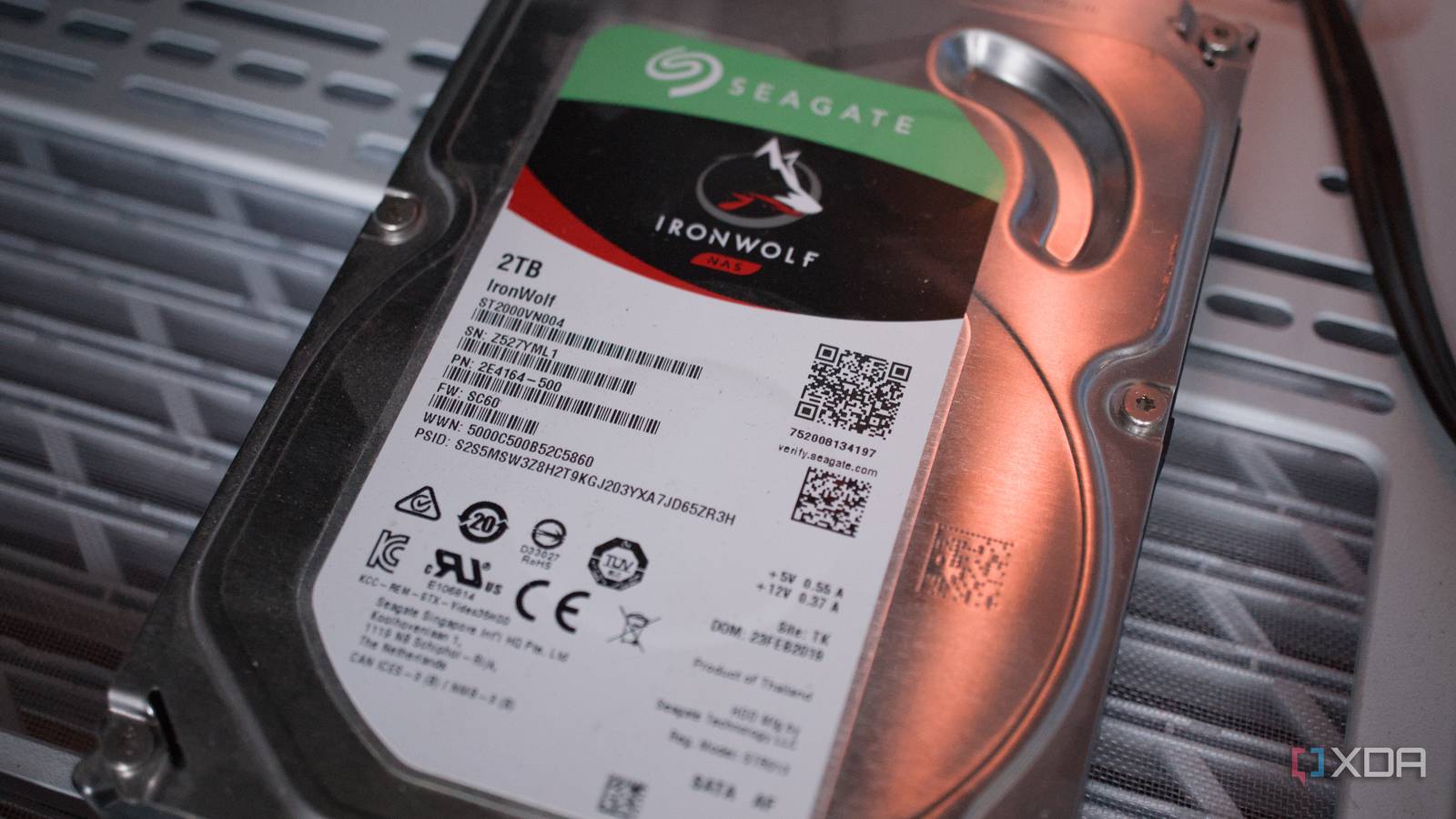
Published Sep 9, 2026, 2:30 PM EDT Richard is the PC Hardware Lead at XDA and has been covering the technology industry for almost two decades. He's been building PCs since young, and when not creating content, you can often find him inside a chassis somewhere. Hard drives, SSDs, and other forms of data storage are often viewed as consumables. They can be replaced on failure and are usually the most expendable parts of a network-attached storage (NAS) setup or server. So long as backups are in place, there shouldn't be an issue if one decides to call it quits. I've always made sure my backup strategy is robust enough that hard drives spinning inside my NAS can be easily replaced without too much downtime experienced. The thing is, no matter which brand or model you go for, an HDD will eventually fail. That said, it can prove challenging to choose the right brand. A recent peer-reviewed analysis of just north of 443,000 drives was published that put my setup into question. What the study concluded was alarming Suddenly, the labels on my NAS drives mattered more Christoph Siemroth and Yeomyung Park, two researchers named in the study, analyzed Backblaze's drive dataset, covering 443,156 hard drives, spanning more than 1.66 million drive-years. If there was to be a solid endurance test to reliably take away some findings, this was a solid offering. But one thing the Backblaze report didn't answer was whether or not some brands were more reliable than others. That's precisely what Siemroth and Park looked into, and it turns out the gaps between brands are present, and they are anything but small. Using Seagate as the baseline and after controlling for drive age, installation year, capacity, and average operating temperature, the Cox model put HGST’s adjusted failure hazard at 39.5% of Seagate’s, with Western Digital at 51.4% and Toshiba at 107%. Western Digital came second at 51.4%, and while it looked bad from the offset, Seagate wasn't even in last place, as Toshiba took that spot with a 107% failure rate compared to the baseline-selected brand. All of the drives inside my NAS are currently Seagate, replacing an old Western Digital array four years prior. The gap is actually much larger than anticipated. I always viewed Seagate as much closer to Western Digital in terms of reliability, with HGST often taking first spot. But what this report shows is HGST isn't simply ahead of Seagate; its adjusted failure hazard is less than half of Seagate's own storage solutions. Western Digital is almost as good, though Toshiba came out in last position. Interestingly, if you weren't aware, WD acquired Hitachi Global Storage Technologies (HGST) from Hitachi in 2012, which may explain why both brands were almost matching. I won't immediately replace all my Seagate drives Backblaze's data is incredibly useful for those of us who manage NAS and home labs, but it's important to note that manufacturers weren't evenly represented. HGST was present at earlier points alongside Seagate, ranging from the early 2010s through 2020. Toshiba was selected with more recent installations, and WD drives are also primarily among the newer batches. This is why failure rates weren't the only metric used for the findings, since we'd be comparing older drives to newer replacements. Instead, the research was conducted using survival and duration regression. This effectively looks at how comparable drives behave when age, capacity, form factor, and temperature are taken into account and are held constant. More than 146,000 drives left the dataset without failing, mostly during capacity upgrades. The survival models account for these right-censored drives, using the time they were known to have survived without treating their removal as a failure. What is certainly more alarming here is the poor showing from Toshiba, which was found to be among the newer drives. Still, for my own Seagate array, this doesn't mean I'm yanking out all my healthy drives, and I don't recommend you do either. It would be easy to take the data and the headline and jump to a conclusion that Seagate drives are inherently bad. They're not, and I've had six of them running inside my NAS for four years without a single issue. The study tells me plenty about what happens across 100,000 drives; it can't tell me when one of the six Seagates in my NAS will fail Temperatures matter as well Even a slight increase in temps could cause problems There's another tidbit I took from the report, and that's the role temperature had on failure rates. According to the report, every 1°C increase in average drive temperature is associated with roughly a 2% increase in failure rate. A drive averaging 10°C warmer was associated with roughly a 23% higher failure hazard in the models, which is astounding but not something that comes as a surprise. We always recommend running drives, notably HDDs and SSDs, as well as CPUs and all other parts at lower temperatures where possible. I always ran my NAS at the slowest fan speeds, but this alone made me reconsider this approach. My TrueNAS enclosure is running at around 40-50°C (104-122°F) for the CPU, though the drive array ranges between 27 and 31°C (80-87°F). Bumping up the fan speed slightly lowered operating temperatures of the six drives by approximately 2°C. All six SMART status reports come out clean, and there are only slight readings of general wear. The model suggests even that modest 2°C reduction moves things in the right direction, although whether it meaningfully extends the lives of these particular six drives is impossible to know. My purchasing habits have been adjusted While I don't have any brand loyalty to a specific company, I made the switch to Seagate from Western Digital simply down to price, performance, and availability. There wasn't a lot between the two. Models from the IronWolf and Red ranges are almost identical with specific capacities. Endurance and other metrics were also all in line with one another, but that's something this report made me question. I would have previously purchased more drives from the same manufacturer, but now I would broaden the search. It's great to choose drives from different batches to help avoid failures from occurring at similar times, but I never considered the brand in that equation, and it's probably about time I did. All that said, however, it's important to remember that NAS drives (and storage in general) come with workload ratings and warranties, the latter of which can always be used if a drive prematurely fails. If I can find a Seagate drive for less than WD, I may still go with the former. If they're both the same across the board, it certainly makes the decision more interesting. When the time comes for a full pool refresh, I may also consolidate onto fewer, higher-capacity drives. My current array uses 4TB disks, and my actual data footprint is small enough that a pair of 16TB drives could potentially hold everything I need. Depending on the redundancy layout I choose, that could mean fewer spinning disks, less vibration, lower power consumption, and less heat. The downside is putting far more data on each individual drive and potentially changing the pool’s fault tolerance, so as always ... YMMV.
A 443,000 drive study just proved one hard drive brand fails twice as often as another
Full Article
Original Source
Read the full article at Xda-developers →KhanList aggregates and links to publicly available news content. We do not host full articles from third-party sources. Always verify important information with original sources.