
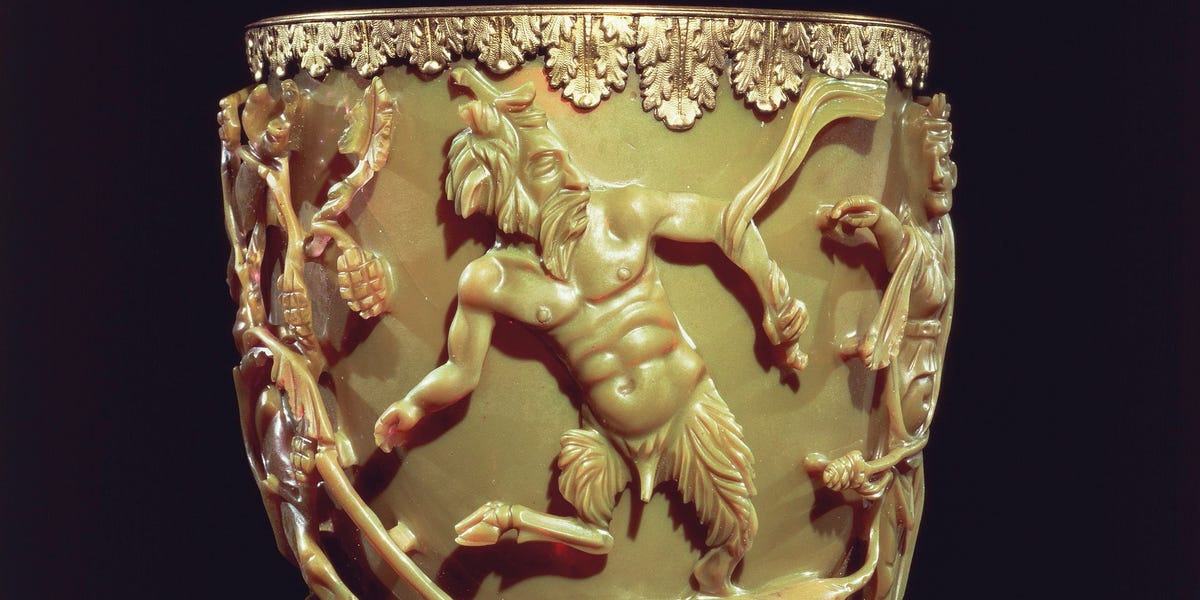
Roughly 1,600 years ago, ancient Romans crafted one of the most pristine—and scientifically advanced—works of glass art, a cup that shifts colors between jade green and ruby red. We’ve never adequately replicated the creation, but that’s all changing thanks to the scientific process used in a University of Sheffield project aimed at mimicking the Romans.“Although if the Romans could have seen me experimenting,” said Lisa Hollands, a team leader at the university’s School of Chemical, Materials, and Biological Engineering, in a statement, “they’d probably laugh and ask: ‘Why does she not know how to make this?’”Well, she does now.Roman color-changing glass first appeared in the fourth century C.E., and the Lycurgus Cup offers the most glamorous example of it. Now on display at the British Museum, it’s one of 40 surviving glass cage cups. Its exterior depicts the mythical Thracian king Lycurgus ensnared in vines. The cup appears green in reflected light and red when light shines through it.It’s a spectacular museum piece, but it’s long puzzled glassmakers and historians. How did the Romans create this color-shifting trick, now known as the dichroic effect? And why has every modern attempt to reproduce it failed? The leading explanation is that Roman artisans embedded trace amounts of gold and silver in the glass, forming nanoparticles thousands of times smaller than a grain of sand. Because these particles are smaller than the wavelengths of light, they don’t just let light pass through. They absorb and scatter certain colors depending on their size and shape, so the glass looks different depending on how light hits it.“I knew that making a glass of this type was likely to be a complex task, as it is not just a case of adding nanoparticles to glass,” Hollands said. “I’ve studied and worked with glass for over 25 years, so I used the knowledge and experience I’ve gained, coupled with a modern scientific understanding of what I was trying to achieve.”Hollands partnered with Caroline Jackson, a leading Roman glass expert, to learn about Roman-era glassmaking and to understand the materials they might have used. “Then came the more difficult part of trying to get small amounts of gold and silver into the glass in the right form,” she said.Hollands experimented with different furnace types, starting materials with varying oxygen levels, and even sugar. Eventually she hit on a recipe that works: Her glass looks opaque green in reflected light and glows red when light shines through.This magical effect occurs because when gold and silver join the molten glass mixture, nanocrystals grow. Because the nanoparticles are smaller than the wavelengths of light, Hollands told The Guardian, the electrons in their atoms can block certain colors under the right conditions. “So, for this glass, if light is shone through it, the gold and silver particles block blue and green light, only allowing reds and oranges to pass through,” she said. “If light is reflected off the surface, the particles have the effect of scattering the light, giving the opaque green color we see.”With the recipe finally cracked, the team asked Elliot Walker to use it in a contemporary sculpture. Walker is one of the UK's foremost glass artists and won season two of Netflix’s Blown Away. “It is a very rare thing to have the opportunity to work with glass developed from ancient mixtures and recipes, and it is always a very exciting one,” Walker said. “You can really get an idea of how the glass makers of the past would have adapted to this sort of glass. It’s like shaking their hands.”Walker gave the sculpture a classical form to echo the Lycurgus Cup, and he included a blown-glass element to show off its color-shifting effect. “The piece is a blend of the Lycurgus story and the Farnese Atlas sculpture,” he said, “with the globe replaced by a cup.”The new creation goes on display at the university’s Festival of the Mind on November 6 before shifting permanently into the school’s Turner Museum of Glass.The Sheffield team said that although the recipe is mainly meant for decorative glass, the science behind it could lead to new photonic materials, which control light, and to advanced glasses for storing radioactive waste. Already, the project has contributed to research on immobilizing complex nuclear waste in glass and understanding the conditions that cause crystals to form, which helps maximize how much waste can be safely locked away.“What Lisa and Elliot have managed to achieve has surpassed all our expectations,” said Christina Metcalfe, the school’s Molecular Photonic Breadboards project manager. “The incredible historic narrative rally captures people’s imaginations, and I like to think we’ve created something that people will marvel at for years to come.”Tim Newcomb is a journalist based in the Pacific Northwest. He covers stadiums, sneakers, gear, infrastructure, and more for a variety of publications, including Popular Mechanics. His favorite interviews have included sit-downs with Roger Federer in Switzerland, Kobe Bryant in Los Angeles, and Tinker Hatfield in Portland.
A 1,600-Year-Old Artistic Marvel Seemed Physically Impossible to Recreate. Until One Scientist Did.
Full Article
Original Source
Read the full article at Popularmechanics →KhanList aggregates and links to publicly available news content. We do not host full articles from third-party sources. Always verify important information with original sources.