
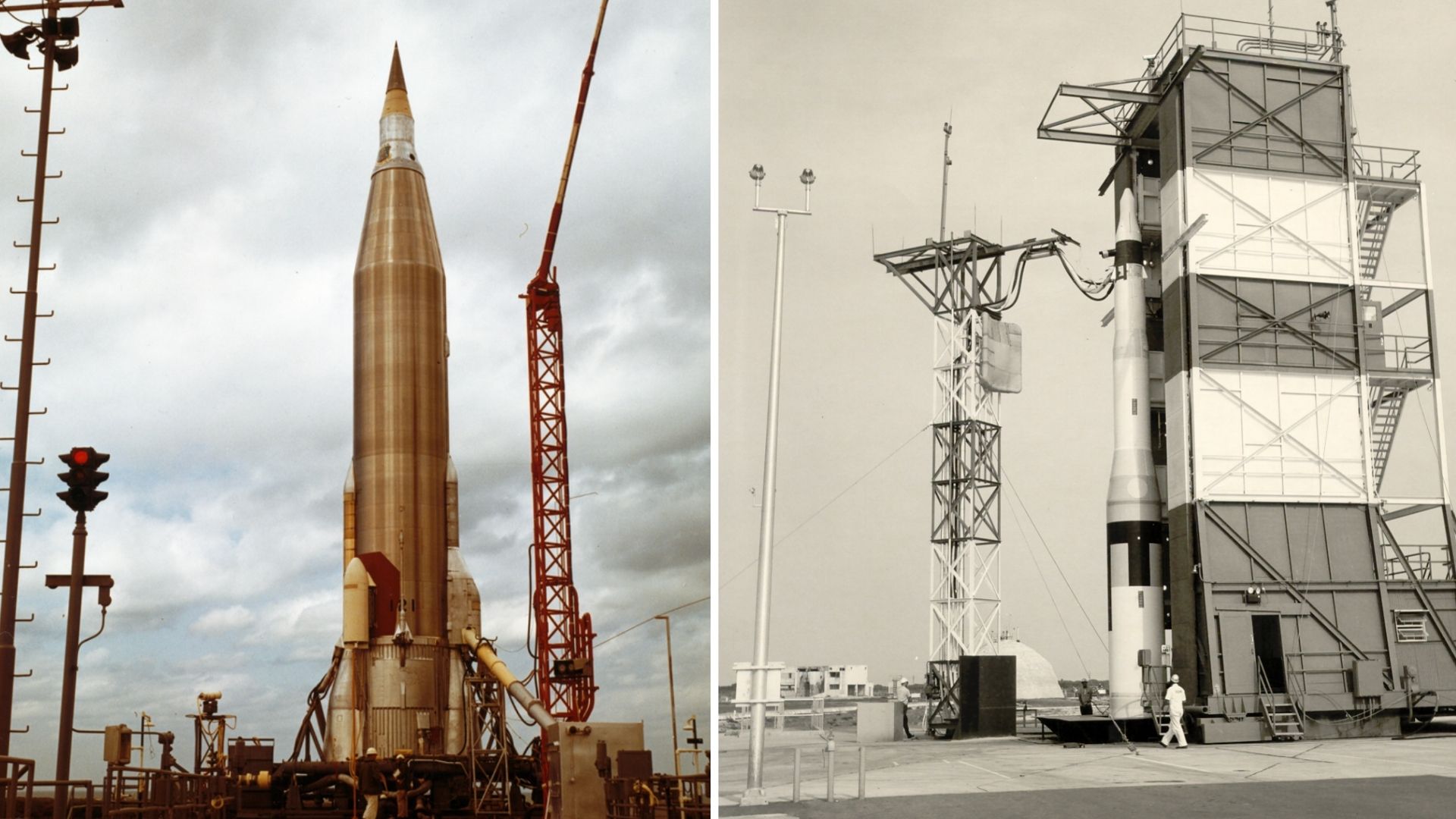
The Cold War was a contest not only of military power but also of engineering ability. Each side needed missiles that could travel farther, react faster, and operate more accurately under unforgiving conditions. Meeting those demands produced advances in propulsion, navigation, computing, materials, and structural design. Some missiles even became launch vehicles for satellites and astronauts, carrying their military engineering into the emerging Space Age. 1. R-7 Semyorka The Soviet R-7 became the world’s first intercontinental ballistic missile to complete a successful flight in 1957. Designed under Sergei Korolev, it used a central core surrounded by four strap-on boosters to generate the thrust needed for intercontinental travel. All its major engines ignited before liftoff, reducing the uncertainty involved in starting engines during flight. A modified R-7 launched Sputnik 1 in October 1957, and descendants of the same basic design later carried Vostok, Voskhod, and Soyuz spacecraft. 2. SM-65 Atlas America’s SM-65 Atlas pursued extreme weight reduction through pressure-stabilized propellant tanks made from thin stainless steel. Internal pressure gave the missile its structural rigidity, meaning the vehicle could buckle if insufficiently pressurized. Atlas also employed an unusual “stage-and-a-half” propulsion arrangement in which all three primary engines ignited before launch. Its two outer booster engines were discarded during flight, while the central sustainer continued operating and later helped the converted Atlas launch John Glenn into orbit. 3. Polaris A-1 Wikimedia Commons The Polaris A-1 turned the nuclear-powered submarine into a mobile ballistic-missile launch platform. In July 1960, USS George Washington successfully fired Polaris missiles while submerged off the coast of Florida. Engineers developed a weapon that could survive extended underwater deployment, exit a sealed launch tube, and travel through water before beginning powered flight. Its two solid-propellant stages eliminated complex pre-launch fueling and established an engineering foundation later developed through the Poseidon and Trident missile families. 4. LGM-30 Minuteman Minuteman changed ballistic-missile operations by combining solid propulsion with highly automated launch control. Its three solid-fuel stages allowed the missile to remain stored inside a silo in a launch-ready condition, avoiding the lengthy fueling procedures associated with earlier liquid-powered systems. The missile also carried a compact digital computer connected to an inertial guidance system. Its development pushed advances in solid-state electronics, miniaturized computing, automated diagnostics, and reliable rocket motors capable of remaining dormant for years before operating. 5. AIM-9 Sidewinder The AIM-9 Sidewinder demonstrated that guided weapons could achieve remarkable effectiveness through mechanical simplicity. Developed at the US Navy’s China Lake facility, it used a passive infrared seeker to follow the heat emitted by an aircraft without requiring continuous guidance from the pilot. One of its most inventive features was the rolleron, a small toothed wheel mounted on each rear fin. Airflow spun the wheels so they acted like gyroscopes, controlling unwanted rolling without complicated powered equipment, while the missile’s modular construction made later upgrades comparatively straightforward. 6. Titan II Titan II was a two-stage American ICBM powered by storable hypergolic propellants that ignited automatically upon contact. Although highly toxic and dangerous to handle, the propellants allowed the missile to remain fueled and launch faster than systems dependent on cryogenic liquids. NASA subsequently converted Titan II into the Gemini Launch Vehicle by reducing vibration and adding equipment designed to protect its astronauts. Between 1964 and 1966, Titan II launched Gemini missions that demonstrated orbital rendezvous, docking, spacewalking, and other procedures required for the Apollo lunar program. 7. BGM-109 Tomahawk Wikimedia Commons The BGM-109 Tomahawk combined the aerodynamic characteristics of an aircraft with the compact packaging of a ship- or submarine-launched missile. After launch, its booster separated, its wings unfolded, and a small turbofan powered it through sustained low-altitude flight. Its Terrain Contour Matching system compared radar measurements of the ground with stored elevation maps, allowing the missile to determine its position without continuous external commands. Later versions added image-matching guidance near the target, helping establish the modern architecture of an autonomous precision cruise missile. Engineering beyond the battlefield These seven missiles represent different answers to the demanding engineering problems created by the Cold War. Together, they advanced lightweight structures, solid and liquid propulsion, digital computers, inertial guidance, infrared seekers and autonomous navigation. Their influence also extended beyond their original military missions and into satellite launches, human spaceflight and unmanned aviation. Built as weapons, they ultimately became important stepping stones in the wider development of modern aerospace engineering. Get the latest in engineering, tech, space & science - delivered daily to your inbox.Atharva is a full-time content writer with a post-graduate degree in media & amp; entertainment and a graduate degree in electronics & telecommunications. He has written in the sports and technology domains respectively. In his leisure time, Atharva loves learning about digital marketing and watching soccer matches. His main goal behind joining Interesting Engineering is to learn more about how the recent technological advancements are helping human beings on both societal and individual levels in their daily lives.
7 legendary missiles that reshaped aerospace engineering during Cold War
Full Article
Original Source
Read the full article at Interestingengineering →KhanList aggregates and links to publicly available news content. We do not host full articles from third-party sources. Always verify important information with original sources.