
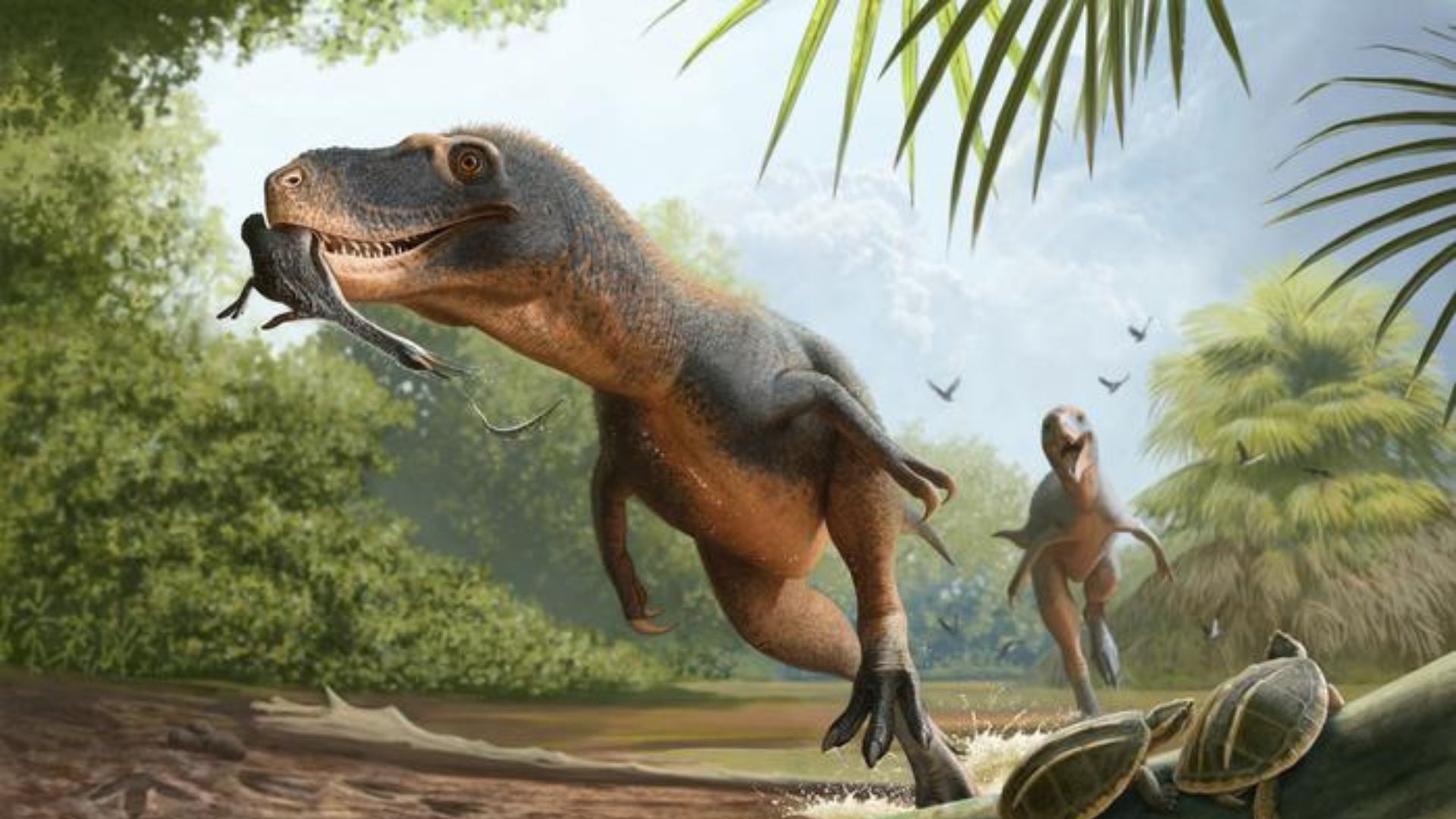
It is rare for paleontology to find feathers at all. Finding them inside the belly of a beast is a miracle of preservation. An apex predator ate a bird. Sixty-six million years later, its fossilized poop is rewriting evolutionary history. A new study reveals that a piece of ancient dung contains the best-preserved 3D feather ever discovered from the dinosaur age. Found in Montana’s famed Hell Creek Formation, the golf-ball-sized nodule sat hidden in plain sight until micro-CT scanning revealed its contents: gar fish scales, avian leg bones, and feathers. These feathers belonged to a hesperornithiform, an ancient flightless bird that dived for fish much like a modern loon. “It’s such a beautiful, well-preserved feather, from such an unexpected source, and it’s exciting that it could help us answer this huge question in paleontology,” said Jingmai O’Connor, the lead author of the new paper and the associate curator of fossil reptiles at the Field Museum in Chicago. David DeMar, Jr. holding the exposed fossil feather in the coprolite fragment on the day of its discovery in 2016. Evolutionary clues Birds evolved as a specialized group of dinosaurs beginning roughly 150 million years ago with Archaeopteryx, and they coexisted with other dinosaurs for a long time. When a massive asteroid impact triggered a global extinction 66 million years ago, almost all dinosaurs and early bird lineages died out. It left only a single small group (Neornithes) to survive. In this new work, ancient bird feathers were preserved inside fossilized animal droppings (coprolites), providing new clues. In 2016, researcher David DeMar, Jr. discovered a reddish-brown nodule in northeastern Montana. Scanning it with a hand lens, he spotted a tiny fossilized feather. This was a rare find for the Hell Creek Formation after 150 years of searching. Later in the lab, scientists tested its minerals and took detailed CT scans, which allowed them to see the hidden contents inside the rock. “Although the preservation was better than many of the feathers I’d been studying in Burmese amber for my thesis, this was in a rock—and a fairly unremarkable one at that. I suspected it might be a coprolite, but it wasn’t until we got it into the micro-CT scanner at USC’s medical campus that the full feathery fabric of this fossil feces became apparent,” said Nate Carroll, a co-author from the Carter County Museum in Ekalaka, Montana. “Every hour processing the data revealed another feather, another scale, another bone—in stunning 3D. As someone who had been relying on far-flung amber mines as my main source of 3D feather data, realizing that fossil poop from my home state could yield such exceptional specimens was a game changer.” Analysis showed its feathers had underwater adaptations seen in aquatic birds today. Hesperornithiforms were close relatives of modern Neornithes birds, but formed a distinct group. They were also separate from enantiornithines, which were the most common birds of the Cretaceous period. Avian survival Some scientists thought aquatic habitats helped certain birds survive the mass extinction. However, hesperornithiforms also lived near water and still died out. O’Connor believes feather differences explain why Neornithes survived. Researchers discovered that the feathers exhibit a strange evolutionary mix. The feathers were partially adapted for diving, yet retained primitive, fuzzy down typical of non-avian dinosaurs. These primitive feathers provided poor insulation against severe cold. Neornithes possessed advanced feathers that kept them warmer during the post-asteroid impact winter. Poor insulation likely caused hesperornithiforms and enantiornithines to go extinct. “The hesperornithiforms retain primitive feather types that may not have been as efficient for insulation as modern plumaceous feathers, and that could explain why they went extinct along with the enantiornithines,” noted O’Connor.The study was published in the journal Current Biology. Get the latest in engineering, tech, space & science - delivered daily to your inbox.Mrigakshi is a science journalist who enjoys writing about space exploration, biology, and technological innovations. Her work has been featured in well-known publications including Nature India, Supercluster, The Weather Channel and Astronomy magazine. If you have pitches in mind, please do not hesitate to email her.
66-million-year-old dung preserves rarest dinosaur-era feather ever found
Full Article
Original Source
Read the full article at Interestingengineering →KhanList aggregates and links to publicly available news content. We do not host full articles from third-party sources. Always verify important information with original sources.