
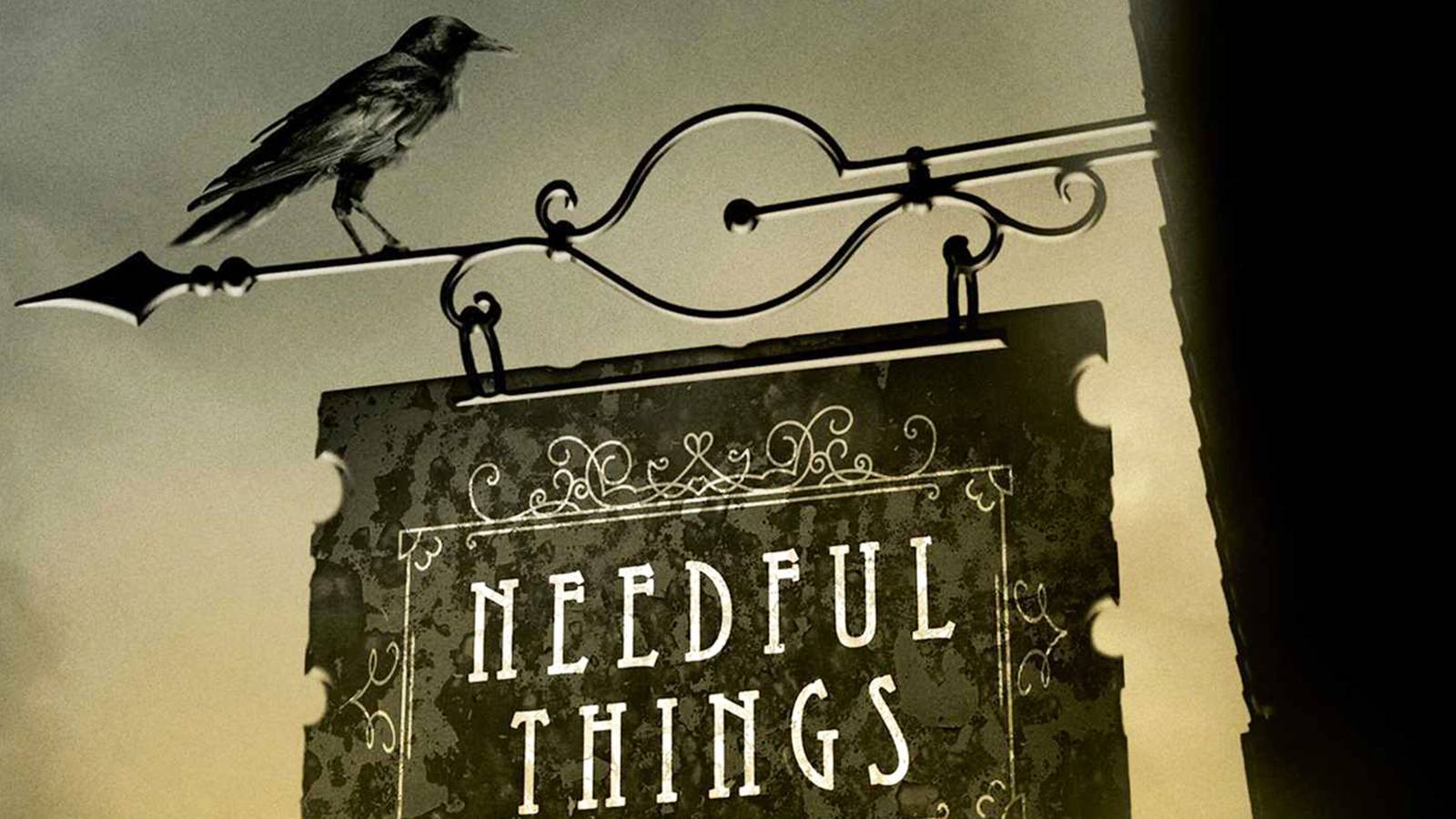
Published Oct 16, 2026, 7:45 AM EDT Luc Haasbroek is a writer and videographer from Durban, South Africa. He has been writing professionally about pop culture for eight years. Luc's areas of interest are broad: he's just as passionate about psychology and history as he is about movies and TV. He's especially drawn to the places where these topics overlap. Luc is also an avid producer of video essays and looks forward to expanding his writing career. When not writing, he can be found hiking, playing Dungeons & Dragons, hanging out with his cats, and doing deep dives on whatever topic happens to have captured his interest that week. Movies have plenty of tools for producing suspense. Music, editing, cinematography, and killer performances can make even an ordinary situation feel unbearably tense. Novels, by contrast, have to use finely crafted prose to keep us hooked and unsettled. Often, they ratchet up the tension by trapping us inside a character's thoughts. With that in mind, this list looks at some of the most intense thriller books ever, the ones that can go toe-to-toe with any film. Some construct elaborate mysteries that become increasingly disturbing as their secrets emerge, while others use unreliable narrators or unconventional storytelling techniques to make us question everything we're reading. 6 'Needful Things' (1991) Image via Viking “Everybody loves something for nothing... even if it costs everything.” Stephen King has always been particularly good at revealing the unpleasantness lurking beneath seemingly ordinary American communities, and Needful Things pushes that fascination to its logical extreme. The plot kicks into gear after a mysterious stranger named Leland Gaunt opens an antique shop offering customers objects they desperately desire. In return, Gaunt persuades his customers to perform seemingly harmless pranks against their neighbors. However, these supposedly small acts have big consequences, exploiting existing resentments and grudges, steadily stoking the flames of the town's repressed anger and jealousy. King spends considerable time fleshing out the characters, making the subsequent collapse of their relationships genuinely unsettling. The brilliance of the story lies in how little Gaunt actually needs to do. Most of the destruction comes from ordinary people who already possess the capacity for cruelty. All they needed was a little push toward the darkness. 5 'House of Leaves' (2000) Image via Random House “This is not for you.” House of Leaves is an experimental horror-thriller with a cult following. In it, the character Johnny Truant discovers a manuscript written by a deceased man named Zampanò. The document analyzes a mysterious documentary called The Navidson Record, which supposedly depicts a family's discovery that their house is larger on the inside than the outside. That impossible architectural detail becomes increasingly terrifying as hidden corridors, vast chambers, and apparently endless darkness emerge within the building. The book is incredibly meta: texts within texts, commentaries on commentaries, fourth-wall breaks, footnotes, contradictory accounts, and, most memorably, some truly unusual typography. For example, at times the words are printed sideways, forcing the reader to physically rotate the book to read it. In other words, House of Leaves is a book that uses the medium of the written word exceptionally well, its narrative structure adding hugely to the creepiness. 4 'London Falling' (2026) Image via Doubleday "Grief can function like a time machine." This is actually a work of investigative journalism, but it delivers the suspense and unsettling atmosphere of a first-rate crime thriller. Here, Patrick Radden Keefe, the author of Say Nothing, examines the mysterious death of Zac Brettler, a 19-year-old from an ordinary middle-class background who fell from the balcony of an expensive London apartment into the River Thames in 2019. We slowly learn that Zac had become entangled with a shady assortment of wealthy businessmen and underworld figures. More bizarrely, Zac had convinced these acquaintances that he was the fabulously rich heir of a Russian oligarch. From here, London Falling plays out as an intense, unpredictable thriller, but also an ensemble character study, a study of one family's loss, and a damning profile of a city that seems to frequently place wealth and power over truth and justice. 3 'Libra' (1988) “There is a world inside the world.” Few events in American history have inspired as much speculation as the assassination of JFK, and Libra transforms that national trauma into an unsettling conspiracy thriller. The novel delves into Lee Harvey Oswald's troubled life alongside a fictional conspiracy involving disaffected CIA operatives who intend to stage an attack on Kennedy and blame it on Cuba. Author Don DeLillo, the brains behind classics like White Noise, handles this melding of fact and fiction with style and skill. In particular, he's interested in how history can emerge from the collision of enormous political forces and seemingly insignificant individual decisions. The resulting atmosphere is extraordinarily paranoid. Characters believe they're manipulating events, but frequently discover that they're merely participating in systems they barely understand. DeLillo's dense, hypnotic prose intensifies that uncertainty, making even ordinary conversations feel loaded with hidden significance. And sometimes danger. 2 'The Secret History' (1992) Image via Knopf Doubleday Publishing Group “Beauty is terror. Whatever we call beautiful, we quiver before it.” Most murder mysteries begin with a killing and spend the rest of the time identifying the culprit. The Secret History reveals its murderers almost immediately, then devotes hundreds of pages to explaining how a group of privileged university students reached the point of killing one of their closest friends. It's an ingenious reversal of the genre's usual structure. Rather than generating suspense through detective work, writer Donna Tartt draws it out of the protagonists' psychological unraveling. Plot-wise, the narrator, Richard Papen, arrives at an elite Vermont college and becomes fascinated by a small group of students studying ancient Greek under an eccentric professor. Their intelligence and apparent sophistication make them irresistible to Richard, but it eventually becomes clear that there's vanity and cruelty beneath their glamorous exteriors. The tale becomes an atmospheric thriller as well as a piercing, character-driven drama. 1 'Ripley's Game' (1974) Image via W.W. Norton & Company “I never wanted to kill anybody. I just wanted to live.” This is perhaps the very best of the Ripley books, and it served as the basis for the fantastic film adaptation The American Friend. In Ripley's Game, the charming but morally empty protagonist is living in France, where he becomes involved in a criminal scheme after taking offense at a relatively minor social slight. Ripley's response is grotesquely disproportionate: he helps manipulate Jonathan Trevanny, an ordinary English picture framer suffering from a serious illness, into committing murder. It's grim but compelling stuff. There is no reassuring moral universe in Ripley's Game; the tension builds entirely from the fear that this fragile, chaotic web of lies and Mafia retaliation will collapse on both men. In the end, Patricia Highsmith's greatest achievement with this book is making readers simultaneously repulsed by Ripley and fascinated by his ingenuity. Collider Exclusive · 8 Questions · 2 Minutes What Is Your Biggest Horror Nightmare? Elm Street · Chucky · Scream · The Conjuring Four horror franchises. Four completely different ways of scaring you. One waits until you fall asleep. One makes sure nobody believes you. One is already in your group of friends. And one is in the house with your family. Answer eight quick questions about how you actually watch horror, and find out which nightmare was built for you. 😴Elm Street(Freddy Krueger) 🧸Chucky(Child's Play) 📞Scream(Ghostface) 🕯️The Conjuring(The Warren Files) FIND YOUR NIGHTMARE → 01 Which horror scene makes you cover your eyes? Four classic images. One of them is worse than the others for you. ASomebody falling asleep when they really should not. BA toy that has moved, and nobody touched it. CA phone ringing in an empty house. DA child talking to somebody who is not there. NEXT QUESTION → 02 You are home alone and you hear a noise. First thought? Everybody has one. It arrives before you have decided anything. AI am exhausted and my mind is playing tricks on me. BSomething in this room is not where I left it. CSomebody is in here with me. DThis house has never felt entirely right. NEXT QUESTION → 03 Which horror movie rule would you break first? Everybody thinks they would survive. Almost nobody actually does. ANever fall asleep. BNever leave it out of your sight. CNever answer the phone. DNever go down to the basement. NEXT QUESTION → 04 Something genuinely frightening happens. What do you do? Not in a film. In your actual living room, tonight. AConvince myself I imagined the whole thing. BTell someone, and brace for them not believing me. CWork out which person I know could be behind it. DGet everybody in the house into one room. NEXT QUESTION → 05 How do you actually watch a horror film? Be honest about this one. Nobody is checking. AFine during. Wide awake at two in the morning. BShouting at the screen that nobody is listening. CCalling the twist out loud before it lands. DThrough my fingers, holding on to something. NEXT QUESTION → 06 Somebody offers you serious money. Which do you still refuse? The amount does not matter. There is one on this list you are not doing. AFall asleep in a room I have never been in before. BKeep an old doll on the shelf facing my bed. CAnswer every unknown number that calls after midnight. DSpend one night alone in a house with a history. NEXT QUESTION → 07 Which feeling stays with you a week after the film? Good horror does not stop when the credits do. ANot wanting to turn the bedroom light off. BNot trusting one particular object in my house. CLooking twice at people I have known for years. DFeeling like something came home with me. NEXT QUESTION → 08 Something wakes you at 3am. What is the worst possibility? Eight questions in, this is the one that decides your nightmare. AThat I am still asleep, and it knows it. BThat the thing nobody believed me about is here. CThat somebody with a key is downstairs. DThat something is in the doorway, watching us sleep. REVEAL MY NIGHTMARE → The Lights Just Went Out Your Nightmare Is…Four franchises, four completely different ways of getting underneath your skin. This is the one built out of your particular fear, why it works so well on you, and what it would leave behind. Elm StreetYour nightmare does not wait outside the door. It waits for you to close your eyes, which you are going to have to do eventually, because nobody has ever won that particular argument. Freddy is horror's cruellest idea: a threat that lives in the one place you cannot guard, cannot lock, and cannot avoid forever. You are the one who is fine during the film and wide awake at two in the morning. Your own head is where this does its damage. These films understood exhaustion as a horror engine. The kids on Elm Street do not lose because they are weak. They lose because they are tired. You can lock every door in the house. You still have to sleep. ChuckyYour nightmare is not really the doll. It is the face of the person you tell, and the way they decide, very kindly, that you have imagined all of it. Chucky works precisely because he is absurd. That is the trap: the more accurately you describe him, the less anybody is going to believe you. You are the one shouting at the screen because the characters are not listening. You know that feeling from real life too. The franchise is at its best when the adults in the room are the real obstacle, and you have met those adults. By the time somebody finally believes you, you will have handled most of it on your own. ScreamYour nightmare has your number, knows your name, and has almost certainly been inside your house before. The worst part is that you already know them. Scream is the only one of these where the killer takes the mask off and turns out to be somebody who was at the party. You are the person who calls the twist out loud before it lands. You watch people the same way you watch films. The franchise made the rules of horror part of the plot, which means the survivors are the ones paying attention. You would be paying attention. Everybody is a suspect, including the person who just offered to walk you home. The ConjuringYour nightmare is not really about you. It is about the people asleep down the hall, and the feeling that whatever is here is not interested in leaving. The Conjuring films are domestic horror. The house, the family, the perfectly ordinary room that quietly stops feeling ordinary. Your instinct is to get everybody into one room. Your fear is protective rather than personal, which is rarer than it sounds. This is the one franchise where belief is the weapon. The people who come through it are the ones who are not alone and refuse to be. Whatever is here did not come for you. It came for the household, and you are the one standing in the hallway. ↻ RETAKE THE QUIZ
6 Thriller Books More Intense Than Any Movie, Ranked
Full Article
Original Source
Read the full article at Collider →KhanList aggregates and links to publicly available news content. We do not host full articles from third-party sources. Always verify important information with original sources.