
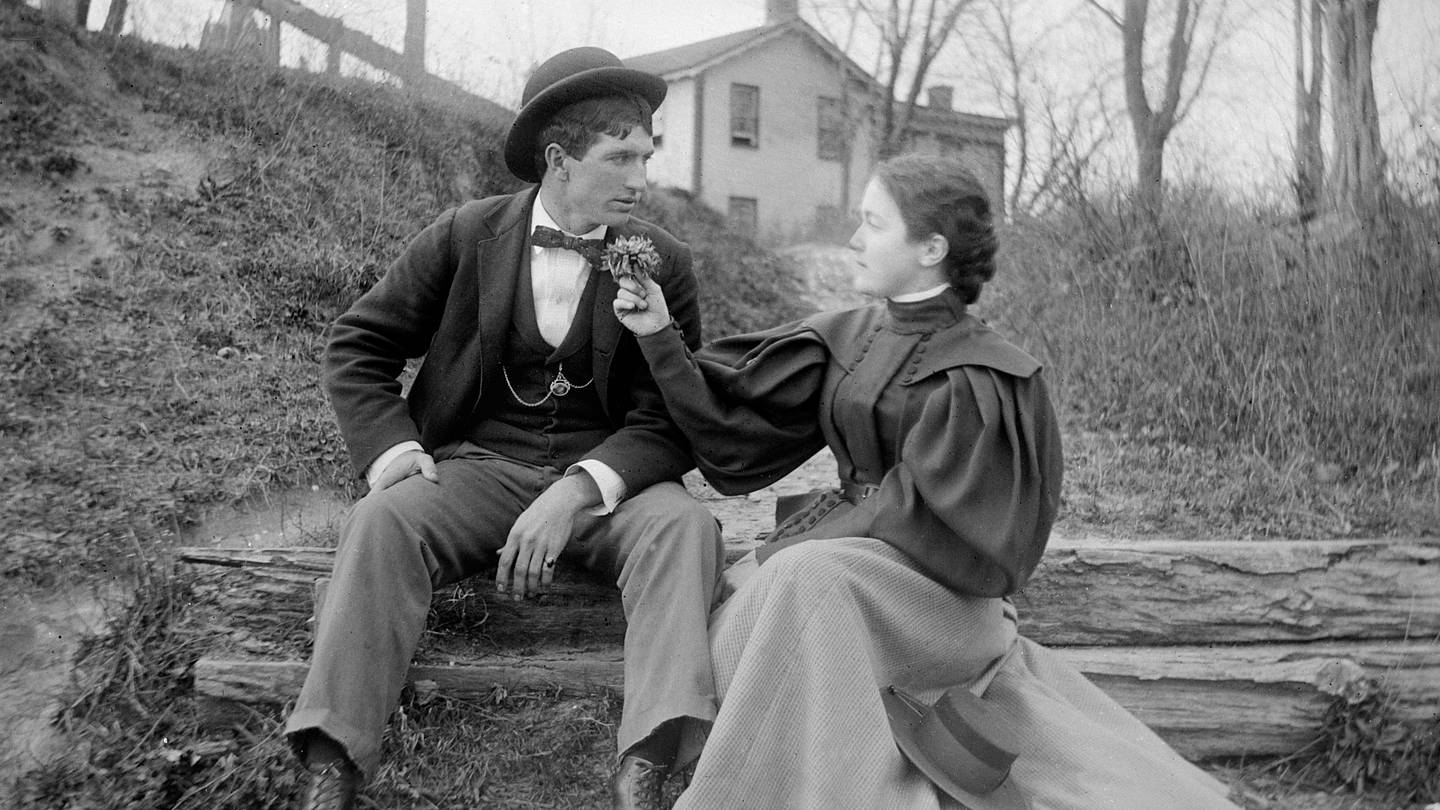
Slang has always existed. We like to think that people in the past only spoke formally, and that modifying language to be more casual is a recent trend. But slang words have been used for millennia. The slang of the past was just different than what we know today.About 100 years ago, people were definitely not calling each other "bae" or "shorty," but they still had their own endearments and words for dating. Some of the words were even euphemisms for some pretty scandalous activities. These words might sound so old to our ears, but they were part of the dating and romance discourse in the early 1900s.Man Kisses Woman's Hand | Samantha Vuignier/GettyImagesWooing/CourtingThe word "woo" actually just means "to court," so wooing and courting mean the same thing: seeking the favor of a person you're interested in. Courting goes back to the royal courts, when people called courtiers attended to the king or queen. They helped the royals with daily life and management of the country. Courting someone, or dating with the intent to marry, began to be used in the 1800s, having morphed from this old definition of courtiers.Hot Pursuit | Jim Heimann Collection/GettyImagesBeauThe word "beau" comes from the French word meaning "handsome or beautiful." Beginning in the 1600s, "beau" was merely a synonym for a dandy, or a man who cared a lot about his presentation and appearance. But it evolved to mean "a male suitor" after 100 years, and remained a popular term well into the 1900s. It was the equivalent of the word "boyfriend."Couple Romance Courtship Love | Universal History Archive/GettyImagesKeenKeen, meaning "eager," has been in the English language since the early 1300s. It didn't become a slang word meaning attraction to someone or having a crush until 1900. At the turn of the century, teenagers used keen to describe anything cool or great, i.e., "peachy keen." It easily slid from there to being "keen on" someone, or eager to be with them because of how great you thought they were.Couple Kissing Romance Love Courtship Historical | Universal History Archive/GettyImagesNeckingThe term "necking" just sounds wrong compared to the modern phrase "making out." Necking was first used in the 1800s to describe kissing and fondling passionately. Maybe it caught on after one too many ladies had hickeys on their necks? In any case, the term "necking" fell out of favor as the mid-1900s hit, being replaced with "petting" or "heavy petting." In the 1920s, necking or petting parties scandalized conservative America. Lovers embracing | Culture Club/GettyImagesLove BiteSpeaking of hickeys, the marks lovers left on each other by sucking on the skin were once called love bites. The term "love bite" dates back to the 1700s, when it was first recorded in John Cleland's novel, Memoirs of a Woman of Pleasure. The word hickey didn't start to replace "love bite" until 1934 in the U.S. In other countries like the U.K. and Australia, "love bite" is still used and preferred over "hickey."Overzealous Suitor | Jim Heimann Collection/GettyImages"Bank's Closed"In the 1910s and 1920s, a woman who was not interested in necking, or kissing at all, would tell her suitor, "bank's closed." It could also be said to a highly affectionate couple, with a similar meaning to "get a room." The phrase "bank's closed" just meant that kissing at that moment was not appropriate, so there would be no "cashing in."Read More:
6 Forgotten Dating Terms From the Early 1900s
Full Article
Original Source
Read the full article at Mentalfloss →KhanList aggregates and links to publicly available news content. We do not host full articles from third-party sources. Always verify important information with original sources.