
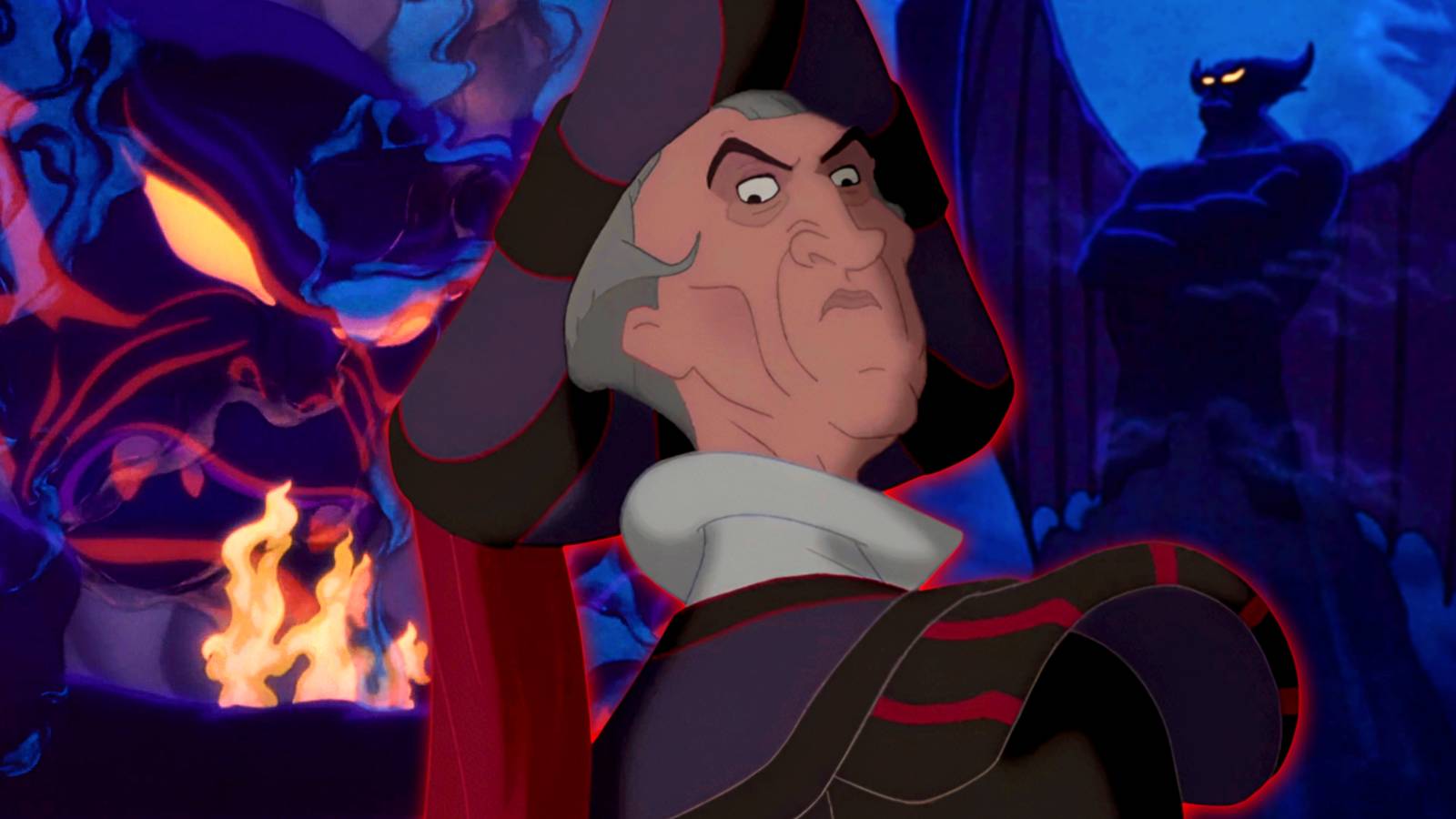
Custom Image by Vanessa Piña Published Aug 22, 2026, 8:02 PM EDT Vanessa Piña has been a freelance writer for the ScreenRant anime section since 2024. As a senior writer, she focuses on timely coverage of the latest anime releases and updates on popular franchises. Sign in to your ScreenRant account It's no secret that, both at Disney and in the film industry at large, there has been a recent surge in the popularity of anti-heroes and villains who occupy a moral gray area, characters who aren't completely bad but have genuine reasons behind their actions. However, there's something particularly engrossing about a truly corrupt antagonist who feels no remorse and exists solely to wreak havoc. Fortunately, Disney has achieved this with some of the greatest villains in the history of animated movies. An evil villain can truly elevate a movie, especially because viewers can root to their hearts' content for them to get exactly what they deserve. While some Disney villains have designs that seem to come straight out of nightmares, others are frightening precisely because they are so deeply rooted in reality. There are some Disney villains who, while they committed evil acts in their films, failed to effectively convey their personalities; one example is Shan-Yu from Mulan, whose sole motivation was conquest. Others Disney villains were kinda right or were given some sort of underlying motive, like Syndrome from The Incredibles or Doris from Meet the Robinsons or even Scar, whose backstory in Mufasa sought to show that his evil stemmed from his upbringing. Even so, what these Disney villains have in common is that they are twisted, infamous, and corrupt, created precisely to embody the worst kinds of deeds, without any redeeming qualities or attempts to elicit viewers' empathy. The Coachman - Pinocchio (1940) Disney's Pinocchio features one of the most dreadful villains in animated movies, especially when viewed through adult eyes, the Coachman. With no known real name, which heightens his terrifying presence, the coachman is one of the several antagonists in Pinocchio and runs Pleasure Island. He promises children boundless fun but actually abducts them and strips them of their humanity, letting them turn into donkeys and then sell them as slaves, serving as a chilling allegory for child exploitation and trafficking. From Steamboat Willie to Encanto · Eight Questions How Well Do You Know Disney Movies? “When you wish upon a star…” 🐭Steamboat EraBlack-and-white Mickey 👑The PrincessesSnow White onward 🦁90s RenaissanceLion King & Aladdin 💡Pixar LampToy Story onward ❄️Modern EraFrozen & beyond UNLOCK THE VAULT → 01 On November 18, 1928, Walt Disney premiered a seven-minute black-and-white short at the Colony Theatre in New York — the first Mickey Mouse cartoon released to the public, and one of the earliest sound cartoons ever made. Whistling Mickey at the helm of a riverboat became the studio’s first iconic image. Name the short. APlane Crazy BSteamboat Willie CThe Karnival Kid DThe Gallopin’ Gaucho ✓ Correct! Steamboat Willie. Mickey actually finished production first on the silent short Plane Crazy earlier that year, but Walt and his brother Roy bet the studio’s entire future on retooling Steamboat Willie with synchronised sound — a brand-new technology that had only just appeared with The Jazz Singer (1927). The gamble worked: Steamboat Willie’s November 1928 release made Mickey an instant national icon and put Disney on the map. The short entered the public domain in January 2024, exactly 95 years after release. ✗ Wrong. The answer is Steamboat Willie. Plane Crazy was actually animated first (May 1928, silent) but didn’t find a distributor. The Gallopin’ Gaucho was the second Mickey short, also originally silent. The Karnival Kid (1929) is where Mickey first speaks. The breakthrough — the first publicly released, sound-synchronised Mickey short — is Steamboat Willie. NEXT → 02 Walt Disney sank the studio’s entire balance sheet, plus a heavy mortgage on his home, into a project Hollywood derisively called “Disney’s Folly” — the first full-length cel-animated feature film ever made in English. It premiered December 21, 1937 at the Carthay Circle Theatre in Los Angeles to a standing ovation. Name the film. APinocchio BBambi CSnow White and the Seven Dwarfs DFantasia ✓ Correct! Snow White and the Seven Dwarfs (1937). The 83-minute film cost $1.49 million — an enormous gamble at the height of the Depression — and grossed $8 million on its initial release, the highest-grossing sound film made up to that point. Walt won an honorary Oscar (one large statuette and seven small ones, presented by Shirley Temple). The film’s success funded the construction of Disney’s Burbank studio and effectively created the feature-animation industry. ✗ Wrong. The answer is Snow White and the Seven Dwarfs. Pinocchio (1940) is the second Disney feature. Fantasia (1940) is the third. Bambi (1942) is the fifth. Snow White was the bet-the-studio first — ridiculed in production as “Disney’s Folly” before becoming the highest-grossing sound film ever made up to 1937. NEXT → 03 Walt Disney’s vision of a film-quality theme park opened to a chaotic, oversold “Black Sunday” debut — counterfeit tickets, a gas leak, and asphalt soft enough to swallow women’s heels. The Anaheim park was built on 160 acres of orange groves in just 12 months. In which year did Disneyland open? A1948 B1955 C1962 D1971 ✓ Correct! July 17, 1955 — press preview day, dubbed “Black Sunday” in Disney company lore. ABC broadcast a live two-hour TV special featuring Ronald Reagan, Bob Cummings and Art Linkletter (collectively winging the script as things went wrong). Disneyland was built on Anaheim orange groves Walt mortgaged his home to fund. Walt Disney World opened in 1971 in Orlando, six years after Walt’s death — that’s the date many people confuse with Disneyland’s opening. ✗ Wrong. The answer is 1955 — specifically July 17. 1948 is when Walt first sketched the concept. 1962 doesn’t mark a major Disney park milestone. 1971 is when Walt Disney World opened in Florida (six years after Walt’s death) — that’s the date most often confused with Disneyland’s. The original Anaheim park opened in 1955. NEXT → 04 The Lion King (1994) was pitched internally as “Bambi meets…” a particular Shakespeare play — and the parallels are unmissable: a young prince’s father is murdered by his uncle, who usurps the throne; the prince later returns to avenge him. Which Shakespeare tragedy provided the bones of the story? AMacbeth BOthello CHamlet DKing Lear ✓ Correct! Hamlet. The internal pitch was famously “Bambi meets Hamlet” (or, in some retellings, “Hamlet with lions”): Mufasa is the murdered king-father (Hamlet Sr.), Scar is the usurping uncle (Claudius), Simba is the exiled prince (Hamlet), and even the ghost-on-a-cliff appearance plays out beat-for-beat. The Lion King grossed $968 million worldwide and remained the highest-grossing animated film for 16 years until Toy Story 3 broke the record in 2010. ✗ Wrong. The answer is Hamlet. Macbeth is the “ambitious wife pushes husband to murder the king” story (the closer Disney parallel there is the Frollo/Esmeralda dynamic in Hunchback). Othello is the jealousy tragedy. King Lear is the divided-kingdom tragedy. The Lion King’s bones are unambiguously Hamlet’s — ghost, uncle-murderer, exiled-prince and all. NEXT → 05 Frozen (2013) became the highest-grossing animated film at the time and won two Oscars including Best Animated Feature. Its standout song — performed by Idina Menzel as Elsa, written by Robert Lopez and Kristen Anderson-Lopez — won the Oscar for Best Original Song and dominated radio playlists for an entire year. Name the song. ALet It Go BDo You Want to Build a Snowman? CFor the First Time in Forever DLove Is an Open Door ✓ Correct! “Let It Go” — the Oscar-winning power ballad that fundamentally rewrote the film’s plot in production: Robert Lopez and Kristen Anderson-Lopez wrote the song so persuasively that the directors threw out the existing script and rewrote Elsa from villain to misunderstood protagonist. The song spent over 30 weeks on the Billboard Hot 100, was translated into 41 languages for international releases, and its Idina Menzel single sold 10.9 million copies. Frozen grossed $1.28 billion and held the highest-grossing-animated-film record until its own 2019 sequel. ✗ Wrong. The answer is “Let It Go.” The other three options are also Frozen songs by the same Lopez/Anderson-Lopez writing team. “Do You Want to Build a Snowman?” is the early childhood-montage number. “For the First Time in Forever” is Anna’s coronation-day song. “Love Is an Open Door” is the Hans/Anna duet. The Oscar-winning monster hit is “Let It Go.” NEXT → 06 In November 1995, Pixar — then a small Disney distribution partner founded by Ed Catmull, John Lasseter and Steve Jobs — released the world’s first fully computer-animated feature film. It became the highest-grossing film of 1995 in North America and won a Special Achievement Oscar for John Lasseter. Name the movie. AA Bug’s Life BToy Story CMonsters, Inc. DFinding Nemo ✓ Correct! Toy Story (November 22, 1995). Made for $30 million, it grossed $373 million worldwide and immediately rewrote what was possible in animation. Steve Jobs — who’d bought Pixar from Lucasfilm in 1986 for $5 million — took the company public a week after the film’s release at $22 a share, instantly making him a billionaire. Disney bought Pixar outright in 2006 for $7.4 billion in stock, making Jobs Disney’s largest individual shareholder. A Bug’s Life (1998) was the second Pixar feature; Monsters, Inc. (2001) the fourth. ✗ Wrong. The answer is Toy Story (1995). A Bug’s Life (1998), Monsters, Inc. (2001) and Finding Nemo (2003) are all later Pixar features. Toy Story was the studio’s first — and the first fully computer-animated theatrical feature in cinema history. Its release a week before Steve Jobs took Pixar public effectively turned him from struggling NeXT-era founder into a billionaire. NEXT → 07 In a roughly seven-year span, Disney made a sequence of franchise acquisitions that transformed it from an animation studio into a global IP empire. Pixar (2006, $7.4B), Lucasfilm (2012, $4.05B) and 21st Century Fox (2019, $71.3B) bracket the era. The remaining major brand — bought in 2009 for $4 billion — brought Iron Man, Spider-Man and the Avengers under Disney’s roof. Name it. ADC Entertainment BImage Comics CMarvel Entertainment DDark Horse Comics ✓ Correct! Marvel Entertainment, acquired August 2009 for $4 billion. The deal followed Marvel Studios’ first independent production (Iron Man, 2008) and gave Disney rights to over 5,000 characters — though crucially not Spider-Man (still under a Sony deal) or the X-Men/Fantastic Four (under Fox until the 2019 acquisition reunited them). Disney’s combined Marvel-Lucasfilm-Pixar-Fox portfolio is now the largest IP holding in entertainment history. ✗ Wrong. The answer is Marvel Entertainment. DC Entertainment is owned by Warner Bros. Discovery (since the 1969 Kinney/National acquisition). Image Comics and Dark Horse remain independent. Disney bought Marvel in August 2009 for $4 billion, two years after Marvel Studios’ first self-financed film (Iron Man, 2008). NEXT → 08 Disney Animation’s Moana (2016) features Hawaiian newcomer Auli’i Cravalho as the title role and Dwayne Johnson as the demigod Maui. Its musical numbers — including “How Far I’ll Go” and “You’re Welcome” — were co-written by a Pulitzer- and Tony-winning Broadway composer who’d become a household name with Hamilton the previous year. Name him. AStephen Sondheim BAndrew Lloyd Webber CLin-Manuel Miranda DAlan Menken ✓ Correct! Lin-Manuel Miranda — co-writing with Te Vaka frontman Opetaia Foa’i and composer Mark Mancina. Miranda’s Hamilton had opened on Broadway the year before (August 2015) and turned him into the rare Disney songwriter with crossover Broadway-rap credibility. Miranda has since become a Disney mainstay, returning for Encanto (2021), where his songs “Surface Pressure” and “We Don’t Talk About Bruno” topped the Billboard Hot 100. ✗ Wrong. The answer is Lin-Manuel Miranda. Stephen Sondheim wrote Sweeney Todd, Into the Woods and West Side Story’s lyrics — but never a Disney animated feature. Andrew Lloyd Webber wrote Cats, Phantom and Evita — also never a Disney film. Alan Menken is the great Disney Renaissance composer (Little Mermaid, Beauty and the Beast, Aladdin) but didn’t write Moana’s songs. Moana is Miranda’s, with Foa’i and Mancina. REVEAL MY RATING → The Castle Has Spoken · Final Tally Your Magic Kingdom Standing 👑 / 8 True Disney royalty — or just a tourist with churros? ⤴ ANOTHER WISH He manages to mask his intentions with a facade of cheerfulness, all while being an irredeemable con man. While this already demonstrates his greedy nature, his truly sinister character is revealed by the fact that the coachman shows no empathy at all. The mysteries surrounding the Coachman, such as how he knows about the island's curse (or why it does not affect him), not to mention that he has only four fingers, have made his construction as a villain so effective, maintaining an unsettling nature even 8 decades later. But the worst thing about the character is that, unlike other Disney villains, the Coachman never faces consequences for his heinous acts. Although Pinocchio escapes, the Coachman continues running his trafficking ring and goes completely unpunished. Professor Padraic Ratigan - The Great Mouse Detective (1986) Although he is an underrated Disney villain, Ratigan from The Great Mouse Detective committed truly despicable acts that proved he was rotten to the core. He's the self-proclaimed "world's greatest criminal mind," boasting of being the best of the worst, and he also proudly confessed to committing atrocities, such as drowning widows and orphans. Ratigan goes so far as to feed one of his henchmen to a cat simply because the minion called him a "rat," which was true. However, it was a word that triggered him due to his enormous ego, as it contradicted the refined image he sought to project. Ratigan commanded the criminal underworld, with Basil of Baker Street calling him the "Napoleon of Crime," and was willing to go to any lengths, such as manipulation and kidnapping, to seize absolute power and rule Mousedom. "Item 96: A heavy tax shall be levied against all parasites and sponges, such as the elderly, the infirm, and especially little children." - Padraic Ratigan Furthermore, Ratigan only sought to climb into power to do more evil acts. The greatest proof of his wickedness is that even Ratigan's henchmen, in his signature song, tell him, "You're more evil than even you," implying that he himself serves as the benchmark for evil, a truly remarkable trait for a villain. Jafar - Aladdin (1992) While the Sultan from Aladdin was certainly quite incompetent, which gave Jafar some justification for wanting to rule Agrabah as the grand vizier and his advisor, the villain never showed a shred of benevolence in any of his actions. Jafar demonstrated a total disregard for the lives of others, using people as mere pawns to achieve his goals. He caused the death of the thief Gazeem in the Cave of Wonders, left Aladdin to die, and subsequently attempted to kill him on several occasions. Jafar sought the position of Sultan out of pure ambition, given that he already controlled Agrabah from the shadows and could even directly manipulate the Sultan with his hypnotic staff. So, what he craved was unlimited power by acquiring the Genie's lamp. Even after achieving his goal of obtaining the Genie, Jafar doesn't hold back. He openly mocks the Sultan, treating him like a puppet, and holds Jasmine prisoner, intending to take her as his wife to satisfy his own lust and assert his dominance while simultaneously attempting to kill her after things didn't go his way. What makes Jafar's villainy so satisfying is that he's defeated by succumbing to his own desire for omnipotence. Judge Claude Frollo - The Hunchback of Notre Dame (1996) Judge Claude Frollo is one of the greatest Disney villains of all time. Originating from Victor Hugo's novel, Frollo possesses neither supernatural abilities nor magic, yet he has been compared to villains with truly formidable powers, as his actions lay bare the worst traits of human beings. Cruel, twisted, and corrupt, Frollo wields his power to commit all manner of atrocities, hiding behind his status as a religious figure and claiming "divine will" to justify his wickedness and believing himself righteous. He murdered Quasimodo's mother and trampled upon the boy all his life. He also abuses his influence to commit genocide by orchestrating a systematic hunt for the Romani people. Frollo's hypocrisy is also evident in the way he yearns for Esmeralda. He is consumed by his own carnal desires and hates himself for it, leading him to choose to destroy her instead. He's a character that can very well exist in real life, but the best part is that The Hunchback of Notre Dame never justified his actions. Furthermore, Frollo's ending feels like poetic justice with one of the grimmest deaths in Disney movies. The Horned King - The Black Cauldron (1985) One of Disney's biggest box-office flops, The Black Cauldron, features a villain who embodies evil in its purest form: the Horned King. Both his inhuman design and his actions are spine-chilling, as the character has no backstory other than a raw desire to conquer the world. Tyrannizing his goons and casting anyone who crosses his path into his dungeon, from a passing minstrel to a princess whose power proved useless to him, the Horned King stops at nothing. He employs forbidden dark arts and sacrifices to raise an army of undead, invincible warriors that will destroy everything in its wake in his search to become "a god among mortal men" and be worshiped. Interestingly, in the Spanish dub of The Black Cauldron, the Horned King is called "El Rey Del Mal," which translates to "The King of Evil." The Horned King doesn't actually commit that many horrors in the movie, beyond the implied seizure of the castle he occupies, the kidnapping of a princess and a pig, the search for a human sacrifice for the Cauldron Born, and attempts to kill Taran and the others. Yet, the Horned King's aspirations for domination alone demonstrate that he is evil by nature, in addition to a truly disturbing death. Chernabog - Fantasia (1940) Chernabog, from Fantasia, is one of the darkest beings in the Disney universe, the very embodiment of evil. Although he doesn't appear to directly do necessarily bad deeds in The Night on Bald Mountain's segment of Fantasia, he demonstrates powers that instill terror by summoning evil spirits. Chernabog is also recognized as a villain in both Mickey's House of Villains and Kingdom Hearts. Chernabog is based on a deity from Slavic mythology associated with evil and darkness. It is therefore not surprising that he projects an imposing presence reminiscent of a demon. Wielding dominion over the forces of evil, he is an immortal deity that summons witches and ghosts, forcing them to dance in a pit of fire in the night he is awake. The fact that he is sealed off speaks volumes about how dangerous Chernabog is, and there is no doubt that if Disney were to make a movie centered on him, it would be one of the most terrifying in the entire company's lineup.
6 Best Disney Villains Who Are Pure Evil
Full Article
Original Source
Read the full article at Screenrant →KhanList aggregates and links to publicly available news content. We do not host full articles from third-party sources. Always verify important information with original sources.