
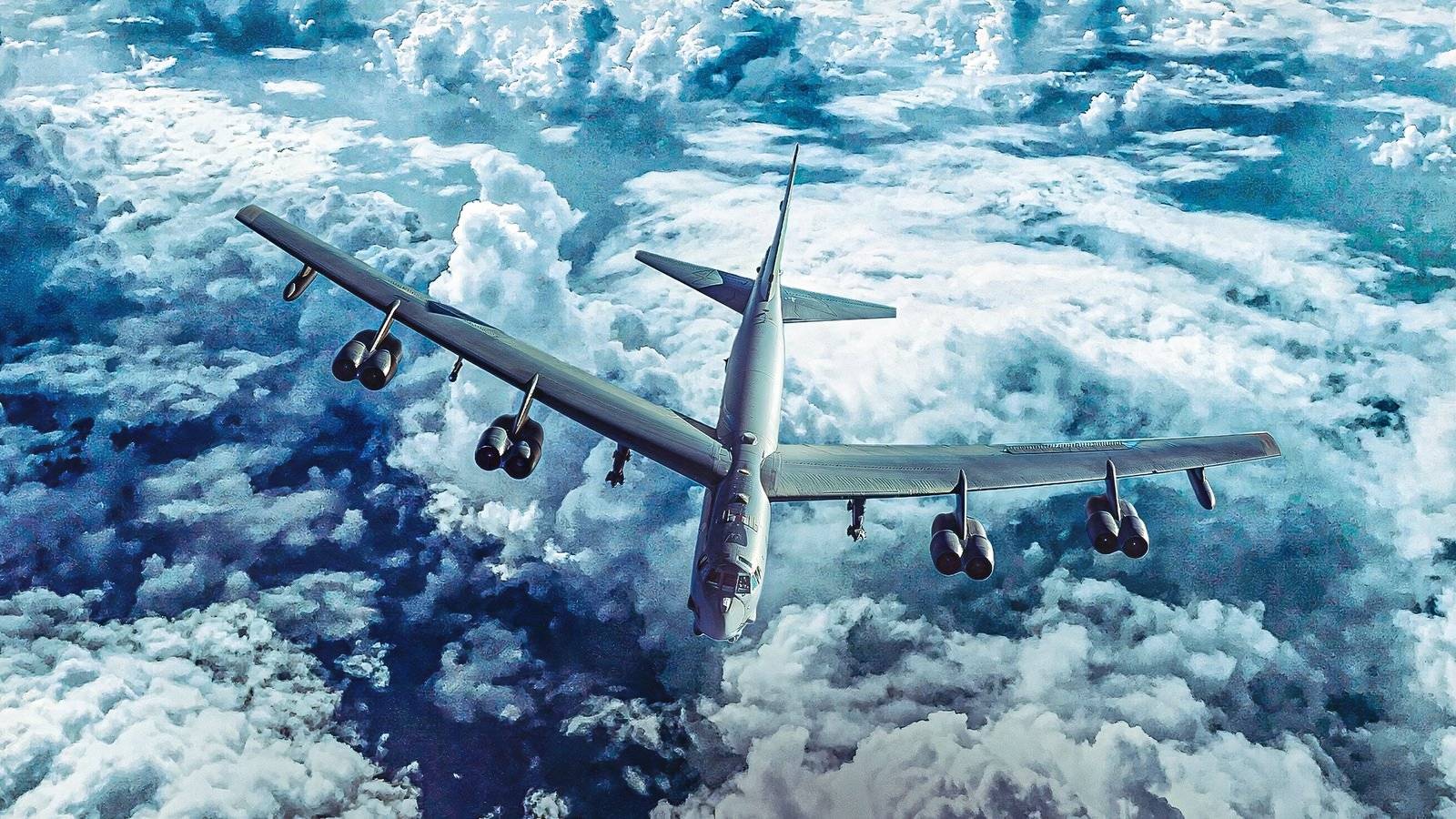
Featured Credit: Shutterstock | Simple Flying Published Sep 14, 2026, 8:01 PM EDT Chris earned a Master’s degree in Defense and Strategic Studies (Highest Honors) from the University of Texas at El Paso. His graduate work concentrated on Global and National Security, Low-Intensity Conflict, Modern Warfare, and US grand strategy. He also undertook extensive regional studies, analyzing how key regions integrate into the broader US security architecture. This rigorous program provided him with a comprehensive understanding of U.S. military operations, global strategy, and weapons systems. Additionally, he gained a strong appreciation for great power competition.—an increasingly central force shaping international relations and conflict for the foreseeable future. Sign in to your Simple Flying account Some United States Air Force (USAF) bases have become inseparable from the aircraft that have operated from them, serving as homes to platforms that have remained in service for generations. These installations have supported aircraft through decades of technological advancement, changing missions, and shifting geopolitical circumstances, creating a unique connection between America’s airpower and the bases from which it operates. Although many of these aircraft entered service during very different eras, they continue to provide important capabilities to the USAF today. Their longevity is a testament not only to the platforms themselves, but also to the bases, personnel, and infrastructure that have supported their operations, modernization, training, and deployments over the decades. Fairchild Air Force Base (AFB) The KC-135 Stratotanker: A cornerstone of US global reach Credit: US National Archives Fairchild AFB is located in the eastern part of Washington State, 279 miles east of Seattle. The base owes its existence to the looming threat of war that preceded World War II (WWII). In an effort to draw military interest to the area, Spokane citizens raised approximately $125,000 (£92,600) in less than one week to purchase 1,400 acres (567 hectares) of land for the airfield. The land was promptly given to the War Department; the base was officially established in 1942 and was subsequently given its first name, the Spokane Army Depot. Fairchild was transferred to Air Mobility Command (AMC), and its assigned wing was redesignated the 92nd Air Refueling Wing (ARW). The 92nd is primarily composed of the 141st ARW and the 336th Training Group; the former supports the base's Boeing KC-135 Stratotankers, of which the wing maintains and flies 68 KC-135 R/Ts, with a combined value of $3.2 billion (£2.372 billion). With the initial production aircraft delivered to Castle AFB, California, in June 1957, the KC-135 has been a primary enabler of US global reach for nearly seventy years. It is capable of refueling aircraft needed to deliver personnel and supplies to an area of operations, as well as aircraft that provide close air support, destroy infrastructure, or provide ISR capabilities for a mission. Currently, the USAF's Stratotanker fleet—which consists of 396 airframes—is in the process of being phased out and replaced by the new Boeing KC-46 Pegasus. Laughlin Air Force Base The T-38 Talon, an aircraft that has been training USAF pilots for nearly 70 years Credit: US National Archives Much like Fairchild, Laughlin AFB in Texas, set its roots during WWII, and was named Laughlin Army Air Field on March 3, 1943, and is named after First Lieutenant Jack T. Laughlin, who lost his life two weeks after the Pearl Harbor attack. At the time of his death, he was flying a mission in his Boeing B-17 Flying Fortress over Java and was the war's first casualty from Del Rio; thus, the base was named in his honor. After the base closed following the war, it reopened in 1952 and was dedicated to training pilots on the Republic Aviation Corporation F-84 Thunderjet. The base also served as a launch point for reconnaissance aircraft with Strategic Air Command. Currently, Laughlin is home to the 47th Flying Training Wing, which, since September 1, 1972, has trained more than 15,000 pilots, both for the USAF and allied nations. The primary aircraft used to train aspiring pilots is the Northrop T-38 Talon, which first flew in 1959. Between 1961 and 1972 (when production ended), more than 1,100 Talons have been delivered to the air service. According to the USAF, after graduation, pilots who received training in the T-38 go on to fly its "...front-line fighter and bomber aircraft such as the F-15E Strike Eagle, F-15C Eagle, F-16 Fighting Falcon, B-1B Lancer, A-10 Thunderbolt and F-22 Raptor." This is a testament to the Talons' importance to the USAF. While the Talon has served exceptionally well, the USAF plans to replace it with the Boeing/Saab T-7A Redhawk. Following Milestone C approval in April 2026, the US Air Force awarded Boeing a $219 million (£160–£165 million) contract for the first 14 production T-7A Red Hawk trainers, along with associated spares, support equipment, and training. The entire Red Hawk program is expected to include the production of 351 aircraft, and the air bases slated to receive the T-7As are as follows: Joint Base San Antonio–Randolph (RDN), Texas; Laughlin AFB, Texas; Sheppard AFB, Texas; Columbus AFB, Mississippi; and Vance AFB, Oklahoma. Offutt Air Force Base The RC-135 has been a key provider of actionable intelligence since the Cold War Credit: US National Archives Originally established as Fort Crook in honor of Major General George Crook, the fort was a frontier outpost in Nebraska that initially hosted a few hundred soldiers. Today, the air base is home to 6,980 military personnel. The installation's airfield was renamed Offutt Field in 1924 in honor of First Lieutenant Jarvis J. Offutt, an Omaha native and World War I aviator killed in France. The entire installation adopted the Offutt name in 1946, before becoming Offutt Air Force Base in 1948 following the establishment of the US Air Force. The host unit at Offutt is the 55th Wing, the largest wing in Air Combat Command and the second-largest wing in the USAF. As an active, directly combat-capable wing, it executes all five of the air service's core missions: Air and Space Superiority, Intelligence, Surveillance, and Reconnaissance (ISR), Rapid Global Mobility, Global Strike, and Command and Control. The 55th comprises more than 7,800 personnel, organized into six groups and operating from six geographically unique locations worldwide. The USAF's entire fleet of 17 Boeing RC-135 Rivet Joint aircraft, operated by the 55th Wing, is permanently based at Offutt. However, the aircraft forward-deploy to locations around the world and have provided a constant presence in Southwest Asia since the early 1990s. The Rivet Joint fleet reached initial operating capability in January 1964 and has participated in nearly every war and brushfire from the Vietnam War through Operation Iraqi Freedom and, most recently, Operation Epic Fury. Beale Air Force Base The U-2 "Dragon Lady": A premier Cold War spy Credit: US National Archives Beale AFB, unlike most other bases operated by the USAF, was not named after an aviator. On the contrary, its namesake is Edward Fitzgerald Beale (1822-1893). He was a 19th-century pioneer, a Naval Academy graduate, served in the California militia, and led a successful experiment intended to replace Army mules with camels. Camp Beale opened in October 1942 as a training site for the 13th Armored and the 81st and 96th Infantry Divisions and was home to more than 60,000 soldiers. By 1948, the camp transferred from the Army to the Air Force. Over the years, the base has hosted tankers, bombers, training, and reconnaissance aircraft. In the latter category, the Lockheed U-2 Spy Plane joined the 9th Strategic Reconnaissance Wing at Beale on July 1, 1976. Housed alongside the SR-71 Blackbird, the facility had two of the world's most unique aircraft. Having begun its service life in 1956, the U-2 was designed from the outset to collect copious amounts of intelligence on America's communist adversaries. As such, it undertook extensive flights over the Soviet Union, China, Cuba, and Southeast Asia and has lived on to serve into the 21st century. The U-2 remains an active USAF reconnaissance aircraft, with the 9th Reconnaissance Wing continuing to operate the Dragon Lady from Beale. The USAF's published inventory of 33 aircraft, however, dates to September 2015 and included five two-seat TU-2S training aircraft and two ER-2 aircraft operated by NASA, meaning it should not be presented as a current fleet figure. Barksdale Air Force Base The B-52 Stratofortress is the longest-serving bomber in the US arsenal Credit: US National Archives The dedication of Barksdale Field occurred on February 2, 1933, in honor of Second Lieutenant Eugene Hoy Barksdale, a notable pilot within the Army Air Corps. Lt. Barksdale departed the US for England in September 1917, where he received flight training with the Royal Flying Corps, and later became associated with the US Army's 25th Aero Squadron. In the fall of 1940, Barksdale was converted into an Air Corps flying school. It would become the site where many replacement crews and entire units were trained before deploying to take part in combat operations during WWII. When the Air Force became an independent service in 1947, Barksdale Field was renamed Barksdale Air Force Base in 1948. Just ten years later, Boeing B-52 Stratofortresses began arriving, with the first B-52 reaching Barksdale on August 14, 1958. A few years later, the base became home to its current host wing, the 2nd Bomb Wing. When the B-52 took up residence at Barksdale in the late 1950s, the bomber was still new, since the USAF had ordered its first 13 B-52As in 1952, after which the service quickly moved into mass production. Incredibly, Air and Space Power Journal notes that “...from the XB-52 to the B-52H, 774 aircraft were approved, produced, and fielded in just over 10 years.” From production to combat, the Stratofortress would deploy from its home at Barksdale to Southeast Asia to support well-known operations such as Linebacker II, Arc Light, and Young Tiger during the Vietnam War. Following the war, B-52s from the base participated in Operation Just Cause, Desert Shield, Desert Storm, Enduring Freedom, and most recently, Operation Epic Fury. The air base has an active-duty population of 5,000 service members and will continue to be home to the Stratofortress, which will likely remain in service into the 2050s due to the fleet's ongoing modernization program. Under this program, Boeing has been awarded a $2 billion contract from the USAF to continue installing the new Rolls-Royce F130 commercial engines as part of the B-52 Commercial Engine Replacement Program. In addition to the new engines, the fleet will also receive a modern Active Electronically Scanned Array (AESA) radar system, developed by Raytheon Technologies, providing the Stratofortress fleet with updated all-weather navigation and targeting capabilities.
5 US Air Force Bases Still Flying Some Of The Service's Longest-Serving Aircraft Types
Full Article
Original Source
Read the full article at Simpleflying →KhanList aggregates and links to publicly available news content. We do not host full articles from third-party sources. Always verify important information with original sources.