
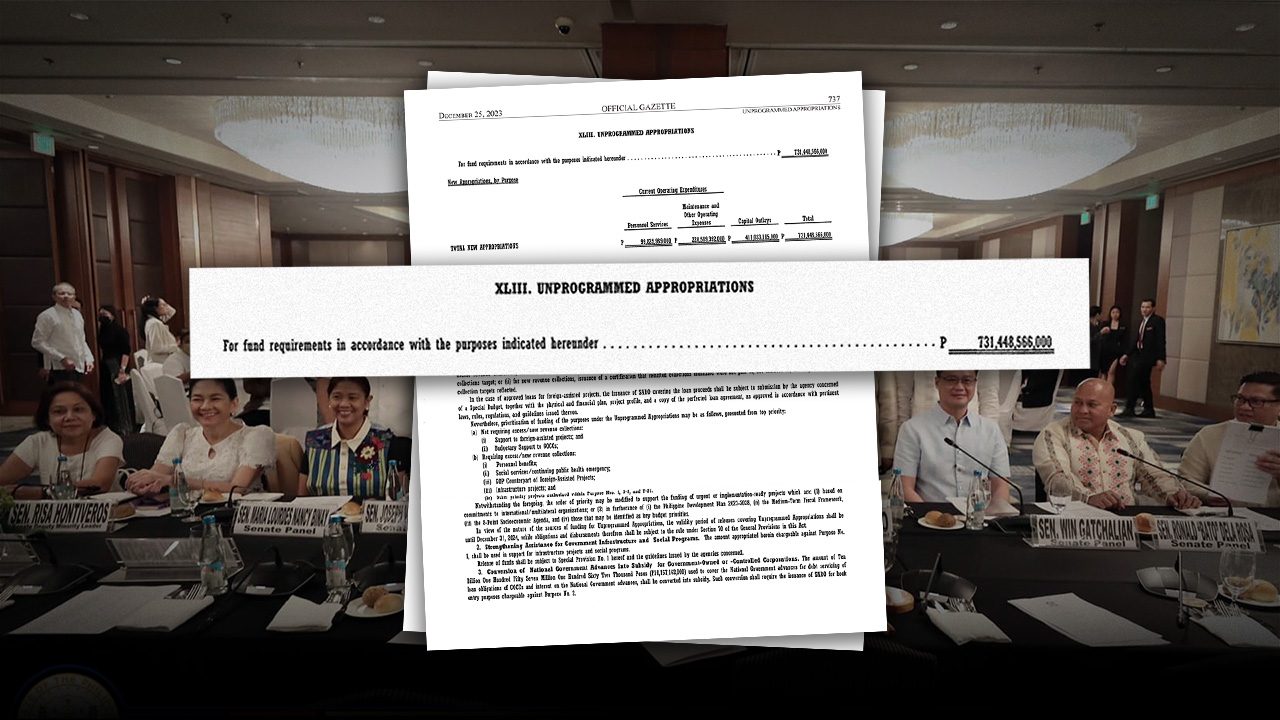
The Supreme Court ruling upholds unprogrammed appropriations but mandates stricter controls and transparency from Congress to prevent misuse. Unprogrammed appropriations can no longer be treated as a blank check for the executive, with the Court emphasizing that lump sums are unconstitutional. Congress is prohibited from increasing the president's proposed budget through unprogrammed appropriations, and future budgets will face stricter conditions for activating these funds. This is AI-generated. Read the article for full context. Report any errors. The Supreme Court decision that voided congressional increases in past national budgets, including in the highly controversial unprogrammed appropriations, vindicates watchdogs and critics who have repeatedly warned against government officials’ manipulation of the national spending plan. But what does the High Court ruling mean moving forward? Rappler breaks down the impact of the decision on our historically corruption-ridden budget process. 1. Unprogrammed appropriations are here to stay, but they will ideally be harder to abuse. The Supreme Court is clear in its press release: unprogrammed appropriations, in general, are not unconstitutional. UA provide flexibility for the president to “adequately respond” to unforeseen circumstances, such as foreign-assisted programs that are not yet approved when the budget plan is drafted, but likely to be approved in the coming fiscal year. The High Court, however, is insisting on providing safeguards to keep spending of the executive branch in check. This means that if UA will be used for more than one purpose, Congress must clearly lay out the prioritization order. The Supreme Court also called out the legislative branch for failing to be transparent during its bicameral committee deliberations. It said past budget bicams had no record of discussions and reports explaining adjustments in budget items. Its call for transparency in Congress will echo through the halls of the House and the Senate. In the wake of the ruling’s release, Senate President Pro Tempore Tito Sotto already promised livestreamed bicam deliberations for the proposed 2027 budget. 2. Unprogrammed appropriations should no longer be treated like a blank check by the executive. In past years, unprogrammed appropriations essentially became a blank check for the executive. The Supreme Court singled out the line item Strengthening Assistance for Government Infrastructure and Social Programs (SAGIP) that was lodged under UA; it had no breakdown in the signed General Appropriations Act. This gave the executive the power to identify beneficiaries even though the budget is already being enacted, and even though that is supposed to be Congress’ responsibility. The Supreme Court called the UA a “covert repository of lump sum allocations for DPWH [Department of Public Works and Highways] infrastructure,” paving the way for the flood control corruption scandal. Marcos himself signed off on the Department of Budget and Management’s UA releases for DPWH projects through Special Allotment Release Orders. These releases did not undergo public oversight, and insiders said executive officials and legislators negotiated privately to insert and move project items. In short, unprogrammed appropriations have become pork. Now, the Supreme Court is clear: there should be no lump sums in the UA. 3. Congress can no longer use UA to circumvent the constitutional rule that it cannot increase the president’s proposed national budget. Section 25(1) of the 1987 Constitution reads: “Congress may not increase the appropriations recommended by the President for the operation of the government as specified in the budget.” This means that if the executive asked for P4 trillion only, Congress can only give them P4 trillion or lower — not P5 trillion, not P4.5 trillion, not P4.1 trillion. Congress found a workaround, believing that the constitutional ceiling only applied to programmed, but not unprogrammed, appropriations. Take the 2024 budget for example. The executive sought P4.019 trillion in programmed funds, so Congress seemingly complied with that limit and approved that exact amount. The UA that year, however, ballooned from the original request of P281.9 billion to the approved P731.45 billion. The P449.5-billion jump, the Supreme Court ruled, is unconstitutional. Why did Congress spike the funding for UA? In the Supreme Court’s words, Congress created an “artificial fiscal space” in the programmed appropriations for financial aid programs — ayuda projects that budget watchdogs have criticized as lawmakers’ pork barrel — by shifting funds for projects that should have been programmed, such as the Metro Manila Subway and MRT-4, to unprogrammed appropriations. Additionally, the Supreme Court struck down Congress’ decision to increase the proposed programmed appropriations of the President by P17.99 billion, through the Special Road Fund, in the 2025 budget. Congress can no longer do that in future budgets, because the Supreme Court said the constitutional ceiling “applies to the total appropriations, both programmed and unprogrammed.” 4. The use of unprogrammed appropriations in the 2026 budget has just become tougher. The current budget in effect is the 2026 General Appropriations Act. It’s also not spared from the Supreme Court ruling. The High Court struck down two conditions that Congress had set in activating unprogrammed appropriations. For example, just because the Bureau of the Treasury collected more than its target from a particular non-tax revenue source does not automatically mean the government can release unprogrammed funds. The government’s total revenue collections must exceed the overall target set in the budget. It is unclear whether that threshold has been met. Aside from that, unprogrammed funds in the 2026 budget can be used only when loans for foreign-assisted projects are approved. 5. No, the ruling won’t automatically invalidate past spending under the 2024 and 2025 budgets, but it also won’t shield budget actors from liability. Now that congressional increases for the 2024 and 2025 GAA have been declared unconstitutional, what happens to the money that had already been spent? The Supreme Court said the doctrine of operative fact applies. This means completed programs whose beneficiaries acted in good faith won’t be undone. “The Court acknowledges that the unprogrammed appropriations under the 2024 GAA…have already funded numerous government programs and projects with far-reaching effects. The Court is mindful that Filipinos have already benefited from these laws and that the difficulties that would be borne by the public far outweigh a rigid insistence on their legal nullity,” the ruling read. However, the doctrine does not provide immunity from criminal, civil, or administrative liability to budget authors, proponents, or implementors. The SC, in the landmark decision, either partially or fully ruled in favor of four group of petitioners. The petition of the late congressman Edcel Lagman listed as respondents then-Senate president Juan Miguel Zubiri, then-speaker Martin Romualdez, then-budget chairpersons Sonny Angara and Zaldy Co, then-executive secretary Lucas Bersamin, then-DBM chief Amenah Pangandaman, and then-treasurer Rosalia de Leon. The petition of former senator Koko Pimentel and former congressman Pantaleon Alvarez listed Bersamin and Pangandaman as respondents. The petition of Filipinos for Peace, Justice, and Progress Movement, Inc. listed Romualdez, then-Senate president Tito Sotto, Bersamin, and the DBM as respondents. The petition of House lawmakers Edgar Erice and Leila de Lima listed then-Senate president Tito Sotto, House Speaker Bojie Dy, Executive Secretary Ralph Recto, and then-DBM secretary Rolando Toledo as respondents. Holding the people behind the unconstitutional budget provisions is an uphill battle though, constitutional lawyer Dan Gatmaytan said in the podcast of former finance undersecretary Cielo Magno. “I cannot imagine what criminal case you would file in this situation. This is not technical malversation,” Gatmaytan explained. “Technical malversation occurs when you use money appropriated for one purpose for something else. That is not what happened here. They are still in the process of appropriating the funds.” “Does it extend to the President? Still no, because of immunity,” Gatmaytan added. – Rappler.com
5 practical effects of SC ruling on unprogrammed appropriations
Full Article
Original Source
Read the full article at Rappler →KhanList aggregates and links to publicly available news content. We do not host full articles from third-party sources. Always verify important information with original sources.