
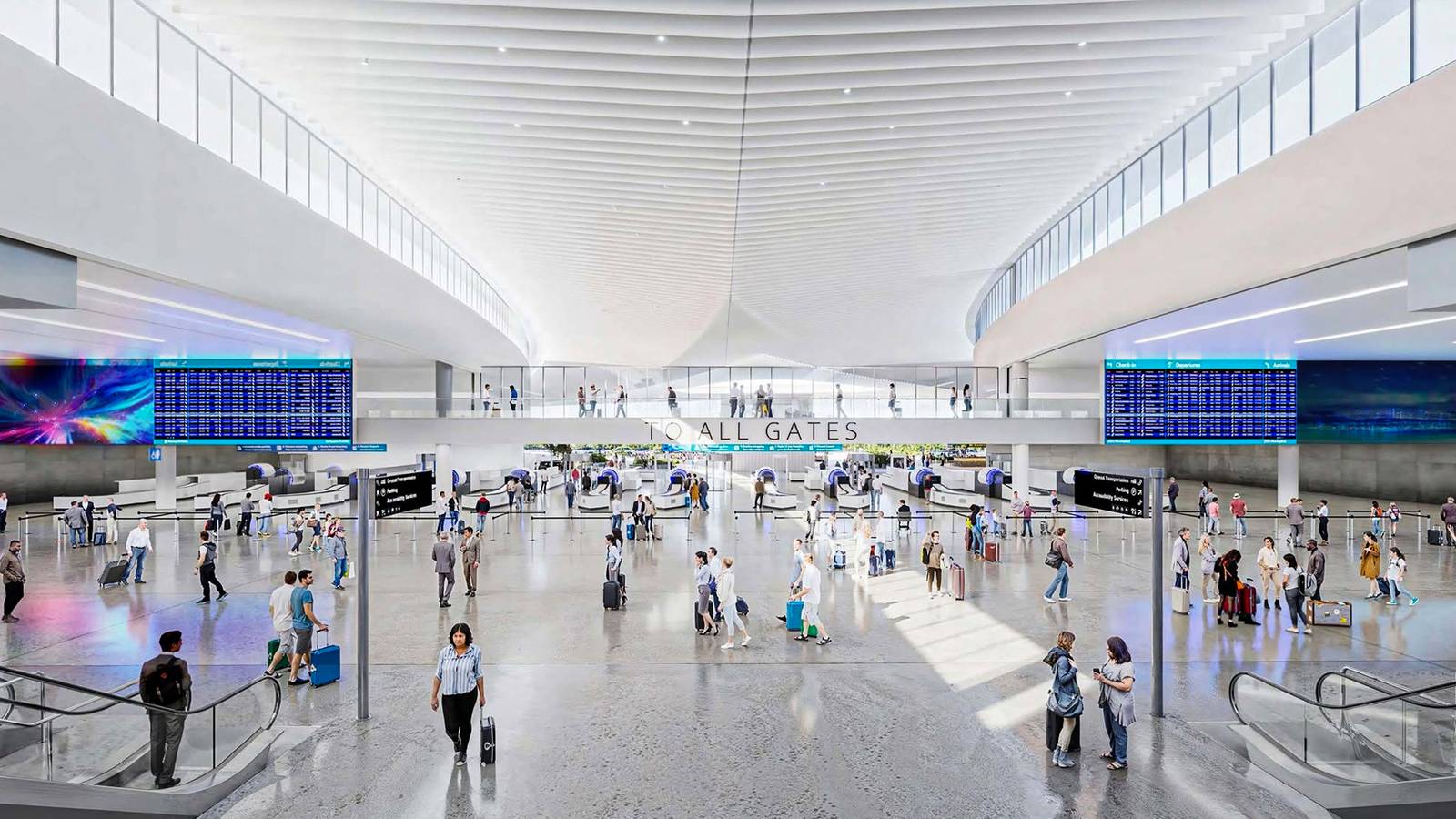
Credit: John Glenn Columbus International Airport, Simple Flying Published Nov 27, 2026, 9:00 PM EST Brandon's passion for aviation started at a young age. He became involved in the flight simulator and VATSIM communities, which sparked his interest in aviation and eventually led him to earn his private pilot license. Outside of work, he continues to build flight hours, explore new airports, and stay involved in the aviation community. Sign in to your Simple Flying account Billion-dollar terminal programs at Chicago, Los Angeles, and New York tend to dominate airport construction headlines, but some of the most practical upgrades in the country are happening one tier down. Medium-sized airports that grew quickly over the last decade are now dealing with the same problem: too few gates for the flights airlines want to add, and terminals split into separate wings that each need their own security checkpoint. For passengers, that layout often means picking the right checkpoint before knowing which gate is free, and for airlines, it limits where new service can go. The five projects below take different routes to the same goal. Some add gates, others knock down the walls between concourses so a single checkpoint can feed every gate, and a few do both. Each has also hit a visible milestone in 2026, whether that is new gates opening to passengers, a finished concourse, a design contract, or steel rising on a replacement terminal, even though most of the work will not wrap up until 2028 or 2029. Eppley Airfield New gates open ahead of a single checkpoint Credit: Eppley Airfield Eppley Airfield (OMA) in Omaha is the furthest along of the projects on this list. In November 2026, passengers got their first look at the $950 million Build OMA Terminal Modernization Program, which the Omaha Airport Authority approved to nearly double the terminal's size. According to Travel Weekly, the building will grow from 375,000 square feet (34,839 square meters) to 646,000 square feet (60,015 square meters), and the expansion adds two gates for international flights along with a customs hall. Holder Construction is managing the work, which broke ground in February 2024 on a terminal that had not been modernized since the 1980s. Four new gates, numbered A1, A1A, A1B and A2, opened on November 4, 2026. Airways Magazine reported that Delta Air Lines was using the new space in place of its previous south concourse gates, with passengers reaching the area through the existing south terminal and its current checkpoint, an arrangement that will only last until the rest of the building opens. Once finished, the unified concourse will connect the terminal areas that are separated today, and every departing passenger will clear a centralized TSA checkpoint in a new central pavilion that also houses a food court and shops. The timeline beyond that is already set. Airways reports that the central pavilion and more of the concourse should open in early 2027, followed by new baggage and ticketing systems in mid-2027, and WOWT reported that the full program remains on time and on budget for completion in 2028. Steady demand is driving the work. Federal Aviation Administration (FAA) data shows Eppley enplaned 2,565,135 passengers in 2025, a 0.70% dip from the prior year, but the airport still set a monthly record of 530,157 passengers in June 2026, according to WOWT. Construction stood at 60% complete in September 2026. Spokane International Airport From concourse C to a $335 million central hall Credit: Spokane International Airport Spokane International Airport (GEG) technically sits in the FAA’s small hub category, with 2,106,307 enplanements in 2025, but it is the second-busiest airport in Washington and runs a terminal program on a medium-hub scale. Its Terminal Renovation and Expansion program, known as TREX, began with a $150 million expansion of Concourse C. The first part, Concourse C West, opened in May 2024 with three new gates and six new ticket counters. The second part, Concourse C East, replaced ground boarding with three new passenger boarding bridges at gates C1 through C3, and the airport announced the full Concourse C project complete on May 26, 2026. That finished concourse sets up the larger second phase. Today, Spokane operates two siloed terminals, so passengers screen separately for the A and B concourses or for Concourse C. The new Central Hall will consolidate security screening for all airlines into one checkpoint and add a post-security hall connecting all three concourses. As the Spokesman-Review reports, the building will place baggage claim on the ground floor and security screening on the second. Utility relocation along the front curb began in May 2026 to clear the site. The scope has grown considerably since planning began, both in floor area and in cost. A January 2023 filing with Washington’s Department of Enterprise Services described a 145,000-square-foot (13,471 square meters) Central Hall with an estimated maximum price of $152 million. The Journal of Business now puts the project at 255,000 square feet (23,690 square meters) and an estimated $335 million. Simple Flying has detailed how the hall will end repeat screening by 2030. Growth explains the larger footprint, since by then the airport expects roughly 6.2 million annual passengers, according to the Daily Journal of Commerce. John Glenn Columbus International Airport Three checkpoints become one Credit: John Glenn Columbus International Airport The largest project here belongs to John Glenn Columbus International Airport (CMH). The CMH Next program is a roughly $2 billion replacement terminal, and WHIO noted it is the most expensive public works project ever undertaken in Franklin County. Columbus also leads this group in traffic by a wide margin, with 4,396,625 enplanements in 2025 according to the FAA, and the Columbus Regional Airport Authority reported nearly 9.4 million passengers across its airports that year. The existing terminal opened in 1958 and will be demolished once the new building is ready. Unlike Omaha and Spokane, Columbus is not stitching older buildings together. Spectrum News reported that the approved plan includes a 36-gate terminal and a central marketplace with just one security checkpoint, replacing the three checkpoints the airport operates today. According to Construction Equipment Guide, those 36 gates are seven more than CMH currently uses, and two will handle international flights with on-site customs facilities. Gensler designed the building, which comes in at just over 1 million square feet (92,903 square meters) and adds 40% to 60% more waiting area at the gates, according to Archinect. Progress in 2026 is mostly structural, with crews now working vertically on the terminal itself. Construction began in December 2024, focused first on a new elevated roadway, and the first steel beam for the building went up on August 8, 2025. Construction Equipment Guide reported in October 2026 that the authority now expects completion in January 2029. That date is deliberate, since Axios notes that the opening is timed to coincide with the airport’s 100th anniversary. Once the move happens, the old terminal site will become additional overnight parking for aircraft, letting airlines position more planes for early morning departures. Richmond International Airport A new medium hub merges its security screening Credit: Richmond International Airport Richmond International Airport (RIC) is the newest medium hub on this list. The airport was classified as a small hub based on 2024 data, but FAA figures for 2025 list it as a medium hub after it enplaned 2,481,863 passengers, a 1.04% increase. That growth has put pressure on a terminal where passengers heading to the A and B concourses use two separate TSA checkpoints. The Capital Region Airport Commission, which runs the airport, describes the planned Consolidated Security Screening Checkpoint as among the most transformative projects in RIC’s history. According to AviationPros, the project is estimated at about $253.1 million. It includes about 103,000 square feet (9,569 square meters) of new construction, renovation of 84,000 square feet (7,804 square meters) of existing space on the first and second floors, and roughly 29,000 square feet (2,694 square meters) of mezzanine. Richmond BizSense reports that the merged checkpoint will open with 10 screening lanes, with room to expand to 14, and that the work will also reshape the main atrium and add space for concessions beyond security. The 2026 milestones at Richmond have focused on securing funding and finalizing the design. In May, the FAA awarded Richmond a $5.8 million grant toward construction, and Senator Mark Warner’s office noted that the rest will come from a mix of federal, state, airport and passenger facility charge revenue, along with bonds. On October 27, the commission approved design contracts that put a team led by architecture firm Gresham Smith officially in charge of the checkpoint, according to Richmond BizSense. Airport officials plan to build in phases to limit disruption, though travelers may see checkpoint locations shift during construction. A firm opening date has not yet been published. Boise Airport Up to 10 gates in a new concourse A Credit: JW_PNW | Shutterstock Boise Airport (BOI) is the outlier on this list because its project focuses on gates rather than checkpoints. Traffic has quickly outgrown the current terminal. According to Engineering News-Record, passenger traffic has climbed 81% over the past decade, and FAA data shows 2,579,647 enplanements in 2025, up 4.21% from 2024. Boise was reclassified from a small hub to a medium hub after that growth, which added federal requirements for passenger services and airline competition plans. The airport also shares its airfield with the Idaho Air National Guard at Gowen Field. In August 2025, the Boise City Council approved Hensel Phelps as construction manager and general contractor for the Concourse A and Terminal Improvements project. The city states that the contract carries a not-to-exceed amount of $700 million for work scheduled through 2029. Its centerpiece is Concourse A, which will add up to 10 new gates for future air service. The package also covers an expanded back-of-house baggage handling system, a new central utility plant, and two phases of improvements to passenger flow inside the existing terminal. No local tax money is involved. KIVI reported that the project will be paid for with airport revenue and passenger facility charges, not local tax dollars. The broader BOI Upgrade program began in 2019, but the project stalled during the pandemic and was later redesigned to handle more passengers. Concourse A remains in design with Fentress Architects and Jacobs, and the airport states that construction is set to begin in 2026. Boise does not plan a checkpoint merger as part of this contract, so its case shows that some mid-sized airports need more gates first, while others need to simplify how passengers reach the gates they already have.
5 Mid-Sized US Airport Projects Quietly Adding Gates & Merging Security Checkpoints In 2026
Full Article
Original Source
Read the full article at Simpleflying →KhanList aggregates and links to publicly available news content. We do not host full articles from third-party sources. Always verify important information with original sources.