
Published Oct 6, 2026, 4:00 AM EDT Airline and Airport Management Graduate, Student Commercial Pilot and Commercial Aviation Writer. Based in London & Nagoya An airport's operational capacity is heavily dependent on its number of active passenger boarding gates. Contact gates determine how many aircraft can embark or disembark travelers via jet bridges, so airports need to make sure they have enough to keep up with demand. For passengers, a high gate count directly impacts connection windows, flight delays, and tarmac holds during peak departure pushes. This ranking covers the top global aviation hubs strictly by active passenger boarding gates connected directly to terminal infrastructure. Remote parking stands requiring apron bus transport are excluded unless formally designated as primary gate facilities, since they don't require the same infrastructure as a gate typically would. From sprawling linear concourses to iconic horseshoe configurations, these five facilities are the best of the best for passenger contact capacity. 5 Los Angeles International Airport (LAX) 161 gates: The West Coast's premier hub for transpacific routes, split across nine different terminals Los Angeles International Airport(LAX) operates 161 active boarding gates distributed across nine distinct passenger terminals, as per SlashGear. Situated on 3,500 acres (1,416 hectares) along the Southern California coastline, the facility banks on its central U-shaped footprint to process tens of millions of travelers each year across four parallel runways. As the West Coast's premier gateway, LAX is a crucial part of transpacific operations, and the airport is home to a wide variety of airlines from both sides of the Pacific. Hemmed in by dense urban neighborhoods and the Pacific Ocean, LAX expands inward rather than outward. The massive West Gates at Tom Bradley International Terminal added 15 contact gates reachable via an underground tunnel, as per Los Angeles World Airports. Post-security walkway connectors now link every terminal, giving passengers seamless airside transfers without reclearing screening checkpoints. Unlike single-carrier fortress hubs, LAX functions under a unique competitive environment where four major domestic airlines maintain substantial operations. American Airlines, Delta Air Lines, United Airlines, and Alaska Airlines each hold terminal presences, requiring high gate turn rates and precise ground handling coordination throughout peak international departure banks. 4 Dallas/Fort Worth International Airport (DFW) 168 gates: Semi-circular terminal modules and high-speed transit with rapid passenger transfers across five concourses Sprawling across 17,183 acres (6,954 hectares) between Dallas and Fort Worth, DFW operates 168 active passenger boarding gates across five distinct semicircular terminal buildings labeled A through E, according to NerdWallet. Designed in the early 1970s around a central highway corridor, the airport's original blueprint prioritized vehicular convenience, which allowed travelers to park steps away from their departure gate. As the main mega-hub for American Airlines, DFW processes thousands of connecting travelers every hour across tight departure schedule banks. To maintain rapid connections across all 168 contact points, the bidirectional Skylink automated train system operates along the roof of each concourse, transporting passengers between any two gates within 12 minutes while remaining inside the secure airside zone. To expand capacity without disrupting airfield traffic, DFW utilized modular construction techniques to deliver new contact gates, including the four-gate High-C expansion assembled offsite and transported into position, as detailed in updates from the airport authority. Complemented by peripheral end-around taxiways that prevent runway crossings, aircraft can move smoothly to and from terminal gates during peak operational hours. 3 Denver International Airport (DEN) 172 gates: A linear parallel concourse spine built for high-altitude wide-body capacity and plenty of airside expansion Spanning 33,531 acres (13,570 hectares) across the Colorado plains, Denver International Airport(DEN) operates a linear midfield concourse layout engineered for high-volume aircraft processing. Official facility data lists 172 active passenger boarding gates distributed across Concourses A, B, and C. Designed around a single main terminal concept, the airport houses all check-in facilities within the iconic tented Jeppesen Terminal, routing travelers to parallel concourses via a subterranean automated train system. Opened in the mid-1990s, the facility is undergoing a $1.3 billion renovation, with the final phase set to be completed in 2027, as detailed in Simple Flying coverage. Operating at a high elevation of 5,434 feet (1,656 meters) creates a unique environmental challenge for airlines, particularly during hot summer months when reduced air density means aircraft need to use longer ground rolls. To support heavy passenger loads and rapid turnarounds, DEN's three parallel concourses offer wide taxiway spacing and high-capacity gate holdrooms. As per PCL Construction, Concourse B stands as the largest single terminal building in the complex, featuring more than 70 contact gates dedicated to United Airlines' massive hub operations. Concourse C functions primarily as a high-frequency base for Southwest Airlines, while Concourse A accommodates international arrivals and regional carriers. To accommodate historic passenger growth, a major multi-year Concourse Expansion Program recently added 39 brand-new contact gates across all three concourses. These additions introduced double jetway positions for wide-body international aircraft, alongside elevated outdoor passenger decks. Thanks to the site's expansive master plan, DEN avoids the layout limitations seen at older urban airports. Air traffic controllers can easily taxi aircraft around terminal piers, giving the airport authority clear room to construct up to four additional concourses in future decades. 2 Hartsfield-Jackson Atlanta International Airport (ATL) 192 gates: The subterranean transit spine and seven parallel concourses built for relentless mega-hub connecting traffic Hartsfield-Jackson Atlanta International Airport(ATL) operates 192 active passenger boarding gates aligned along an efficient subterranean transit spine, as reported by The Daily Express. Covering 4,700 acres (1,902 ha) south of downtown Atlanta, Georgia, the airport processes more annual passenger traffic than almost any other commercial aviation facility on earth. According to official facility data published by the City of Atlanta Department of Aviation, these gates are distributed across seven parallel midfield concourses labeled T, A, B, C, D, E, and F, held together by domestic and international terminal buildings at opposite ends of the airfield complex. The airport's signature parallel layout was engineered specifically to streamline high-density airline connecting flows. An underground transportation corridor housing the automated Plane Train connects all seven concourses, moving passenger trains along a three-mile (4.8 kilometer) loop every two minutes. The subterranean transit system lets travelers traverse the entire 192-gate complex in 15 minutes, which is especially useful for airport leader Delta Air Lines, which orchestrates hundreds of tightly timed flight arrivals and departures throughout the day. Managing 192 contact gates within a compact airfield area requires precise ramp control and rapid aircraft turnaround routines. As covered in Simple Flying analysis, Delta Air Lines occupies the vast majority of gates across Concourses A, B, C, and T, while Concourse E and Concourse F handle international departures, which need dedicated dual jetway wide-body positions. To keep taxiway movement smooth around each pier, air traffic controllers use five parallel runways with dual end-around taxiways, so landing aircraft can reach their assigned gates without delaying departing flights. 1 Chicago O'Hare International Airport (ORD) 199 gates: Dual mega-carrier hubs and four terminal complexes form the world's dense contact gate leader Chicago O'Hare International Airport(ORD) holds the top ranking globally with 199 active passenger boarding contact gates. According to official facility data published by the Chicago Department of Aviation, these contact gates are distributed across four active terminal buildings labeled Terminals 1, 2, 3, and 5. Covering over 7,200 acres (2,913 ha) on Chicago's northwest side, O'Hare is made up of a combination of older finger piers and linear concourses to maintain high daily flight volume for its two major hub carriers. The airport's gate layout reflects its unique position as a major dual-carrier fortress hub. United Airlines makes use of 91 gates across Terminal 1 and Terminal 2, utilizing the famous subterranean light tunnel between Concourses B and C to shuttle connecting passengers, as per Simple Flying reporting. American Airlines operates its second-largest domestic hub out of Terminal 3, occupying 66 gates across four distinct concourses. Meanwhile, Terminal 5 serves as the airport's dedicated international gateway, with 30 gates along Concourse M to handle wide-body arrivals and foreign flag carriers. To prepare for future air travel demands, O'Hare is undertaking a multi-billion dollar capital transformation program. This major redevelopment plan includes replacing legacy Terminal 2 with a brand-new O'Hare Global Terminal, alongside satellite concourses that will add modern wide-body jetways. The plan is to continually expand contact gate capacity, so O'Hare can allow landing aircraft to park directly at jet bridges rather than waiting on taxiways or holding at remote aprons.
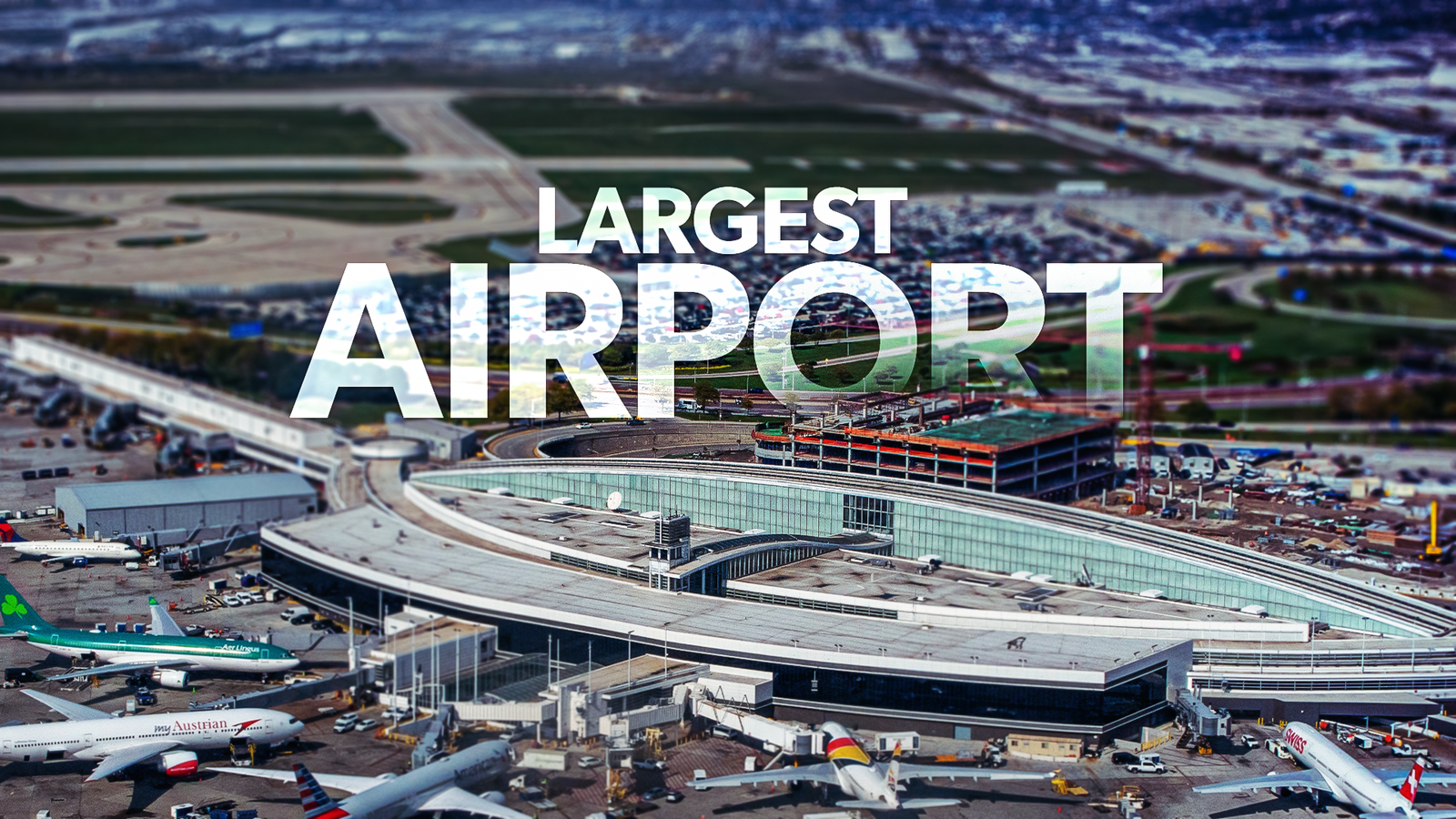
5 Largest Airports In The World By Number Of Gates
Full Article
Original Source
Read the full article at Simpleflying →KhanList aggregates and links to publicly available news content. We do not host full articles from third-party sources. Always verify important information with original sources.