
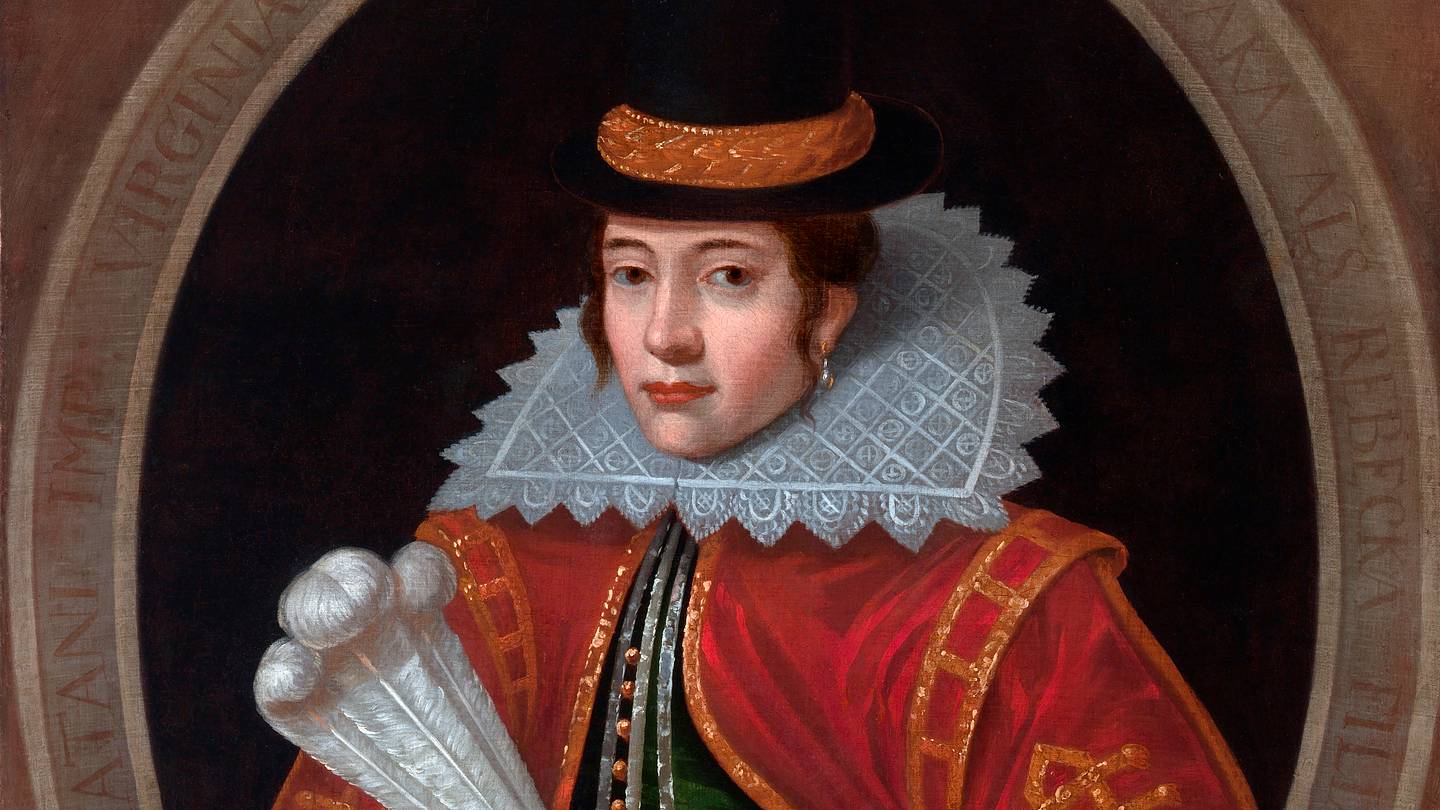
While she might not have lived happily ever after, Amonute, better known as Pocahontas, played a nonetheless indispensable, pivotal role in shaping early relations between Native Americans and English colonists. Her real name wasn’t actually PocahontasEngraving depicting the crowning of Powhatan as head of Algonquian tribes known as Confederacy of Powhatan in Eastern Virginia. | Bettmann/GettyImagesDaughter of Wahunsenacah, leader of the Powhatan Confederacy in Virginia’s Tidewater region, Pocahontas was given two names at birth: Amonute, her formal name, and Matoaka, her “sacred” birth name known only to her parents. “Pocahontas” was simply a nickname meaning “playful one,” given to her in childhood. Later, when she was captured and held for ransom by English colonists in 1613, she was “encouraged” by her captors to convert to Christianity and was given the name “Rebecca” following her baptism. She probably didn’t actually save John Smith’s life In late 1607, English explorer and colonist John Smith was captured by Wahunsenacah’s men while exploring the Chickahominy River. Smith later claimed that just before he was to be executed by his Powhatan captors, the chief’s young daughter, Pocahontas, threw herself atop Smith and begged her father to spare his life. Despite the dramatic episode later becoming a central tenet of Pocahontas’s historic legacy, experts have speculated the ordeal was either fabricated by Smith, or at the very least heavily embellished. Alongside the unlikelihood that the interference of a young girl could stop a Powhatan leader’s ordered execution, Smith himself never publicly recounted the ordeal until years later, by which time Pocahontas had already become internationally famous through her trip to England with her husband, John Rolfe, in 1616.She met her husband in captivity Pocahontas is baptized with the name Rebecca, in Jamestown, before her marriage to John Rolfe in 1614. | Hulton Archive/Getty ImagesDuring the First Anglo-Powhatan War, Pocahontas was captured and held for ransom by the Jamestown settlers. Throughout her near year of captivity, Pocahontas was held at Henricus, an English settlement in what is now Chesterfield County, Virginia, where she was taught English language and customs, baptised, and introduced to her future husband, tobacco farmer John Rolfe. Rolfe married Pocahontas on April 5, 1614, ushering in a new era of peace between the Native Americans and English settlers. Just a year after they wed, the couple welcomed their first and only child, Thomas Rolfe, in January 1615. Her grave has been effectively lost While returning home from a lengthy trip to England with her husband and son in 1617, Pocahontas grew gravely ill. Just about 21 years old at the time of her passing, Pocahontas’s exact cause of death remains a mystery, though many historians have speculated smallpox, pneumonia, or tuberculosis to be the cause. Shortly afterward, she was buried at St George’s Church in Gravesend, Kent. After the church was destroyed in a fire in the late 1720s, Pocahontas’s exact gravesite, thought to reside somewhere beneath the church, was lost. In the mid-20th century, a statue was erected in the churchyard to commemorate Pocahontas’s memory. After his mother’s death, Thomas Rolfe never saw his father again Pocahontas and her only child, Thomas Rolfe. | Culture Club/GettyImagesThomas, like his mother, had grown seriously ill on the journey back to Virginia. Fearing his young, ailing son could not survive the journey back to America, John Rolfe asked Sir Lewis Stukley, vice-admiral of Devon, to serve as his son’s guardian while he remained in England. Thomas was later raised by his father’s brother, Henry, but never reunited with his father, who passed away from an unknown illness in 1622, about five years after his wife. Read More:
5 Facts You Might Not Know About the Real Pocahontas
Full Article
Original Source
Read the full article at Mentalfloss →KhanList aggregates and links to publicly available news content. We do not host full articles from third-party sources. Always verify important information with original sources.