
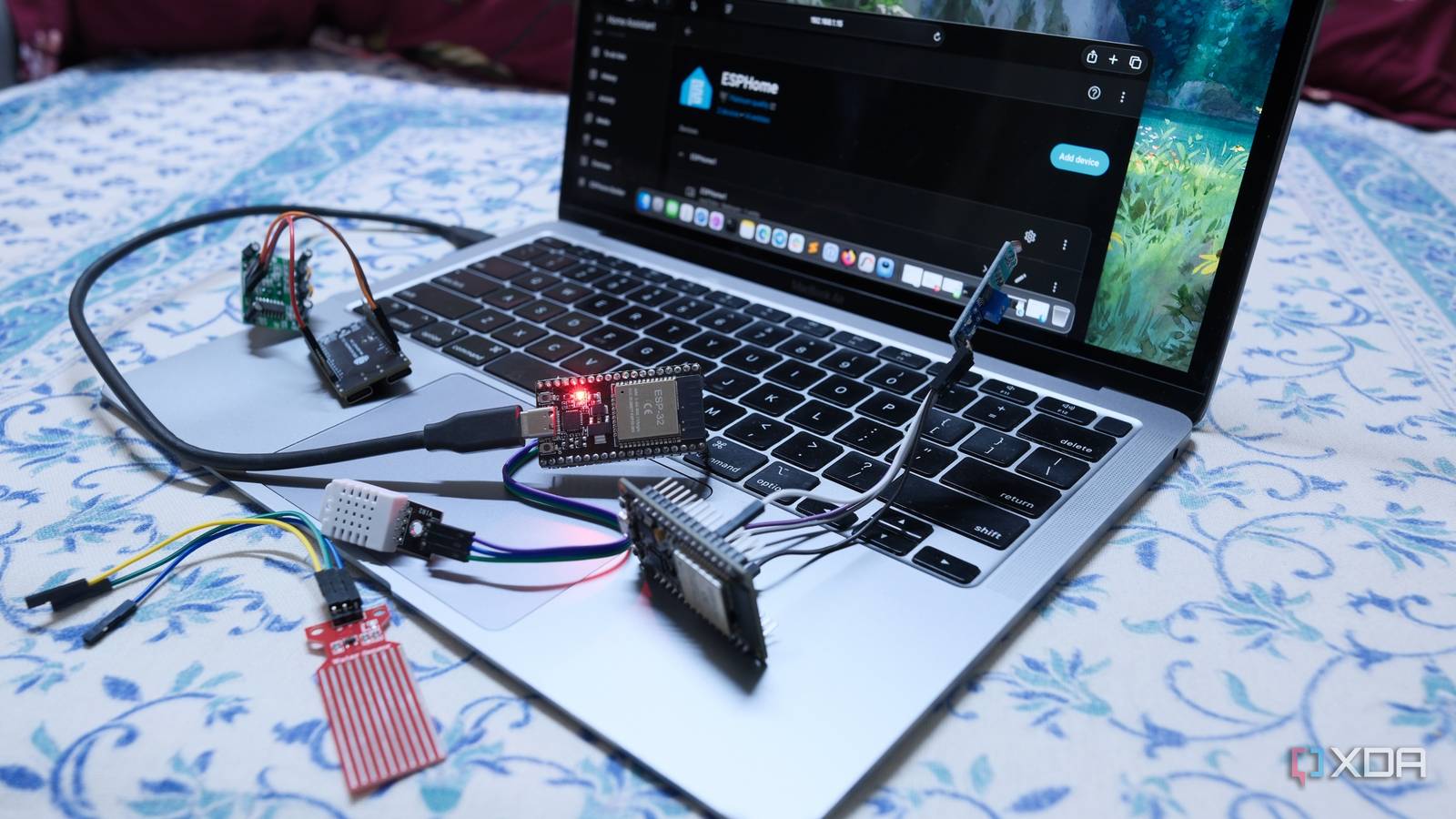
Published Oct 1, 2026, 11:00 AM EDT Samir Makwana is a technology journalist and editor from India since past 18 years and his work appears on MakeUseOf, HowToGeek, GSMArena, BGR, GuidingTech, The Inquisitr, TechInAsia, TechWiser, and others. He has written news, features, and gadget reviews for national technology media publications. His passion is to help people with their technology problems and gadget purchases. For that, he has worked for some of the biggest international technology publications, covering news, explainers, how-to guides, listicles, and product-buying guides. He has worked as an editor and managed teams since 2015. His expertise broadly covers computers, smartphones, game consoles, headphones, smart home products, browsers, and apps. Last year, I started building ESP32 projects for my smart home, and the ones that stuck weren’t the cleverest; they were the ones that fixed something before the day was out. I expected these to eat up my entire weekend, but most were done in a few hours. Each build replaced something I’d been working around, ignoring, or just living with. My doorbell finally tells me which door someone’s at An ESP32-C6 with a knock sensor goes behind each door frame My home has two entry points and one dumb doorbell chime covering both, which in hindsight was always going to cause problems. Every time it rang, I had to guess which one it was, and I often walked to the wrong door and took too long to open it. It stopped feeling minor when I had to attend to them several times a day. Swapping to two distinct chimes was the obvious fix, but that meant new hardware and actual wiring. Instead, I mounted an ESP32-C6 board with a piezoelectric knock sensor behind each door frame. The sensor picks up vibration whenever someone knocks or rings the bell. ESPHome pushes a notification to Home Assistant labeled with whichever door triggered it. Thankfully, I didn’t have to wire into the doorbell circuit at all. Plus, I don't need to create an account or pay monthly fees. The components cost me about $10, and I had it working before dinner. ESPHome Turn your ESP32, ESP8266, or RP2040 boards into powerful smart home devices with simple YAML configuration The garage door tells me whenever I leave it open A magnetic reed switch on an ESP32 helped fix that I haven’t added any smarts to the garage yet, and there’s no camera with a view of the door. As a result, the only option was to walk to the garage door to check whether it was left open, which I often did a couple of times. All I wanted was to know whether the door was open. For that, I used a magnetic reed switch with an ESP32 board. A few lines in the ESPHome config got the reed switch reporting door status to Home Assistant over Wi-Fi. I also set up a notification to fire if the garage door stays open for more than five minutes. Using the board I already had, I grabbed a reed switch for a few bucks and used a spare board. It took me less than two hours to install it at the garage door and get it running. My washing machine now tells me when the laundry is done A vibration sensor taped to the machine pings my phone when the cycle ends My washing machine isn’t smart, and I’ve lost count of how many times I’ve left laundry sitting in the drum long after the cycle finished. So I taped an ESP32 board with a vibration sensor to the back of the washing machine. Using ESPHome, I exposed it as a binary sensor in Home Assistant. When the sensor stops detecting vibration for more than three minutes, a simple Home Assistant automation sends a notification. The buffer is intentional since the washers do go quiet between spin and fill phases. Without it, every quiet phase mid-cycle would trigger a false finish alert. The sensor cost me a few dollars, and it took me a couple of hours to adjust the delay timing. My smartwatch and headphones don’t go missing in my house Two Bluetooth proxies and Bermuda integration showed me their location I lost my smartwatch and Bluetooth headset inside the house more than I’d like to admit. I find them by wandering into rooms and spending minutes retracing my steps. It’s a minor annoyance that adds up. I flashed ESPHome’s Bluetooth proxy firmware onto two spare ESP32 boards, one for the living room and another for the bedroom. I also installed the Bermuda BLE Trilateration integration through HACS, which uses signal strength from each proxy to estimate which room a device is in. Each proxy listens to BLE advertisements from the devices and passes that data to Home Assistant. Bermuda then pins each device to the room its proxy is closest to, so I know exactly where to look. This build needed no extra hardware and was ready within an hour. My air purifier now runs on actual air quality data, not guesswork A PMS7003 sensor on ESP32 feeds real PM2.5 readings When I bought a Coway Airmega 150 air purifier, I overlooked its lack of smarts. I turned it on and off manually, only after I noticed my eyes were itchy or my room smelled stale. I wanted the purifier to respond to real data, not my delayed reaction. A Plantower PMS7003 sensor measuring PM1.0, PM2.5, and PM10 paired with an ESP32 felt like a good fit for a medium-sized room. The only catch is that the sensor runs on 5V and communicates over UART, so I paired it with an ESP32-S3, which handles both cleanly. It took an afternoon to wire up and tune the automation thresholds, but by the end, the purifier was responding to the room on its own. The afternoon rule keeps me honest about which builds actually matter The one thing all five builds share isn’t the microcontroller. It’s the constraint I put on myself before picking any of these projects. If I can’t fix something broken or annoying by the same evening, it’s solving a hypothetical problem. ESP32 boards are cheap, and ESPHome is approachable enough to make this bar achievable for most builds. The house is measurably less annoying than it was before I spent each afternoon on these builds. Home Assistant OS Windows, macOS, Linux iOS compatible Yes Android compatible Yes Home Assistant is the best way to connect your smart home systems together.
5 ESP32 builds that fixed something in my house the same afternoon I finished them
Full Article
Original Source
Read the full article at Xda-developers →KhanList aggregates and links to publicly available news content. We do not host full articles from third-party sources. Always verify important information with original sources.