
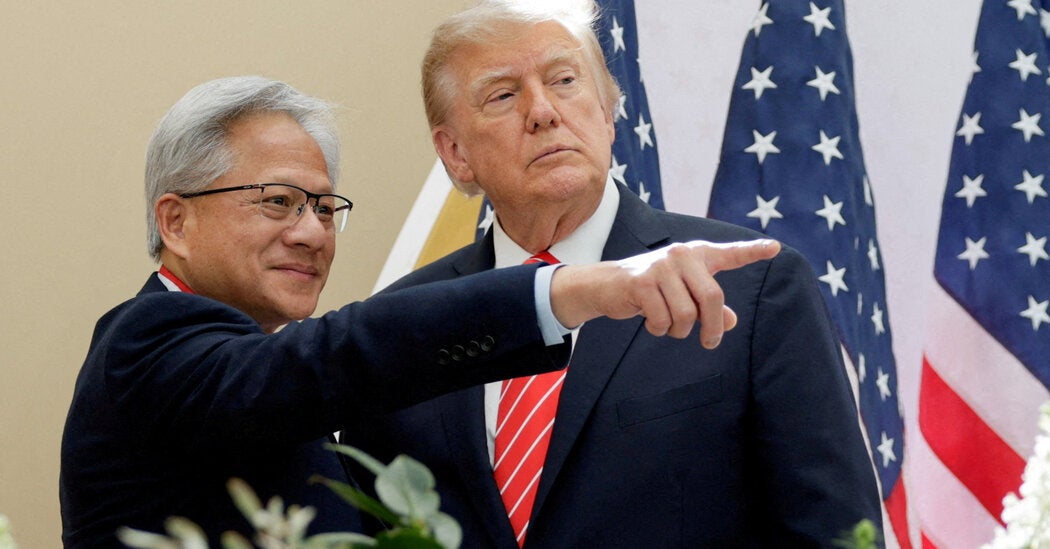
AdvertisementSKIP ADVERTISEMENTU.S.-Chinese business relations were thrown a curveball ahead of a major C.E.O. summit in Shenzhen, China, next week. On Thursday, Jensen Huang resigned as the chief executive of Nvidia after it was revealed that he had affairs with an executive at the company and a woman suspected of being a Chinese spy.One of the architects of the artificial intelligence boom, Huang was also perhaps the strongest proponent in Washington for U.S. companies selling A.I. hardware to China — an issue that has become central to the countries’ fraught economic relationship. Huang, who has a close relationship to President Trump, has also promoted open A.I. models, an approach favored by many Chinese firms.China hawks in Congress have already seized on the scandal, using it to push for three bills that would put more restrictions on technology exports to the country.Next week’s summit, which is hosted by the Asia-Pacific Economic Cooperation forum, has the potential to advance policy talks. Trump and the Chinese leader Xi Jinping (and perhaps President Vladimir Putin of Russia) are expected to meet. On the sidelines, Treasury Secretary Scott Bessent will take part in a bilateral dialogue on A.I.But observers have low expectations for big changes. “The Chinese would like to prolong this fragile stability for as long as they can,” Ryan Hass, a senior fellow at the Brookings Institution who advised President Barack Obama and White House officials on U.S. policy toward China, told DealBook.Still, amid a stalled trade war, expanding export controls, legal tussles and suspected spy games, the conversation may have just gotten a little more complicated. Here are the biggest questions looming about the world’s most important economic relationship.1. Does America clamp down further on the export of advanced chips?The U.S. has banned its most advanced A.I chips, like Nvidia’s Blackwell, from reaching China — though, given reports of chip smuggling operations in Singapore, Taiwan and elsewhere, perhaps to limited effect.In designing and manufacturing advanced semiconductors, China’s capabilities still lag those of the U.S. and Taiwan. Hawks want to keep it that way. But Trump has been less than resolute. In January, his administration allowed sales of Nvidia’s less powerful H200 to China, a move that is now being scrutinized by Congress in the wake of Huang’s resignation.On Capitol Hill, a handful of proposed pieces of legislation could severely restrict China’s access. “Given how vocal Congress has been on this topic, and given the fact that Congress is going to be more empowered post-midterms, it’s less likely we get a loosening of chip rules and more likely we get a tightening,” said Chris Miller, author of “Chip War: The Fight for the World’s Most Critical Technology.”On the other side of the chip coin are foreign data centers, which have largely escaped Washington’s attention. That may soon change, too. Lawmakers in Congress have been pushing for tighter limits on Chinese companies’ renting computing power abroad, whether from U.S.-owned data centers or facilities running American chips.This month, the U.S. firm Oracle canceled a roughly $7 billion contract that gave Tencent, a Chinese company, access to advanced A.I. chips in data centers in Southeast Asia, after U.S. officials raised concerns, according to The Financial Times. In 2027, U.S. cloud giants like Microsoft and Amazon could face similar scrutiny for hosting open-weight models from Chinese labs such as Moonshot and Z.ai, said Paul Triolo, partner at DGA-Albright Stonebridge Group, a global advisory firm.If the U.S. further restricts access to chips, China would probably retaliate by restricting access to rare earths and the powerful magnets made from them, which go into products as varied as electric vehicles and fighter jets. “We’re sort of on the brink here,” Triolo said. “If the Chinese escalate further on rare-earths export controls, we’re in uncharted territory.”2. Does China further barricade its tech economy?In Shenzhen, U.S. tech executives will probably press for more leniency for their companies in China. On the whole, observers said, they’re unlikely to get it. In May, Bloomberg reported that China had begun requiring senior A.I. researchers and executives at private firms like Alibaba and DeepSeek to get approval before traveling abroad, with some surrendering their passports. The authorities also barred the two Chinese founders of Manus, an A.I. start-up based in Singapore, from leaving China after the company was acquired by Meta, then ordered Meta to unwind the deal.This month, Chinese regulators blocked SoftBank’s $5.4 billion acquisition of a robotics firm on national security grounds. And China’s own export control list — which includes not just rare earths but also batteries and industrial machinery related to solar panels and tunnel boring — is lengthening.“In 2027, we should expect more of this,” said Rush Doshi, a political scientist at Georgetown University who oversaw China policy in the Biden administration. “Every two weeks, there’s new announcements from China. It’s all in the same direction.”3. Can America make progress on rare earths?China dominates the market for rare earths. In 2025, Beijing responded to U.S. tariffs and semiconductor controls with a series of sweeping export restrictions on these elements, which forced the Trump administration to back down.U.S. policymakers have since scrambled to erode that dependence. So far, more than $2.5 billion in federal loans and equity has flowed into American rare earth companies like MP Materials, which operates the country’s only producing rare earth mine, and USA Rare Earth, which is building a mine-to-magnet supply chain in Texas and Oklahoma. Washington is also striking mining deals abroad, in Australia, Brazil, Saudi Arabia and elsewhere. Still, experts said such efforts would take years to bear fruit.“Until new rare-earths processing facilities and permanent magnet manufacturing capabilities come online, it will continue to feature as a bargaining tool by the Chinese,” said Gracelin Baskaran, a director of the Critical Minerals Security Program at the Center for Strategic and International Studies.4. Does the trade war truce hold long term or disintegrate?In April 2025, after “Liberation Day” set off a tit-for-tat escalation with Beijing, tariffs on Chinese goods reached as high as 145 percent. A month later, after bilateral talks in Geneva, those fell to 30 percent. In October 2025, on the sidelines of an APEC summit in Busan, South Korea, Trump and Xi struck a truce. Washington agreed to lower the rate further while Beijing paused its rare-earth export controls and agreed to buy American agricultural products and Boeing jets.China, according to industry observers, has not followed through on its promises. This month, the White House voiced its displeasure with Beijing, a move officials might reiterate in Shenzhen. On Jan. 10, the Busan agreement is set to expire. Instead of extending it, the Trump administration may take new offensive measures, such as financial sanctions against Chinese companies.“The current U.S.-China détente could come apart,” Doshi said.In 2027, the trade war could resume in earnest. Would that mean decoupling continues? This year, American exports to China barely recovered from a 26 percent plunge in 2025, the steepest in recent history. Chinese exports to the U.S. were down about 11 percent through September, though they have been climbing since the spring, as China’s global trade surplus surpassed $1 trillion. Washington has also continued to restrict Chinese technology. Still, Bessent said this week that Washington’s intent is to “de-risk, not to decouple” with China.In September, the countries announced a 30-for-30 deal: China would lower barriers on $30 billion of U.S. exports, and the U.S. would lower barriers on $30 billion of Chinese imports. The sides have exchanged product lists, but the deal still awaits domestic legal confirmation.5. Does a black swan take flight?Some years ago, Xi ordered his military forces to be ready for a successful invasion of Taiwan by 2027. The Chinese leader will be 74 next year and presumably contemplating his legacy. With a new term likely beginning and a Trump presidency waning, will he give the order? Or will a conflict finally erupt over contested territories in the South China Sea? A great power war is the blackest of black swans.But there is also the potential for an A.I.-enabled cyberattack that wreaks havoc in either China or the U.S., Triolo said. Or the semiconductor market could implode in some way, Miller added. As Xi warned Communist Party cadres last month, “Be ready at all times to withstand the major tests of high winds, choppy waters and even stormy seas.”IN CASE YOU MISSED ITThe Jensen Huang scandal rocked Wall Street, Washington and Silicon Valley. The future of Nvidia’s prolific investing, which has helped fuel the A.I. boom at a delicate time for the industry, was thrown into uncertainty. And President Trump is facing scrutiny over what he knew about the allegations against Huang.Anthropic set a price range for its I.P.O. The range, of $70 to $78 a share, would make the company worth $1.26 trillion to $1.41 trillion. Nvidia’s partners have agreed to buy billions of dollars’ worth of stock at the final I.P.O. price. At the high end, the public offering, expected on Thursday, could raise as much as $100 billion. That would be a new record.Home sales fell to a record low. Sales of existing homes fell last month to a seasonally adjusted annual rate of 3.75 million, the lowest level since 2010 and a sign of consumer weakness. Mortgage rates slid for the fourth consecutive week but remained above 7 percent.More big deals: SpaceX plans to spend $74 billion on data centers in Texas and Arizona. Kalshi cut ties with Donald Trump Jr. And work in some offices ground to a halt after a global outage disrupted Microsoft services.Can you future-proof your kids? The first thing that Daniel Susskind wants you to know about his new book, “What Should My Children Do?,” is that his answers probably aren’t as specific as you would like them to be. “I think a really important starting point is to give up on the idea of future-proofing, that if only we think deeply and cleverly enough about the future, we’ll be able to predict exactly what jobs are going to have to be done, and then say exactly which advanced skills we ought to teach young people,” he said.Susskind, an economist and a professor of business at Gresham College in London, talked with Sarah Kessler about what we can do. The conversation has been condensed and edited.How should parents prepare their children for the future, if not with specific skills?I think one of the most important things we can do is get back to basics: literacy, numeracy and critical thinking.And I think we ought to be spending about a third of our time now in primary, secondary, university, professional, in work, teaching people to make effective use of these technologies.The big challenge is how you can do both, how you can encourage young people to use these technologies without at the same time undermining these basics.So how do you do both?We were here in the 1980s with the arrival of the electronic calculator, which provoked exactly the same sorts of worries. Why bother learning to do a difficult calculation if this powerful little computer in your pocket could do it for you?The approach was to say, we need to do both. We essentially took maths education in the U.K. and divided it in two, and said: “We’ve got to spend part of our time teaching young people to use this technology and solve problems that would have been unimaginable before. But we also need to spend parts of our time without it, making sure that arithmetic stays sharp.”And crucially, we need to test both at the end. I call this “teach both, test both.” And that’s what I think we need to do now across education.The calculator example kind of falls apart in the business world. There is a good deal of learning that happens on the job, and employers rely on that to build their employees into experts. But they’re not necessarily willing to make employees do work that a machine could do much faster. So what do you think is the best route there?Simulated learning environments are used really widely, but not really in the white-collar world.So Day 1 of a nuclear power plant manager’s job is not the first day that they’ve sat in front of those controls. They’ve learned how to keep a core stable in a simulated environment or perhaps in full-scale replicas. An astronaut, the first time they do a spacewalk is not the first time that they’ve done that. They practiced in neutral buoyancy labs.Do you think that employers would pay for that? If you’re doing grunt work, you’re still doing work that the company actually needs.The economics of it and the challenge to the sort of traditional model of a professional firm, I think that’s where the biggest question marks are at the moment.ImageCredit...Kylie Cooper/ReutersThanks for reading! We’ll see you tomorrow.We’d like your feedback. Please email thoughts and suggestions to dealbook@nytimes.com.Follow DealBook on Instagram: @nytdealbookRelated ContentAdvertisementSKIP ADVERTISEMENT
5 Big Questions as C.E.O.s Meet in China
Full Article
Original Source
Read the full article at Nytimes →KhanList aggregates and links to publicly available news content. We do not host full articles from third-party sources. Always verify important information with original sources.