
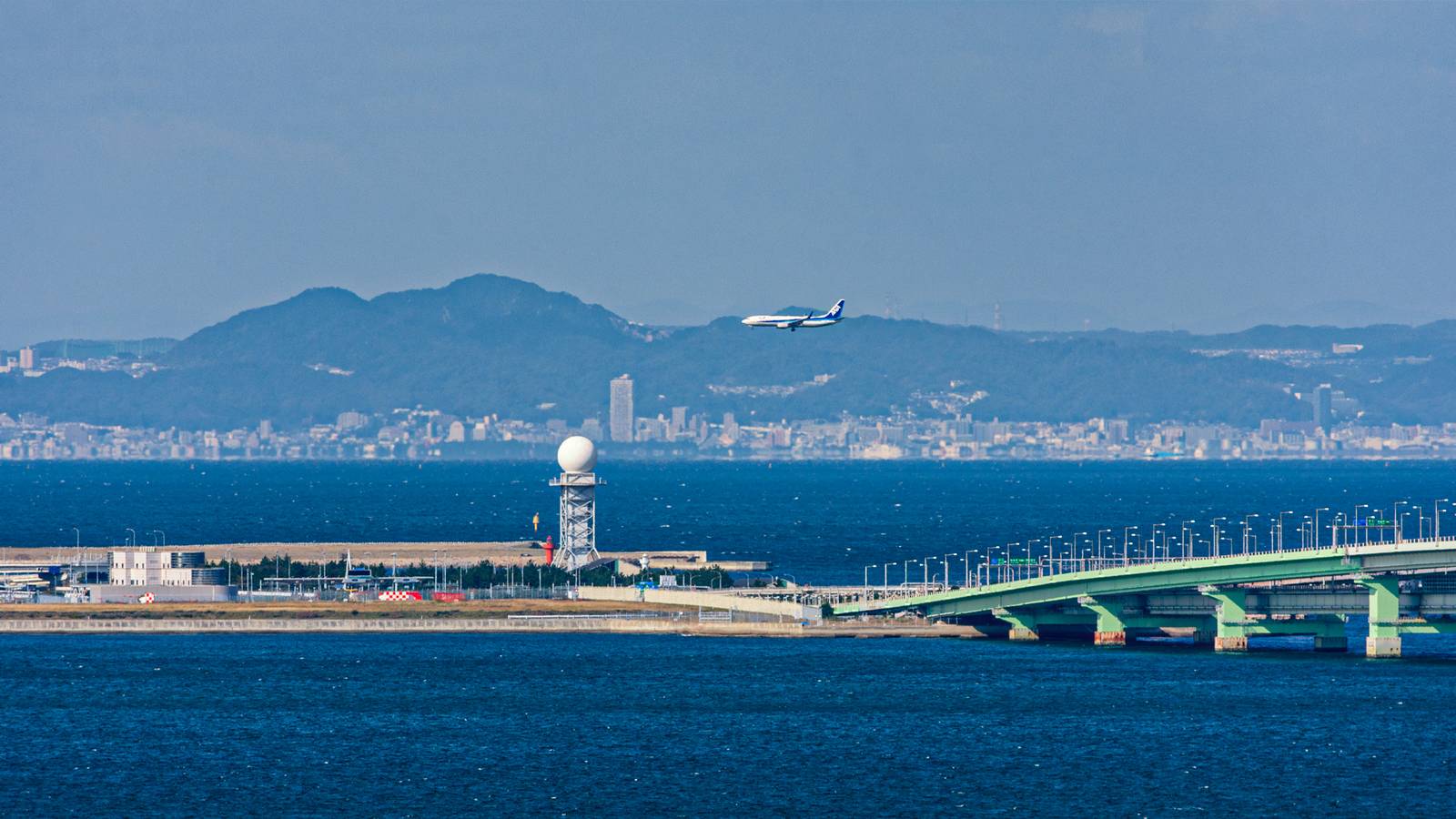
Only a handful of airports in the world have been built on artificial islands, but each of those unique airfields has become a major global hub today. All were built to satisfy overwhelming demand for air travel where there was simply no other option but to reclaim land from the sea. The incredible engineering behind each island aerodrome has not only allowed these unique airports to survive the test of time but to thrive. The very first airfield established on land reclaimed from the sea was opened in the mid-1990s in Japan. The history-making hub was soon followed by two more in China, and a fourth would later open in Japan, again. The newest entry on this list is a unique airstrip that serves one of Turkey's busiest metropolitan areas in a land with virtually zero level ground. This forced an ambitious mega-project that raised an international gateway on the coast of the Black Sea. Macau International Airport A 319-acre island built in 1995 Credit: Kit Leong | Shutterstock Macau International Airport (MFM), opened in 1995, represents a masterclass in hyper-efficient marine engineering. Macau's genius lay in its surgical land reclamation strategy. While Hong Kong opted to place its entire airport infrastructure onto a singular massive artificial island, Macau's engineers targeted only what they absolutely needed to place in the water: the runway. The passenger terminal and support facilities were constructed on Taipa Island. This structural split allowed the small space to secure a long runway without the immense capital requirement of a full offshore island. Only a narrow strip of reclaimed land wide enough to hold a single 11,024-foot (3,360-meter) runway and its immediate safety margins was reclaimed from the waters of the Pearl River Estuary. While Macau's split-island concept saved billions of dollars upfront, its restricted footprint eventually became an operational bottleneck. With no room for aircraft parking and limited flexibility during peak traffic hours, the Macau International Airport Company officially launched a massive 129-hectare (319-acre) expansion. The construction phase is scheduled to span from 2026 through 2028. When full reclamation wraps up in 2030, the airport's total usable layout will swell to 325 hectares. This targeted expansion will drastically increase the annual capacity from ten million to 13 million passengers. Kansai International Airport A 2,607-acre island built in 1994 Credit: tera.ken | Shutterstock Kansai International Airport (KIX), designed by renowned architect Renzo Piano and opened in 1994, stands as one of the most ambitious engineering projects of the 20th century. It was constructed entirely on a reclaimed artificial island within Osaka Bay to mitigate urban crowding at the city's legacy airport. The fundamental engineering challenge of KIX stems from the seabed geology of Osaka Bay. The immense structural weight of the facility continually compresses the soft seabed clay, forcing water out and lowering the surface level. Engineers drove nearly one million sand columns into the seabed to act as vertical escape routes for the trapped water, forcing the clay to collapse and solidify more quickly. While operators anticipated this settlement, a significant volume of the subsidence occurred unexpectedly before commercial operations commenced. When people hear that the island has dropped roughly 45 feet (13.66 meters) in total, they picture the airport actively plunging into the ocean. In reality, the vast majority of that drop happened during the initial construction phase. Since opening day, the airport structures themselves have dropped about 13 feet (3.84 meters). The dramatic sinking has slowed to a virtual crawl, with the island settling a mere two inches (five cm) over the course of 2024. On September 4, 2018, Typhoon Jebi inundated the primary runway and terminal building, while unmoored vessel impacts severed the singular mainland transit bridge. A fuel tanker unmoored by 110-mph winds crashed into the bridge connecting KIX to the mainland. This severed the airport's only road and rail link, trapping 8,000 passengers and staff on the artificial island. It required three weeks for all passenger flights to resume, challenging local officials' expectations and leaving the long-term efficacy of heightened seawalls against ongoing settling unresolved. Ordu Giresun Airport A 445-acre island built in 2015 Credit: Bogac Erkan | Shutterstock Ordu-Giresun Airport (OGU) was the third artificial island airport ever built, mirroring the ambition of Kansai but adapted for the unique topography of northern Turkey. It was constructed in the sea because Turkey’s Black Sea coast offered no flat ground among the dramatic Pontic Mountains. Engineers deposited approximately 35 million tons of rock into the water. To secure a stable footprint, trucks made roughly 950,000 trips to deposit between 30 and 36 million tons of heavy stone into the ocean bed. The island features a single, fully capable asphalt runway measuring 9,842 feet (3,000 meters long and 45 meters wide. Since the island is built primarily of heavily compacted rock fill directly resting on a firmer coastal shelf, the operator reports zero structural settlement issues. Statistic Kansai International Airport Macau International Airport Hong Kong International Airport Chūbu Centrair Airport Ordu Giresun Airport Opening Date September 4, 1994 November 9, 1995 July 6, 1998 February 17, 2005 May 22, 2015 Longest Runway 13,123 feet (4,000 m) 11,024 feet (3,360 m) 12,467 feet (3,800 m) 11,483 feet (3,500 m) 9,843 feet (3,000 m) Artificial Land Area 4.07 square miles (10.55 sq km) 0.76 square miles (1.96 sq km) 4.82 square miles (12.48 sq km) 1.81 square miles (4.70 sq km) 0.70 square miles (1.80 sq km) Annual Passengers ~33.5 million ~7.6 million ~53.0 million ~10.6 million ~1.1 million Additionally, as the Black Sea is notorious for its volatile swells, a colossal 7,435-meter (4.6-mile) protective breakwater wraps around the perimeter. The table above shows the key statistics of each island aerodrome, per data from Road Genius and official airport statistics. In its true maiden year of 2015, the airport welcomed a modest 221,000 passengers. By 2016, that figure exploded by over 250% to roughly 777,000 annual passengers. To date, the coastal airfield has not been shuttered by the effects of a severe ocean storm. Today, the facility has grown to process well over 1.1 million passengers annually. Chūbu Centrair International Airport A 1,433-acre island built in 2005 Credit: Lee Yiu Tung | Shutterstock Chubu Centrair International Airport is commonly classified as Japan’s second major offshore airport after Kansai International. Opened in 2005 on an artificial island in Ise Bay, it serves as the primary international gateway to Japan's industrial heartland in and around the Nagoya area. The island was sculpted into a unique curved D-shape with rounded corners rather than a sharp rectangle to allow prevailing bay currents to glide around the island. In the interest of harmonizing construction with wildlife, the plan even incorporated a dedicated wildlife sanctuary inside the island's footprint to protect nesting sites for the vulnerable Little Tern. Instead of harsh, vertical concrete barricades that alienate marine life, engineers layered the sloped shoreline banks with natural stones. These rocks actively simulate natural rocky shores, encouraging the growth of seaweed beds and providing a thriving habitat and breeding ground for local fish and crabs. Prior to Centrair's opening, a comprehensive market survey showed that half of all of Nagoya's travelers bound for major international destinations in the US or Europe were forced to first take domestic flights or bullet trains up to Tokyo's Narita Airport. The airport was fast-tracked and opened on February 17, 2005, specifically to act as the global gateway for the 2005 Aichi World Exposition, welcoming a surge of international tourists and dignitaries directly into the region. Hong Kong International Airport A 3,084-acre island built in 1998 Credit: ArtisanGreenLife | Shutterstock Hong Kong International Airport (HKG), located at Chek Lap Kok, stands as a premier global aviation milestone today. Its construction was the crown jewel of the Airport Core Program, the largest infrastructure undertaking in Hong Kong’s history. Designed to replace the dangerously congested Kai Tak Airport, the facility has continuously evolved from an isolated island reclamation project into a massive 'city-within-a-city.' Construction crews used massive amounts of explosives to literally flatten the rocky terrain. The blasted mountain rock was immediately recycled to fill the open seabed channels between the two islands. This aggressive 9.5-square-kilometer marine reclamation project effectively fused the two landmasses into one giant, flat mega-island, expanding Hong Kong's total land area by a full 1%. The original peak of Chek Lap Kok was brutally and systematically leveled, dropping from a towering 328 feet (100 meters) down to a uniform 23 feet (seven meters) above sea level. Originally scheduled to open before the 1997 sovereignty handover to China, complex engineering logistics delayed the grand debut until July 1998. On the night of July 5, 1998, major municipal roads across Kowloon were entirely blocked off. In a matter of hours, an endless convoy of heavy ground support equipment, fleets of baggage loaders, and thousands of airport vehicles were marshaled across the newly built suspension bridges. Simultaneously, around 30 commercial aircraft took off from Kai Tak in rapid succession to perform short, low-altitude ferry flights straight to Chek Lap Kok. Immediately following the final departure, the iconic runway lights of Kai Tak were permanently turned off. At exactly 6:27 AM on July 6, 1998, Cathay Pacific Flight CX887 touched down smoothly at the new Chek Lap Kok facility, launching a new era of aviation. Today, the airfield is growing once again, with its third runway opening in 2022 and a new terminal expansion slated for 2030.
5 Airports Built On Artificial Islands
Full Article
Original Source
Read the full article at Simpleflying →KhanList aggregates and links to publicly available news content. We do not host full articles from third-party sources. Always verify important information with original sources.