
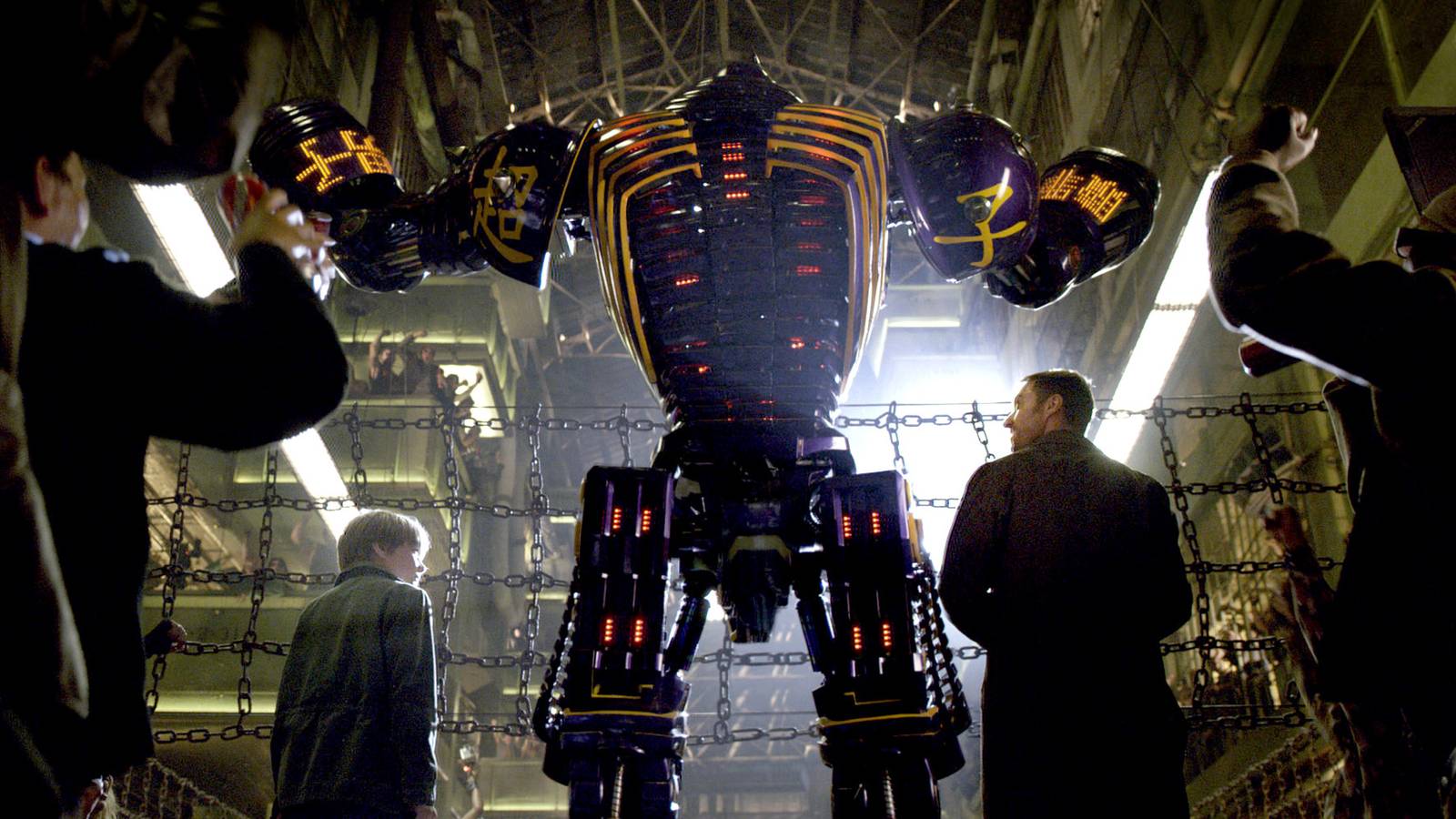
Image via Everett Collection, Touchstone Picturs Published Aug 29, 2026, 11:09 PM EDT Michael John Petty is a Senior Author for Collider who spends his days writing, in fellowship with his local church, and enjoying each new day with his wife and daughters. At Collider, he writes features, reviews, recaps, and conducts interviews. In addition to writing about stories, Michael has told a few of his own. His novella, The Beast of Bear-tooth Mountain, was released in 2023. His Western short story, The Devil's Left Hand, received the Spur Award for "Best Western Short Fiction" from the Western Writers of America in 2025. Michael currently resides in North Idaho with his growing family. Sign in to your Collider account It's been 15 years since Shawn Levy and Hugh Jackman first teamed up for Real Steel, long before the pair reunited for Deadpool & Wolverine. The 2011 sci-fi boxing drama starred Jackman as former boxer turned robot trainer Charlie Kenton, who is forced to build a robot boxer with his son when automated machines replace the sport. While this might feel like an original concept, the film was an adaptation of a short story titled Steel, written by notable science-fiction and horror author Richard Matheson. Of course, more well-known is The Twilight Zone episode of the same name that aired in October 1963, starring Lee Marvin as Tim "Steel" Kelly, a former boxer who decides to go a round in the ring with a robotic counterpart. Nearly five decades before Jackman stepped into the robot-boxing world, The Twilight Zone had already entered the ring. If you haven't seen this original series episode, consider this your starting bell. What Is Richard Matheson's 'Steel' About? Whether you prefer the short story or the television episode, both versions of Matheson's "Steel" are incredibly similar. In each of them (set in the near future of 1974...), former boxer Tim "Steel" Kelly has resorted to becoming a boxing trainer/promoter after the sport was outlawed for humans. That might sound preposterous today, but that's only because you weren't living in the 1960s at the time. In 1963, the sport was filled with controversy after the death of not one, but two different boxers — Benny Paret and Davey Moore — one of whom died during a match on live television. Because of this, the massive weight of the sport was becoming clear to general audiences, and many believed that there could come a time when boxing itself was expunged from the record. This is the world of Richard Matheson's story. Collider Exclusive · Sci-Fi Survival Quiz Which Sci-Fi World Would You Survive? The Matrix · Mad Max · Blade Runner · Dune · Star Wars Five universes. Five completely different ways the future went wrong — or sideways, or up in flames. Only one of them is the world your instincts were built for. Eight questions will figure out which dystopia, galaxy, or desert wasteland you'd actually make it out of alive. 💊The Matrix 🔥Mad Max 🌧️Blade Runner 🏜️Dune 🚀Star Wars TEST YOUR SURVIVAL → 01 You sense something is deeply wrong with the world around you. What do you do? The first instinct is often the truest one. APull on every thread until I understand the system — then figure out how to break it. BStop asking questions and start stockpiling — food, fuel, weapons. Questions don't keep you alive. CKeep my head down, observe carefully, and trust no one until I know who's pulling the strings. DStudy the patterns. Every system has a rhythm — learn it, and you learn how to survive it. EFind the people fighting back and join them. You can't fix a broken galaxy alone. NEXT QUESTION → 02 In a world of scarcity, what resource do you guard most fiercely? What we protect reveals what we believe survival actually requires. AKnowledge. If you understand the system, you don't need resources — you can generate them. BFuel. Everything else — movement, power, escape — runs on it. CTrust. In a world of fakes and informants, a truly reliable ally is rarer than any commodity. DWater. And after water, information — the two things empires are truly built on. EShips and credits. The galaxy is big — you survive it by being able to move through it freely. NEXT QUESTION → 03 What kind of threat keeps you up at night? Fear is useful data — if you're honest about what you're actually afraid of. AThat reality itself is a lie — that everything I experience has been constructed to keep me compliant. BA raid. No warning, no mercy — just the roar of engines and then nothing left. CBeing identified. Once someone with power decides you're a problem, you're already out of time. DBeing outmanoeuvred — losing a political game I didn't even know I was playing. EThe Empire tightening its grip until there's nowhere left to run. NEXT QUESTION → 04 How do you deal with authority you don't trust? Every dystopia has a power structure. Your approach to it determines everything. ASubvert it from the inside — learn its rules well enough to weaponise them against it. BIgnore it and stay out of its reach. The further from any power structure, the better. CAppear to comply while doing exactly what I need to do. Visibility is the enemy. DManoeuvre within it carefully. You can't beat a system you refuse to understand. EResist openly when I have to. Some things are worth the risk of being seen. NEXT QUESTION → 05 Which environment could you actually endure long-term? Survival isn't just tactical — it's physical, psychological, and very much about where you are. AUnderground bunkers and server rooms — cramped, artificial, but with access to everything that matters. BOpen wasteland — brutal sun, no shelter, constant movement. At least the threat is honest. CA dense, rain-soaked city where you can disappear into the crowd and nobody asks questions. DMerciless desert — extreme heat, no water, and something enormous living beneath the sand. EThe fringe — backwater planets and busy spaceports where the Empire's attention rarely reaches. NEXT QUESTION → 06 Who do you want in your corner when things fall apart? The company you keep is the clearest signal of who you actually are. AA tight crew of believers who've seen behind the curtain and have nothing left to lose. BOne or two people I'd trust with my life. Any more than that and someone talks. CNobody, ideally. Alliances are liabilities. I work alone unless I have no choice. DA community bound by shared hardship and mutual survival — people who need each other to last. EA ragtag team with wildly different skills and total commitment when it counts. NEXT QUESTION → 07 Where do you draw the line — if you draw one at all? Every survivor eventually faces a moment that tests what they're actually made of. AI won't harm the innocent — even the ones who'd report me without hesitation. BI do what I have to to protect the people I've chosen. Everything else is negotiable. CThe line shifts depending on who's asking and what's at stake. DI draw a long-term line — nothing that compromises my people's future, even if it'd help now. ESome lines, once crossed, can't be uncrossed. I know which ones they are. NEXT QUESTION → 08 What would actually make survival worth it? Staying alive is one thing. Having a reason to is another. AWaking others up — dismantling the illusion so no one else has to live inside it. BFinding somewhere — or someone — worth protecting. A reason to keep moving. CAnswers. Understanding what I am, what any of this means, before time runs out. DLegacy — shaping the future in a way that outlasts me by generations. EFreedom — for myself, for others, for every world still living under someone else's boot. REVEAL MY WORLD → Your Fate Has Been Calculated You'd Survive In…Your answers point to the world your instincts were built for. This is the universe your temperament, your survival instincts, and your particular brand of stubbornness were made for. The MatrixYou took the red pill a long time ago — probably before anyone offered it to you. You're a systems thinker who can't help but notice the seams in things. You're drawn to understanding how the system works before figuring out how to break it. You'd find the Resistance, or it would find you — your instinct for spotting constructed realities is the machines' worst nightmare. You function best when you have access to information and the freedom to act on it. The Matrix built an airtight prison. You'd be the one probing the walls for the door. Mad MaxThe wasteland doesn't reward the clever or the well-connected — it rewards those who are hard to kill and harder to break. That's you. You don't need comfort, community, or a cause larger than the next horizon. You need a vehicle, a clear threat, and enough fuel to outrun it — and you're good at all three. You are unsentimental enough to survive that world, and decent enough — just barely — to be something more than another raider. In the wasteland, that distinction is everything. Blade RunnerYou'd survive here because you know how to exist in moral grey areas without losing yourself completely. You read people accurately, keep your circle small, and ask the questions others prefer not to answer. In a city where humanity is a legal designation rather than a feeling, you hold onto something that keeps you functional. You're not a hero. But you're not lost, either. In Blade Runner's world, that distinction is everything. DuneArrakis is the most hostile environment in the known universe — and you are precisely the kind of person it rewards. Patience, discipline, and political awareness are your core strengths — and on Arrakis, they're survival tools. You understand that the long game matters more than any single victory. Others come to Dune and are consumed by it. You'd learn its logic and earn its respect. In time, you wouldn't just survive Arrakis — you'd begin to reshape it. Star WarsThe galaxy far, far away is vast, loud, and in a constant state of violent political upheaval — and you wouldn't have it any other way. You find meaning in being part of something larger than yourself — a cause, a crew, a rebellion. You'd gravitate toward the Rebellion, or the fringes, or whatever pocket of the galaxy still believes the Empire's grip can be broken. You fight — not because you have to, but because standing aside isn't something you're capable of. In Star Wars, that willingness is what makes all the difference. ↻ RETAKE THE QUIZ Matheson, who also penned the more iconic (and very next) Twilight Zone episode, "Nightmare at 20,000 Feet," wrote this half-hour drama as the second to air during the fifth and final season of the show's original run. With Lee Marvin (who had previously appeared in Season 3's "The Grave") in the leading role, there was no doubt that this one would thrive on its own merits, regardless of its Magazine of Fantasy & Science Fiction origins. While Matheson's next Twilight Zone is infinitely more beloved, Steel has more than enough emotional draw, even if it's a bit more understated about it. What starts as a story about a washed-up boxer trying to reclaim his glory days through the use of a machine (in this future, machines are the sole boxers of the day) slowly becomes a Rocky story that ends fairly similarly to the later Sylvester Stallone picture. After his B2 model boxing bot, "Battling Maxo" (Tipp McClure), sheds a spring, the robot is unable to fight. To make ends meet, "Steel" Kelly, himself a former boxer, decides to take on a superior B7 model himself. Though Kelly gives a valiant effort, he doesn't stand much of a chance in the ring. As Rod Serling's ending narration notes, "Portrait of a losing side, proof positive that you can't outpunch machinery." Despite that, the narrator also notes that "Steel" is a prime example of the courageous nature of the human spirit, and our willingness to rise to the challenge no matter how impossible the odds. One almost wonders if Stallone might've watched or read Steel before coming up with the plot of the first Rocky. It's impeccable how familiar (and perhaps even relatable) the story still feels after all these years, which is a true testament to the lasting power of an author like Matheson. These days, we know him best for I Am Legend, Hell House, or Duel, which would later turn into a Steven Spielberg film of the same name. This 'Twilight Zone' Episode Was Richard Matheson's Favorite According to The Twilight Zone Companion by Marc Scott Zicree, Steel was Matheson's favorite of the 16 episodes bearing his name ("And When the Sky Was Opened" and "Third From the Sun" were based on his works but not written by him). More than that, the author noted that the short story/episode's title had a double meaning of its own. "Steel was his nickname and that was his character, his backbone, that he was so determined," Matheson explained. "When you have a monumental character like that, it's easier to handle." The author likened "Steel" Kelly to Captain Ahab from Moby Dick, who was so consumed with his own obsession to "win" against his opponent that it cost him everything. "He has no greys; he just wants to kill the whale." In this case, Kelly just wants to beat the B7, Maynard Flash (Chuck Hicks), and secure the winnings he needs to continue his washed-up career. Unfortunately, he barely makes it out of the ring alive. What makes Lee Marvin's performance as Kelly especially notable is his clear commitment to the role. Matheson recalled watching the actor psyche himself up for the big sparring match, noting that Marvin went to great lengths to prepare himself for the role. "I saw the Lee Marvin character as the sort of man who never liked to ask anyone for help but chose, in the old-fashioned way, to take care of things for himself, however mad," explained Matheson. We see this clearly through Kelly's boisterous threats to his business partner and robot mechanic Pole (Joe Mantell), who tries unsuccessfully to pull Kelly away from his single-minded (and bullheaded) approach to, well, just about everything. "Even when he did get his brains beaten out and only a small percentage of the money, he did not give up," the author concluded. "Not the brightest man in the world but, in many ways, pretty admirable, pretty brave." The Twilight Zone was always a show that thrived in putting ordinary people in extraordinary circumstances, something "Steel" happens to do remarkably well. But how does Matheson's Steel compare to the 2011 blockbuster Real Steel? Well, there are similarities, of course. Robots have indeed replaced boxers in the sport, and Hugh Jackman's Charlie Keaton is a clear stand-in for Lee Marvin's "Steel" Kelly, albeit a slightly more level-headed (and likable) one. But much of the content has been changed for the more blockbuster style of modern Hollywood filmmaking. Instead of adapting "Steel" into a more Rocky-esque story about one man's obsessive quest (though those elements partially remain), Real Steel is also a heartwarming story about the relationship between a father and his son (played by Dakota Goyo). The updated special effects make Real Steel feel like most action movies you remember from the 2010s, even if this one has more entertainment value than most. Real Steel earned nearly $300 million worldwide, and the movie's enduring fan base has continued to call for the story to return in some form. Shawn Levy Hadn't Seen 'Steel' When He Signed on for 'Real Steel' Funny enough, director Shawn Levy didn't know anything about Richard Matheson's original material before signing on for the 2011 motion picture. "I knew of Matheson as a writer. I’d not read Steel or seen the episode," the director told Complex in 2011. "So shortly after I met with [Steven] Spielberg and talked about doing the movie, I promptly educated myself, and it got me even more excited." Though he didn't adapt Matheson's short story as faithfully as the author had for The Twilight Zone, Levy pulled from the desperation of the Kelly character and poured that idea into Hugh Jackman's Charlie Keaton. From the time he was first involved in the film, there was always this father-son dynamic present within the story, with John Gatins ultimately writing the screenplay from a story credited to Dan Gilroy and Jeremy Leven. But the filmmaker wanted to lean further into that emotional aspect of the picture: "I felt that to occupy a unique space, Real Steel needed to be more about its underdog story, more of a father-son and sports movie than just a robots-wailing-on-each-other movie." By changing the themes from Matheson's obsessive underdog into a father-son bonding narrative, Real Steel certainly adapts the Steel concept for a new age. While The Twilight Zone episode allowed the Lee Marvin character to take the place of his battling robot in the ring, that wasn't possible in the world of Real Steel, where the robots were (1) clearly machines and (2) much taller than the average man. That's where Levy's idea for the "shadow mode" came in, which he used as a vehicle to adapt the Kelly character's tenacity and courage to Jackman's. "In this last fight, yes, it’s gotta be about our robot maybe having a shot at winning, but more importantly it’s gotta be about the Hugh Jackman character returning to grace," the director explained. "And even more critically, it’s gotta be about the son witnessing the father’s return to grace." While Real Steel is a much different production than the original Twilight Zone episode, it captures the same tenacity of the human spirit that exists in Marvin's signature boxer. Whether audiences will ever return to the world of Real Steel, however, is looking increasingly uncertain. A Disney+ series based on the movie entered development in 2022, but Levy offered a discouraging update in late 2025, saying the project's status was "unclear" and admitting that he wished he felt it was more likely to happen than he currently did. Fifteen years after the movie's release, then, Real Steel may still stand on its own. But its connection to Matheson's Steel ensures that the story itself has already survived far longer than one movie — stretching all the way back to one of The Twilight Zone's most underrated hours. The Twilight Zone is available for streaming on Paramount+. Ordinary people find themselves in extraordinarily astounding situations, which they each try to solve in a remarkable manner. Main Genre Sci-Fi Seasons 5
48 Years Before Hugh Jackman’s Best Sci-Fi Movie, ‘The Twilight Zone’ Did It First
Full Article
Original Source
Read the full article at Collider →KhanList aggregates and links to publicly available news content. We do not host full articles from third-party sources. Always verify important information with original sources.