
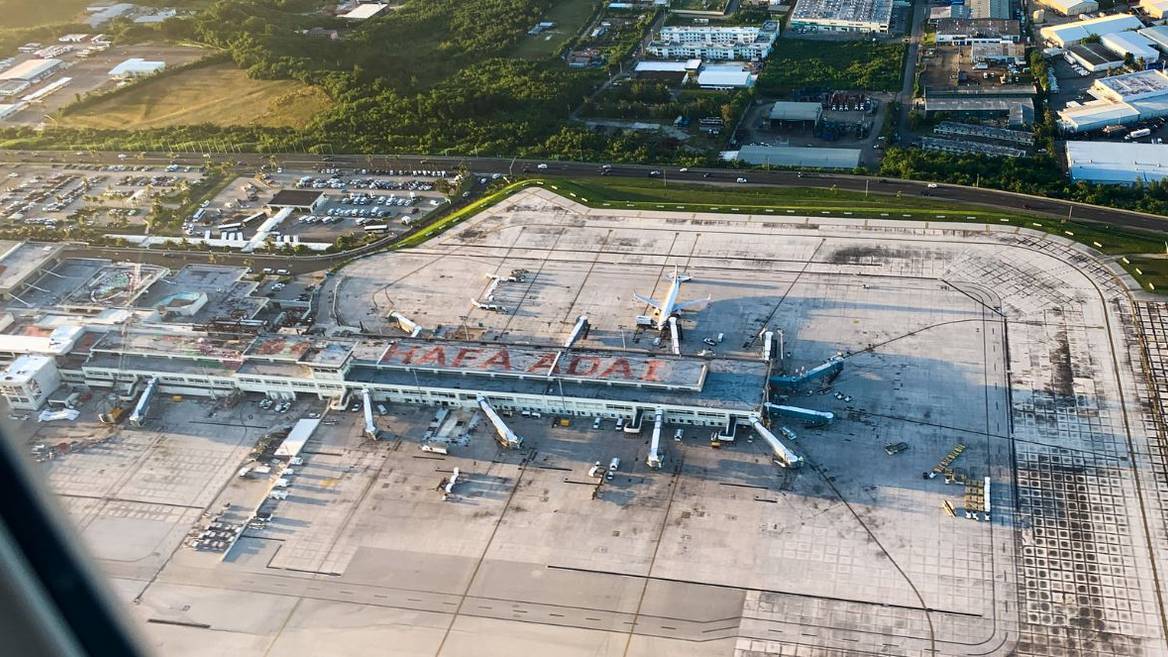
Credit: Daniel Ramirez | Flickr Published Nov 11, 2026, 9:00 PM EST Aaron is an aviation enthusiast and world traveler with a deep interest in aerospace history and technology. He has traveled around the world numerous times, often incorporating visits to aviation museums and historic aircraft collections into his journeys. A native of New Zealand, he is an expert in aviation and maintains a broad interest in a variety of other subjects. Sign in to your Simple Flying account Guam International Airport is a significant US international airport located on the organized, unincorporated territory of Guam. The US has owned the island since the conclusion of the Spanish-American War of 1898, and it now serves as a major military base in the Pacific. The commercial airport should not be confused with Andersen Air Force Base, located on the northern end of the island. I flew through Guam as part of my Micronesia island-hopping backpacking journey that included Palau, Yap, Ulithi, and Guam. After flying through island airports (and airstrips), Guam felt like a large airport, especially for its region. While much of the island's infrastructure (especially the roads and hotels) appears to be decaying, the airport itself looked modern and clean, even if the WiFi leaves much to be desired. Here is what to know about flying through Guam's international airport, its vital connection to Micronesia, and its declining influence on East Asian tourism. What To Know About Guam's Airport Credit: Aaron Spray Guam International Airport (officially Antonio B. Won Pat International Airport) is a major regional international airport located on the US territory of Guam in Micronesia. It is a hub for United Airlines and a cargo hub for Asia Pacific Airlines. The airport offers significant connections to destinations in East Asia and is one of the major hubs of the Pacific (along with Hawaii, Auckland, Brisbane, Nauru, and Fiji). Practically all the domestic flights are operated by United Airlines using a fleet of Boeing 737s. This includes flights to the former US Trust Territories, now independent nation-states of Palau, the Federated States of Micronesia, and the Marshall Islands. United operates around 87 weekly flights from Guam to 14 different destinations in the Asia Pacific. Guam is an important hub for Micronesia, but not elsewhere in the Pacific. It has no flights to Polynesia, Australia, New Zealand, Melanesia, or even some Micronesian states like Nauru and Kiribati. The airport does attract a number of Asian international airlines, such as the flag carriers Korean Air, Japan Airlines, and Philippine Airlines, along with low-cost Korean airlines like Jin Air and Air Busan. Flying Into Guam, Immigration Credit: Aaron Spray Guam feels like a large international airport, partly because the terminal is relatively modern and spacious. The current terminal was completed in 1998, meaning it is not particularly new, although it feels modern. My United Boeing 737 MAX 8 flight from Yap in the Federated States of Micronesia (pictured in Yap above) arrived at 4:00 AM. Immigration was largely empty, as it was only processing the passengers from the half-empty United flight. I have visited over 100 countries, including Iran, Iraq, Pakistan, and various other countries that have put me on a US watchlist. The last time I visited the US, I was questioned by Customs and Border Protection (CBP) for an hour; this time it was three full hours. Questioning included a detailed search of my checked baggage and an hour of scrolling through chats on my phone. In my opinion, the CBP officers were very professional. I saw them question various other passengers, and I didn't see anything I would consider rude or unprofessional. The officers appeared to take their jobs seriously; they told me as much several times. Car Rental At Guam Airport Credit: Aaron Spray A number of car rental companies operate on the lower floor, near the exit. I rented a car for two days to drive around and explore the island. Picking up the car was easy. I have a credit card specifically for renting cars around the world, but it wasn't needed on this occasion. Only a $100 deposit was required, payable in either cash or by credit card. Fortunately for me, the rental car kiosks are open 24/7 (or at least Economy Rent a Car). I picked the car up at around 7:30 am and dropped it off at around 2:30 am. Rental companies located at the airport include Avis, Budget, Alamo, Enterprise, National, Hertz, SIXT, Nissan (includes Economy), Dollar, and GOGO. Guam International Airport (per official website) Hub for United Airlines Notable absent airlines Delta, Southwest, Alaska, American, Hawaiian Aircraft movements 32,968 (2025) — down from approx. 60,000 in 2019 Capacity Approx. 3 million Passengers Approx. 1.8 million (for 2025, excluding transit passengers) The rental cars are parked a few feet (meters) from the terminal exit, with staff normally stationed there. I was handed the keys, looked around the car, and drove away. Returning in the dead of night, there was no one in the parking area. I parked the car, returned the key to the kiosk, and the staff said 'all good' without anyone even inspecting the car. First time that has happened. This was probably the smoothest car rental pick-up and drop-off I have had. Guam's Airport WiFi & Shops Credit: Aaron Spray Being in Guam for just two days, I elected not to purchase a SIM card or eSIM; this left me reliant on public WiFi. Perhaps my biggest criticism of the airport is the shoddy WiFi. I failed to connect to it when I arrived and first connected to the internet in Guam when I drove to McDonald's. Returning for the outbound flight, I found the airport's WiFi signal was strong in the main food court. However, as I walked to the boarding gates, the airport's WiFi weakened. Even when my devices connected, they couldn't send or receive messages. I had to walk back from the boarding gate, back to the food court area to regain connectivity. Still, Guam's connection turned out to be much better than my onward layover in Manila. That airport is one of the worst major international terminals I have seen. This is not lost on the Philippines, and the country is building a massive replacement airport. The Guam International Airport also had the typical duty-free alcohol, candy, and cigarette shops expected at a modest US international airport. The shops and airport were all rather quiet as I was flying in the wee hours of the morning. Jin Air was also operating a flight; otherwise, the airport was quiet. Most shops were open, but it was quiet with minimal staffing. Guam's Connections To Asia And Micronesia Credit: Aaron Spray Guam is well-connected to non-Mainland China destinations in East Asia. This includes four routes to Japan, including Tokyo (2x), Nagoya, and Osaka, and two routes to South Korea (Seoul and Busan). There are also flights to Taipei (Taiwan) and Manila. Asia Pacific Airlines operates a cargo route to Hong Kong. The only route to the United States proper is to Hawaii's Honolulu. One of the main roles of Guam is to be a hub for Micronesia. Routes include Palau, the Northern Mariana Islands (a US commonwealth), Yap, Chuuk, Pohnpei, Kosrae, Kwajalein, and Majuro. Palau is an independent country; Yap, Chuuk, Pohnpei, and Kosrae are the four states that make up the Federated States of Micronesia (FSM), while Kwajalein and Majuro are islands of the Marshall Islands. United operates direct flights from Guam to Yap, Palau, Rota, and Saipan. The other destinations are connected via its famous Island Hopper, which continues to Honolulu in Hawaii before island-hopping on its way back. I wanted to take this flight, but it was too expensive. About half of Guam's population is Micronesian (especially native Chamorros), and it has cultural and historical ties to other islands in Micronesia. United offers flights from Guam to Hawaii on January 7th, including a direct option that takes seven hours and costs $1,163 one-way in economy, as well as a 15-hour itinerary with five stops for $1,170. Guam's Passenger Traffic Didn't Recover From COVID Credit: Aaron Spray In 2025, Guam emplaned 1.0 million passengers and recorded 32,968 aircraft movements. In Fiscal 2024, the airport recorded 1,972,461 total passenger movements, including 921,887 arrivals, 923,885 departures, and 126,689 transit passengers. Guam has not recovered from COVID-19, primarily due to tourism and air-connectivity challenges. Its tourism model was heavily dependent on Japan and South Korea, which did not fully recover. This was made worse by Typhoon Mawar in 2023; extensive typhoon damage is visible around the island. Other issues have included a weaker Yen in Japan. In 2019, Guam saw 1.7 million Korean and Japanese tourists; in 2025, it was 783,000. Consequently, the aircraft movements are around half of what they were in 2019. The island's resorts, mostly concentrated on a single strip near the airport, are also aging and crumbling, creating a negative feedback loop. When I was there, I saw large groups of Japanese tourists. Even so, the hotel I was staying at was decaying, and some resorts I saw were long past their prime and received minimal maintenance. This means the airport was built with a capacity of around three million passengers, but it received only a bit more than half of that last year. The airport is operating under capacity, the direct opposite of Manila, the next airport I flew into. Besides passenger services, cargo is an important part of Guam's operations, with the port handling 28,116 tons in 2025 (down from 38,741 tons in 2021).
3 Hours At Immigration: My Journey Through One Of America's Most Remote Airport Hubs
Full Article
Original Source
Read the full article at Simpleflying →KhanList aggregates and links to publicly available news content. We do not host full articles from third-party sources. Always verify important information with original sources.