
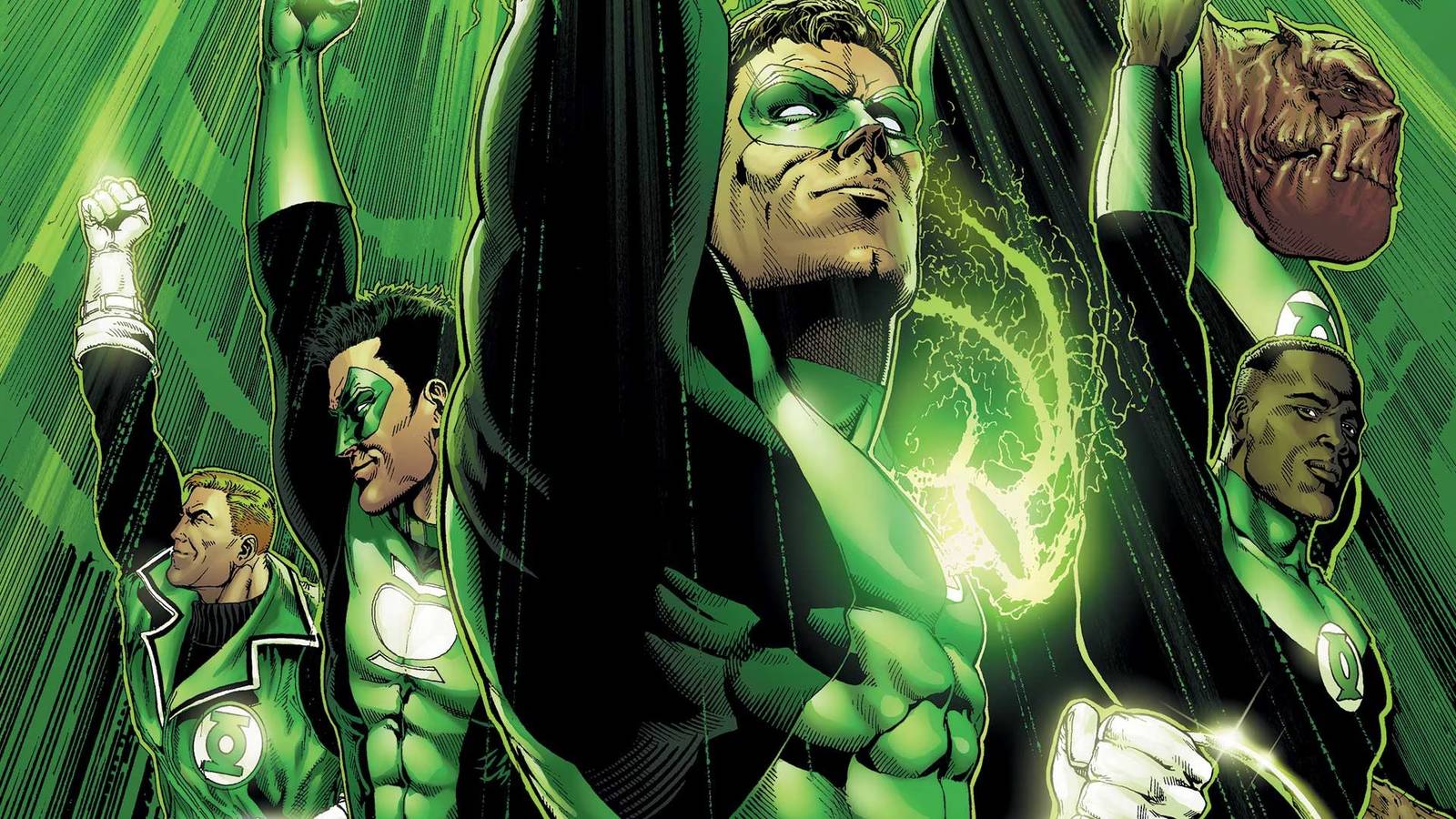
Published Nov 1, 2026, 11:00 PM EST Adam has been writing in the entertainment news space for over a decade. Beginning his career of covering film and TV at CinemaBlend, he has also appeared on The Flash Podcast and done several radio spots. When Alan Scott, the original Green Lantern, was introduced in 1940, his power ring and lantern were magic-based, and he was the only individual to go by that superhero moniker. Then in 1959, this mantle was rebooted with Hal Jordan, the first human member of the Green Lantern Corps, which uses rings and lanterns powered by technology instead. While Alan remains active in the DC Universe as part of the Justice Society, it’s through the Corps that the Green Lantern property has thrived. With their impressive willpower and ability to overcome great fear, Green Lanterns can fly, generate force fields, and bring to life constructs from their imagination, so long as they periodically recharge their ring. This intergalactic law enforcement agency protects the 3600 sectors that make up the universe, with Hal, John Stewart, Guy Gardner, and all the other human Green Lanterns hailing from Sector 2814. A Green Lantern is often a staple member of the Justice League as well. The Green Lantern property is still going strong both in the comics and in other media, as most recently evidenced with the success of HBO’s Lanterns. 22 years ago, however, an important retcon that didn’t just give the Green Lantern lore arguably its biggest popularity boost, but was also a game-changer for the entire DC landscape. Green Lantern: Rebirth Introduced The Emotional Spectrum DC Comics Green Lantern: Rebirth is well known for bringing Hal Jordan back to life and changing the way readers looked at his time as Parallax. In Issue #3 of the Geoff Johns-written 2004–2005 miniseries, Kyle Rayner told Green Arrow how he discovered that there’s an “emotional electromagnetic spectrum that can be harnessed and used,” and “green willpower is the most pure.” Each emotion on the spectrum also has a corresponding entity, with the insect-like Parallax being the physical manifestation of the yellow energy of fear. At the time, these revelations were huge because they painted Hal’s actions during the Emerald Twilight storyline in a different light. Parallax had been influencing Hal’s behavior while imprisoned within the Green Lanterns’ Central Power Battery on Oa, then it fully took control of him when he destroyed the battery. This retcon also explained why a Green Lantern construct couldn’t affect anything colored yellow. However, all this was the tip of the proverbial iceberg with the Emotional Spectrum. While longtime Green Lantern villain Sinestro had been using a yellow power ring for years, after Rebirth, he formed the Sinestro Corps, i.e. an entire organization of Yellow Lanterns harnessing the power of fear. The Zamarons also formed an entire corps of Star Sapphires, i.e. Violet Lanterns, powered by love, after Carol Ferris had previously been the main character to hold that title. From there, the rest of the core Emotional Spectrum was established: red for rage, orange for avarice, blue for hope, indigo for compassion, black for death, and white for life. The Emotional Spectrum Was A Game-Changer For DC DC Comics Once these other emotional energies and their corresponding Lantern Corps were established, they took the DC Universe by storm. Blackest Night saw Nekron unleashing the Black Lanterns, i.e. the reanimated corpses of various deceased DC heroes and villains, alongside his proxy, Black Hand. The many multicolored Lanterns subsequently teamed up with the Justice League, Justice Society, and Teen Titans, and many others to foil this reign of zombie terror. Then, the White Lantern’s Life Entity was the driving force behind the Brightest Day crossover storyline. While the Emotional Spectrum is still chiefly tied to the Green Lantern comics, these other Lantern energies still cross over into other corners of the DC Universe now and then. Various non-Lantern characters have temporarily joined one of these Corps, including Superman as a Yellow Lantern, Supergirl as a Red Lantern, Flash (Barry Allen) as a Blue Lantern, and Wonder Woman as a Violet Lantern. The Emotional Spectrum has also been confirmed as one of the Seven Forces of the Universe, making it a key building block for all existence. In more recent years, the main Emotional Spectrum has expanded with gold (it’s unclear what emotion that channels) and gray (sorrow). There’s also an Invisible Emotional Spectrum, which includes the Ultraviolet Lantern Corps fueled by buried primal emotions and controlled by the entity Umbrax. More than two decades after its introduction, the Emotional Spectrum remains one of DC’s most important retcons, and anyone who wields one of these energies, if not several of them, automatically becomes a force to be reckoned with. Created By Martin Nodell, Bill Finger, John Broome, Gil Kane, Dennis O'Neil, Neal Adams Cast Ryan Reynolds First Appearance All-American Comics Alias Alan Scott, Hal Jordan, Guy Gardner, John Stewart, Kyle Rayner, Simon Baz, Jessica Cruz, Sojourner Mullein Alliance Justice League, Justice Society of America, Green Lantern Corps Movies Green Lantern
22 Years Ago, Green Lantern Changed DC Lore Forever With The Best Retcon In Comic History
Full Article
Original Source
Read the full article at Screenrant →KhanList aggregates and links to publicly available news content. We do not host full articles from third-party sources. Always verify important information with original sources.