
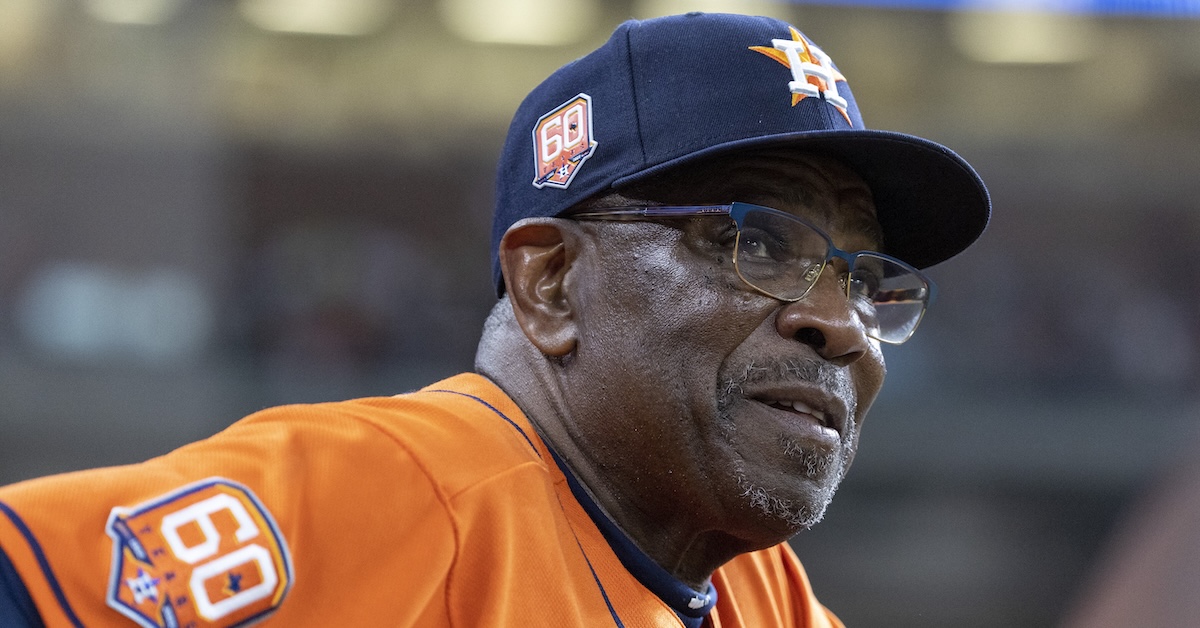
Thomas B. Shea-USA TODAY Sports This post is part of a series covering the 2027 Contemporary Baseball Era Committee Managers/Umpires/Executives ballot, which includes candidates in those categories who made their greatest impact from 1980 to the present. You’ll find an introduction to the ballot here. The eight candidates will be voted on in San Diego on December 6, and anyone receiving at least 75% of the vote from the 16 committee members will be inducted in Cooperstown on July 25, 2027 along with any candidates elected by the BBWAA. 2027 Contemporary Baseball Candidate: Manager Dusty Baker Manager G W-L W-L% G>.500 Playoffs Pennants WS Dusty Baker 4046 2183-1862 .540 321 13 3 1 AVG HOF Mgr* 3636 1943-1673 .537 270 7 5 2.5 Source: Baseball-Reference * Average based on the careers of 22 enshrined AL/NL managers from the 20th and 21st centuries By the time he was 20 years old, Dusty Baker had been drafted by the Braves, fished with Satchel Paige, attended the Monterrey Pop Festival, smoked marijuana with Jimi Hendrix, enlisted in the Marine Corps Reserves, and collected his first two major league hits. More than half a century later, after a 19-year playing career and 24-plus seasons as a manager, he secured his 2,000th win as a skipper and led the Astros to a championship, becoming the oldest manger to win a World Series (age 73) in the process. In between those two points, he was mentored by Henry Aaron while the slugger chased and surpassed Babe Ruth’s all-time home run record, inadvertently helped invent the high five, won a World Series as a player, endured several excruciating near-misses as a manager, and became friends with future president Barack Obama. The lives and careers of baseball figures don’t get much more fascinating. Election to the Hall of Fame isn’t just based on hipster credibility, but fortunately, Baker has the numbers to bolster his compelling back story, and even on an overstuffed ballot, his candidacy stands out. He led his teams to 90 or more wins 13 times, 11 of which resulted in playoff appearances thanks to the addition of the Wild Card(s). His teams also made the playoffs two other times; his total of 13 postseason appearances ranks fourth all-time behind contemporaries Bobby Cox, Tony La Russa, and Joe Torre. He ranks eighth in both games managed and wins. In 2002, he became just the second Black manager to win a pennant (after Cito Gaston), and in ’23, the third to win a World Series, after Gaston and Dave Roberts. He’s the only manager to take five different franchises to the postseason, a testament to his resilience and adaptability, but also a sore spot given his lack of job security, as his tenures in San Francisco, Cincinnati, Washington, and Houston all ended with playoff appearances after seasons of at least 90 wins. “I feel fortunate to have gotten that many jobs, but I feel unfortunate that I shouldn’t have lost jobs when I was winning,” he told reporters in 2021 after the Astros clinched a playoff berth. In a sport woefully short of minority representation in management, he felt obligated to persevere through some indignities. “You just gotta continue to carry on and be strong,” he told The Athletic’s Claire Smith later that month. “A lot of other minorities are counting on it… ‘Hey, man, you gotta hang in there, you know, to give us a chance.’ Sometimes it’s a heavy burden, but, hey, I was chosen for it, you know what I mean?” … Johnnie B. Baker Jr. was born on June 15, 1949 in Riverside, California, the oldest of five children. His father was a World War II veteran who worked as a sheet-metal technician at Norton Air Force Base, while his mother Christina was a secretary. The young Baker earned his nickname in early childhood by gravitating to playing in a patch of dirt within his family’s big, grassy backyard. His parents emphasized academics and culture (he took piano lessons), and his father coached his Little League team — but cut him three times for tantrums. When Baker was 16, his family moved to Sacramento after his father was transferred to McClellan Air Force Base. Dusty and his younger brother were the only Black students at Del Campo High School, where he starred in baseball, basketball, football, and track. He received a basketball scholarship offer from UC-Santa Clara but chose to attend American River College near Sacramento, where he studied journalism. When the Braves selected him in the 26th round of the 1967 amateur draft, he was torn between signing and moving on to a four-year college with a scholarship. Aaron counseled him, “If you’re confident you’ll be in the big leagues by the time your college class graduates, then sign. If not, go to school.” He also promised Christine, “I will take care of him as if he’s my own son.” Baker signed for a $15,000 bonus, which put his recently divorced parents at odds. His father, who wanted his son to go to college, sued in an attempt to void the deal; in a compromise, the court appointed a trustee to oversee the young Baker’s finances until he turned 21. The bonus money helped pay for his siblings and Christine to attend college. In the same month that Baker was drafted, his mother gifted him two tickets to the the three-day Monterrey Pop Festival for his 18th birthday, along with $20 and the use of the family car. Baker and his friends slept in the car and adhered to a “no grass” rule to preserve their athletic futures. At Monterrey, he saw legendary performances by Hendrix, The Who, Janis Joplin and Otis Redding, an adventure he recounted in a 2015 mini-memoir, Kiss the Sky. In 1968, after playing just 67 minor league games — and losing some playing time to his service obligations as a motor transport mechanic in the Marine Corps Reserve — Baker debuted in the majors on September 7. Pinch-hitting for Phil Niekro in the seventh inning against the Astros’ Denny Lemaster, he grounded out. The 19-year-old Baker went 2-for-5 in six appearances off the bench, collecting singles off the Astros’ Mike Cuellar and the Giants’ Juan Marichal. During that stint, he connected with the 62-year-old Paige, whom Braves owner William Bartholomay had hired in late 1968 as a goodwill ambassador and uniformed coach so that he could accumulate enough service to qualify for a major league pension. Baker was among the youngsters who toted Paige’s fishing gear and served as his gopher. “He called me Daffy,” Baker recalled for Larry Tye, author of an excellent 2009 bio, Satchel: The Life and Times of an American Legend. “I said, ‘My name is Dusty.’ He said, ‘Daffy, I know what your name is.'” That winter, so the story goes, Baker ran into Hendrix on the streets of San Francisco and shared a joint. From 1969–71, Baker played just 45 more major league games while spending most of his time in the minors, where he confronted the horrible realities of the Jim Crow South, including sundown laws, segregated housing, and police harassment. Baker broke camp as the Braves’ starting center fielder in April 1972 and hit .321/.383/.504 with 17 homers, a 145 wRC+, and 4.8 WAR. He never topped either of those last two figures, and his performance declined slightly in each of the next three seasons, though he did witness history up close; he was on deck for Aaron’s 715th homer on April 8, 1974. On November 17, 1975, he was traded to the Dodgers as part of a six-player deal, with Lee Lacy, Tom Paciorek, Jerry Royster and Jimmy Wynn heading to Atlanta. He was basically replacement level in his inaugural season in Los Angeles, hampered by knee problems traceable to a pickup basketball game. Following offseason surgery, the Dodgers — who had traded for center fielder Rick Monday — moved Baker to left field. New manager Tommy Lasorda expressed confidence the move would work, and it did. Baker set a career high with 30 homers, joining Ron Cey, Steve Garvey, and Reggie Smith as the first quartet of 30-homer teammates. When Baker crossed the plate after hitting no. 30 off the Astros’ J.R. Richard, outfielder Glenn Burke, who had been on deck, congratulated him. “His hand was up in the air, and he was arching way back,” recalled Baker in 2011. “So I reached up and hit his hand. It seemed like the thing to do.” When Burke followed with a homer, Baker returned the gesture, which gained visibility during the Dodgers’ run to the World Series. Baker won NLCS MVP honors for hitting .357/.438/.857 with two homers and eight RBI against the Phillies. From 1978–83, Baker helped the Dodgers win three more division titles, two more pennants, and, in the strike-torn 1981 season, the World Series. He finished fourth in the National League MVP voting in 1980, and made the NL All-Star team in both ’81 and ’82. After using his 10-and-5 rights to veto a trade to the A’s in February 1984, Baker was released while still owed two years of salary. He had been surrounded by unsubstantiated rumors about cocaine usage; at the Pittsburgh drug trials in 1985, Dave Parker testified that he had arranged cocaine transactions involving Baker and fellow Dodgers Steve Howe and Derrel Thomas in the early ’80s. Unlike Parker, Baker was not suspended, but in 1986, he was among the nine players whom commissioner Peter Ueberroth ordered to submit to random, mandatory drug testing for the remainder of their playing careers. After his release by the Dodgers, Baker signed with the Giants, for whom he played one season under manager Frank Robinson. Traded to Oakland the following spring, he spent his final two seasons (1985–86) with the A’s. He finished his playing career with 1,981 hits, 242 homers, a .278/.347/.432 (117 wRC+) line, and 37.9 WAR. Dusty Baker in spring training, 1986. Photo by Jay Jaffe Upon retiring, Baker took classes in finance and investing, and briefly worked as a stockbroker, but the Black Monday crash in October 1987 led him to reconsider. In the wake of Dodgers general manager Al Campanis’ racist remarks on ABC’s Nightline in 1987, in which he said that Black people “may not have some of the necessities” to be a field manager or general manager, Giants GM Al Rosen recruited Baker, who expressed a desire to be an assistant GM and eventually a GM. Rosen believed he’d be better suited to managing, and steered him to accept a job as a coach. Baker spent 1988 as the Giants’ first base coach under manager Roger Craig, then ’89-92 as hitting coach. In the 1988–89 offseason, he helped first baseman Will Clark overhaul his swing, keying the best season of Clark’s career; he finished second in the NL MVP voting behind teammate (and NL home run and RBI leader) Kevin Mitchell. The duo helped the Giants win their first pennant since 1962, but they lost the World Series to the A’s, a four-game sweep interrupted by the Loma Prieta earthquake. In late 1992, Giants owner Bob Lurie’s plan to move the franchise to St. Petersburg, Florida was rejected by a vote of NL owners, paving the way for a group led by Peter Magowan to purchase the team and keep it in San Francisco. In a two-week span, Magowan fired Craig, whose teams had finished below .500 in each of the previous two seasons, signed two-time NL MVP Barry Bonds to a record-setting six-year, $43.75 million contract, and promoted Baker, making him just the seventh Black manager hired to lead an AL or NL team. Not long afterwards, Bill Walsh, who had coached the San Francisco 49ers to three Super Bowl victories, gave Baker an oversized accordion file filled with handwritten notes about how to run an organization. “He said you should always be open to new ideas,” Baker recalled for the Washington Post’s Dave Sheinin in 2016. With Bonds leading the NL in homers, RBI, and WAR, second baseman Robby Thompson and third baseman Matt Williams turning in strong seasons, and Bill Swift and John Burkett both winning at least 20 games, the Giants went 103-59 in Baker’s first season, but after leading the NL West by as many as 10 games, they lost eight straight in early September, and entered the season’s final day tied for first with the Braves. A 12-1 thumping by the Dodgers, coupled with the Braves’ win over the Rockies, cost them the division title. Baker did win NL Manager of the Year for the first time, but it was small consolation. Clark departed in free agency after the 1993 season, and the Giants slipped below .500 during both strike-shortened seasons, then bottomed out to 68-94 in 1996 amid a slew of injuries; Bonds was one of just two position players to appear in more than 105 games. After the season, Magowan promoted assistant GM/director of player personnel Brian Sabean to GM, replacing Bob Quinn, who moved into a senior advisor role. Sabean’s first big move was to trade Williams to Cleveland in a six-player deal that brought second baseman Jeff Kent and shortstop Jose Vizcaino to San Francisco. Both put together solid seasons in 1997, and with youngsters like third baseman Bill Mueller and lefty starters Shawn Estes and Kirk Rueter blossoming, the Giants rebounded to 90 wins and a first-place finish. They were swept in the Division Series by the Marlins, though again Baker was voted NL Manager of the Year. The Giants finished a distant second in the NL West in both 1998 (89-74 after losing a Game 163 tiebreaker to the Cubs for the Wild Card spot) and ’99 (86-76). Bonds missed seven weeks in 1999 due to a torn triceps tendon in his right elbow. According to testimony from Bonds’ former mistress Kimberly Bell given during his 2011 federal trial for perjury and obstruction of justice, the slugger attributed the injury to his use of anabolic steroids obtained from the Bay Area Laboratory Co-Operative (BALCO). In the coming years, Baker would receive considerable criticism for seemingly enabling Bonds’ alleged use of performance-enhancing drugs, and for ignoring his physical transformation and the frequent presence of Bonds’ personal trainer (and PED supplier), Greg Anderson, in the Giants’ clubhouse. “Everybody saw the physical change,” Baker said in reaction to Game of Shadows, the 2006 book by reporters Mark Fainaru-Wada and Lance Williams chronicling Bonds and the BALCO scandal. “You didn’t know if Barry was [just] lifting weights, because he lifts all the time. [The book] says I wasn’t interested, but what are you going to do? I’m not a detective. What are you going to do as a manager?” Bonds hit a career-high 49 homers in 2000, though it was Kent’s career year and higher RBI total (125 to 106) that captivated MVP voters. Regardless of the individual honors, the Giants — who had just moved into Pac Bell Park — benefitted, going 97-65 and winning their second division tile under Baker (who won his third Manager of the Year award), though they lost a four-game NLDS to the Mets. In 2001, Bonds hit 73 homers, breaking the single-season record of 71 set by Mark McGwire in 1998, but even with big supporting seasons from Kent and slugging shortstop Rich Aurilia and a strong second half (44-30, after a 46-42 first half), the team fell two games short of a playoff berth. Over the winter, Baker underwent treatment for prostate cancer, but was back on the job in time for spring training. Thanks to an NL-best 36-18 record after July 31, the Giants snagged the Wild Card berth with a 95-66 record in 2002, a season that didn’t lack for drama. Kent broke his wrist during his spring “truck washing” incident, and on June 25, he scuffled with Bonds in the dugout and exchanged heated words with Baker. From the late Ross Newhan in the Los Angeles Times: Baker interceded, and Kent reportedly said, “I want off this team,” to which Baker is said to have told him, “Don’t ever say that again,” and Kent reportedly replied, “It’s his team anyway. Of course, you’ll take his side.” It’s a testament to Baker’s people skills that he prevented the rift between the two superstars from tearing the clubhouse apart, and emerged from the situation appearing to have both players’ backs. “It ain’t a problem,” Baker told reporters. “Usually this happens on good teams. Bad teams always get along… [Bonds and Kent have] helped each other, and they’re more similar than most people realize.” In the playoffs, the Giants overcame a two-games-to-one deficit to beat the Braves in the NLDS, and trampled the Cardinals in a five-game NLCS. In the World Series against the Angels, the Giants took a three-games-to-two lead; in Game 5, Baker’s three-year-old son Darren — who reached the majors in 2024 — inadvertently gained national attention when, while acting as the Giants’ batboy, he had to be dragged away from home plate by J.T. Snow in order to avoid injury as Kenny Lofton’s triple plated two runs. The Giants led 5-0 with one out in the seventh inning in Game 6 — eight outs away from the franchise’s first championship since 1954 — before all hell broke loose. Starter Russ Ortiz, who had shut out the Angels on two hits through six innings, surrendered back-to-back one-out singles before reliever Felix Rodriguez yielded a three-run homer to Scott Spiezio. A solo homer by Darin Erstad off Tim Worrell and a two-run double by Troy Glaus off Robb Nen gave the Angels a 6-5 lead in the eighth, and it held up. In Game 7, the Angels piled up four runs in two-plus innings against starter Livan Hernandez, who had previously been shellacked in Game 3; the alternative would have been to start Rueter on three days of rest after he allowed three runs in six innings in Game 4. Bonds and Kent, who had combined for seven homers in the series, were quiet save for the former’s single in the 4-1 loss. “Baker came closer to winning the World Series than any manager has without actually winning it,” observed Tom Verducci in 2021 of Game 6. “No team had ever lost such a big lead in a potential clincher.” Less than two weeks later, the Giants announced that Baker wouldn’t return for in 2003. He had spent the pennant-winning season as a lame duck while long-simmering tensions between him and Magowan — and Sabean — bubbled up. He felt underappreciated, and hinted at interest in other openings. “It has become increasingly apparent that Dusty’s interest in exploring opportunities elsewhere is paramount in his mind,” said Sabean. “There remained non-compensation issues that he seemed reluctant to embrace… We felt slighted that again, for whatever reason, Dusty was more comfortable talking up other people’s situations.” Never mind whether Baker felt slighted over the lack of an extension offer. Less than two weeks later, he signed a four-year, $15 million deal with the Cubs, a considerable improvement upon his final two-year, $5.25 million deal with the Giants. Chicago had gone 67-95 in 2002 and two of the three previous seasons as well, with an 88-74 showing in ’01 the exception. Manager Don Baylor had been fired in early July as part of a larger organizational shakeup that included the appointment of director of player personnel Jim Hendry to the GM position. While the team headed into 2003 with an aging lineup built around slugger Sammy Sosa, their promising young rotation featured 26-year-old Kerry Wood and 22-year-olds Mark Prior and Carlos Zambrano, all of whom threw at least 211 innings. Third in the NL Central at 69-66 through the end of August — but just 2.5 games behind the Cardinals — the Cubs rode a 19-8 September into first place during the season’s final week. For the second straight season, Baker’s team beat the Braves in a five-game NLDS; up against a rotation that featured future Hall of Famers Greg Maddux and John Smoltz, Wood and Prior combined to allow just three runs in 24.1 innings, including Prior’s 133-pitch complete game victory in Game 3. Then for the second year in a row, Baker’s team was close to clinching in Game 6 — five outs away, this time — before things fell apart. The Cubs carried a 3-0 lead into the top of the eighth against the Marlins in the NLCS, with Prior allowing just three hits through seven. He ran out of gas around the time he crossed the 100-pitch mark, a situation exacerbated by Cubs fan Steve Bartman’s inadvertent interference with left fielder Moises Alou’s pursuit of Luis Castillo’s foul ball. Castillo worked a nine-pitch walk, but Baker allowed Prior to face three more hitters, all of whom reached; two pitching changes later, the Marlins led 8-3. They forced a Game 7, where Baker stayed with Wood for too long in the fifth as he coughed up a 5-3 lead over the span of six hitters. The Cubs lost 9-6. Baker had a difficult time living down the NLCS loss, which began a streak of six consecutive postseason series losses that ran through 2017. What’s more, the Cubs never got any closer on Baker’s watch. At 88-68, the team led the NL Wild Card race by a game with six games to go in 2004 despite Wood and Prior missing time in midseason due to injuries (triceps tendinitis and Achilles tendinitis, respectively). They went 1-5 the rest of the way, and after Sosa left Wrigley Field early on the season’s final day, teammates smashed his boom box. Hendry received the message and traded Sosa to the Orioles, but the Cubs slipped to 79 wins in 2005 and then 66 in ’06. Wood and Prior battled further injuries; to this day, many fans still blame Baker for their stunted careers. The Cubs parted ways with Baker after the 2006 season. He spent 2007 as a broadcaster for ESPN, and in October signed a three-year, $10.5 million deal to manage the Reds. At that point, the team hadn’t had a winning season since 2000 and had gone 72-90 under Jerry Narron and interim replacement Pete Mackanin in ’07. They finished below .500 in both 2008 (74-88) and ’09 (78-84), but youngsters Johnny Cueto, Edinson Volquez, and Joey Votto found their footing in those years, and veteran Scott Rolen arrived via trade. Led by an MVP-winning season by Votto, the Reds went 91-71 en route to an NL Central title in 2010, reaching the playoffs for the first time since 1995. They were swept by the Phillies in the NLDS, but Baker received a two-year extension. After backsliding to 79-83, the Reds won the division with a 97-65 record in 2012, with their top five starters (Cueto, Mat Latos, Bronson Arroyo, Homer Bailey, and Mike Leake) accounting for 160 starts, and fireballer Aroldis Chapman emerging as a lights-out closer. Facing the Bruce Bochy-managed Giants in the NLDS, the Reds rolled to easy wins in the first two games despite back spasms forcing Cueto from Game 1 after facing just one batter, but the Giants won a 10-inning, 2-1 squeaker in Game 3 and ultimately took the series in five; once again, Baker left a trusted starter (Latos) in long enough to surrender six fifth-inning runs in the finale. Still, Baker netted another two-year extension after the defeat. In 2013, the Reds were tied with the Pirates in the Wild Card race at 90-67, two games behind the Cardinals, but they closed the season by losing five straight, including three to Pittsburgh at home, then lost the NL Wild Card Game in Pittsburgh, 6-2. Baker had led the Reds to three seasons of 90-plus wins and postseason berths. Though his belated hook of Latos recalled some critical postseason lapses with the Cubs, in the grander scheme, he had shown he could change with the times regarding pitcher management; as Jeff Sullivan noted, in six seasons in Cincinnati, he oversaw 24 starts of 120 pitches or more, fewer than the 2003 Cubs alone (29, the most of any team-season during his Cubs tenure), and just the 10th-highest total in the majors. Though he was under contract for 2014, GM Walt Jocketty fired him, reportedly after he stood up for hitting coach Brook Jacoby by telling Jocketty, “If you want to fire someone, fire me.” In 13 seasons since, the Reds have made the playoffs just twice while topping out at 83 wins. Baker spent 2014–15 out of baseball, expressing interest in various managerial openings but finding no takers. He started a vineyard, Baker Family Wines, and did studio work for TBS in late 2015. After the Nationals fired Matt Williams following a second-half collapse, Baker interviewed twice before president of baseball operations Mike Rizzo offered the job to Bud Black. Rizzo reportedly bungled the negotiations, first by offering Black just a one-year, $1.6 million contract and then refusing to go longer than two years. Black walked away, so Rizzo offered the job to Baker, who agreed to a two-year, $4 million deal. In Washington, Baker inherited a talented team featuring Bryce Harper, coming off an MVP-winning season at age 22, as well as a rotation headed by Max Scherzer and Stephen Strasburg. The Nationals won back-to-back NL East titles under Baker, with 95 wins in 2016 and 97 in ’17. Scherzer won the NL Cy Young Award in both seasons, and both he and Strasburg made the All-Star team in both years. Harper battled injuries in 2016, but Anthony Rendon, Trea Turner, and Daniel Murphy picked up the slack. But yet again, Baker’s teams failed to advance in the postseason. In 2016, the Nats blew a two-games-to-one lead against the Roberts-led Dodgers in a five-game NLDS capped by Clayton Kershaw’s save, and in ’17 they lost to the Joe Maddon-led Cubs in five games. Baker’s teams went 0-5 in one-run games across those two postseasons, including both Game 5s, during which they surrendered early leads — all of which put his in-game decision-making squarely in the crosshairs, fairly or unfairly. In his final game at the helm, for example, he took the fall in part because Scherzer allowed four runs in a messy inning of emergency relief. Stung by defeat, the Nationals decided not to renew Baker’s contract. “Our expectations have grown to the fact that winning a lot of regular-season games and winning divisions are not enough,” said Rizzo. Baker was 68 when he was let go by the Nationals. He spent 2018–19 as a special advisor for the Giants, unsure he’d get a chance to manage again. He did some rebranding. In a wide-ranging August 2018 interview, The Athletic’s Ken Rosenthal asked about the misconceptions of him as a manager: “‘Dusty don’t believe in sabermetrics.’ What are you talking about, man? I don’t believe in it 100 percent. There ain’t no 100 percent of nothing. There are no absolutes. We were using it before it had a name. You’ve seen me study. What do you think, I was just writing something down?” Baker did interview for the Phillies’ managerial opening, which was filled by Joe Girardi in October 2019. Between the interview and that decision, he told the Philadelphia Inquirer’s Matt Breen, “I think the best clubs combine analytics and scouting together. I don’t think you can really do a true job just using one. I think you have to use both.” The Mets reportedly considered reaching out to Baker when they mulled firing manager Mickey Callaway in mid-2019, and again when they parted ways with Carlos Beltrán in January 2020 after his role in the Astros’ illegal sign-stealing scandal came to light. Baker didn’t hear from them, but by the end of that month, he had a job. After commissioner Rob Manfred issued his report on the Astros and suspended manager A.J. Hinch and general manager Jeff Luhnow for the 2020 season, owner Jim Crane fired both. Baker beat out four other experienced managers (Brad Ausmus, Jeff Banister, John Gibbons, and Buck Showalter) and four first-time hopefuls (Astros bench coach Joe Espada, plus Mark Kotsay, Eduardo Perez, and Will Venable). As I wrote at the time, it was a fascinating and counterintuitive choice. In desperate need of their own makeover from an analytically-inclined organization that Manfred deemed “insular” and “problematic,” the Astros turned to a manager with old-school credibility and a proven ability to weather controversy and public scrutiny, one who could command respect within the clubhouse while relating to players on a human level. Despite going just 29-31 under Baker during the pandemic-shortened 2020 season, the Astros qualified for the expanded playoffs, then raised their game. They beat the Twins in a two-game Wild Card Series, took three out of four from the A’s in the ALDS, then rallied from a three-games-to-none deficit to force a Game 7 before losing to the Rays in the ALCS. The Astros picked up Baker’s option and in 2021, went 95-67 and reached the World Series after beating the White Sox in the ALDS and Red Sox in the ALCS; down two games to one in the latter series, they outscored the Red Sox 23-3 over the final three games. They couldn’t carry that momentum into the World Series against the Braves, slugging just .299 and scoring 20 runs in a six-game defeat. Though Baker couldn’t get more than a one-year commitment out of Houston, he kept going. Led by Jose Altuve, Yordan Alvarez, Alex Bregman, and Cy Young winner Justin Verlander, the team won 106 games in 2022. On May 3, with a 4-0 win over the Mariners, Baker became the 12th manager to win 2,000 games, and the first Black manager to do so. The Astros began the 2022 postseason by winning seven straight games, surrendering just 18 runs while sweeping both the Mariners in the ALDS and the Yankees in the ALCS; four of the wins were by a single run. Led by Harper and Kyle Schwarber, the Phillies won Games 1 and 3 of the World Series, but Cristian Javier and three relievers pitched the first combined no-hitter in World Series history in Game 4, and over the final three games, the Astros outscored the Phillies 12-3. In his 25th season as a manager, Baker finally won his ring, breaking Jack McKeon’s record as the oldest manager to win a World Series. What he did not have, however, was job security. While Crane lauded him as “a legend,” he only offered Baker another one-year deal. Unlike general manager James Click, who had worked through three one-year deals after replacing Luhnow, only to decline another one-year offer, Baker accepted, saying, “This is what I like to do and this is what I was called to do… I prayed on it and my answer was, ‘Hey man, get your butt back out there and manage again.’” The Astros won 90 games and their third straight AL West title in 2023. They advanced as far as Game 7 of the ALCS before losing to the Rangers, who were managed by Bochy in his return to the dugout after a three-year break. Three days later, Baker announced his retirement. “It was probably the quickest four years I’ve ever spent in my life,” he said of his time in Houston. “But that’s what happens when you win… They were winning when I got here, winning while I was here and I wish them well.” … Before the 2021 World Series, I explored Baker’s potential Hall of Fame case, framing it both in the context of his contemporaries and that of the four enshrined AL/NL managers who did not win a World Series. Suffice it to say, those comparisons are outdated. As noted, Baker is now eighth in both games managed and wins (that’s a lot of toothpicks). Everybody in the top 15 is enshrined save for him, Bochy (who’s also on this ballot), the still-active Terry Francona, and Gene Mauch, who never won a pennant and who finished below .500 for his career: Career Leaders in Games Managed Manager Seasons Years G W-L W-L% G>.500 Playoffs Pen WS Connie Mack+ 53 1894–1950 7755 3731-3948 .486 -217 8 9 5 Tony La Russa+ 35 1979–2022 5387 2884-2499 .536 385 15 6 3 John McGraw+ 33 1899–1932 4769 2763-1948 .586 815 9 10 3 Bobby Cox+ 29 1978–2010 4508 2504-2001 .556 503 16 5 1 Joe Torre+ 29 1977–2010 4329 2326-1997 .538 329 15 6 4 Bruce Bochy 28 1995–2025 4518 2252-2266 .498 -14 9 5 4 Sparky Anderson+ 26 1970–1995 4030 2194-1834 .545 360 7 5 3 Dusty Baker 26 1993–2023 4046 2183-1862 .540 321 13 3 1 Bucky Harris+ 29 1924–1956 4410 2158-2219 .493 -61 3 3 2 Joe McCarthy+ 24 1926–1950 3487 2125-1333 .615 792 9 9 7 Terry Francona* 25 1997–2026 3946 2108-1838 .534 270 12 3 2 Walter Alston+ 23 1954–1976 3658 2040-1613 .558 427 7 7 4 Leo Durocher+ 24 1939–1973 3739 2008-1709 .540 299 3 3 1 Casey Stengel+ 25 1934–1965 3766 1905-1842 .508 63 10 10 7 Gene Mauch 26 1960–1987 3942 1902-2037 .483 -135 2 0 0 + = Hall of Fame. * = active Baker holds up well within that group, ranking seventh in winning percentage (.5397 to Durocher’s .5402) and eighth in games above .500. He’s light in terms of pennants, the flip side of his Wild Card-driven postseason standing; the more rounds you play, the more ways there are to lose. He and Bochy are tied for fifth in postseason wins with 57, though Bochy has just 37 losses to Baker’s 51. Note that Baker has better numbers across the board than 2024 honoree Jim Leyland, who’s 17th in games managed (3,499) with a 1,769-1,728 (.506) record, eight playoff appearances, three pennants and a championship. At this point, I don’t think there’s much doubt that Dusty Baker belongs in the Hall of Fame, near-misses and all. He showed remarkable growth during his storied career, and while his case wouldn’t be as strong without his final stint in Houston, he made the most of that last stop. He’s earned a spot in Cooperstown.
2027 Contemporary Baseball Era Committee Candidate: Dusty Baker
Full Article
Original Source
Read the full article at Blogs →KhanList aggregates and links to publicly available news content. We do not host full articles from third-party sources. Always verify important information with original sources.