
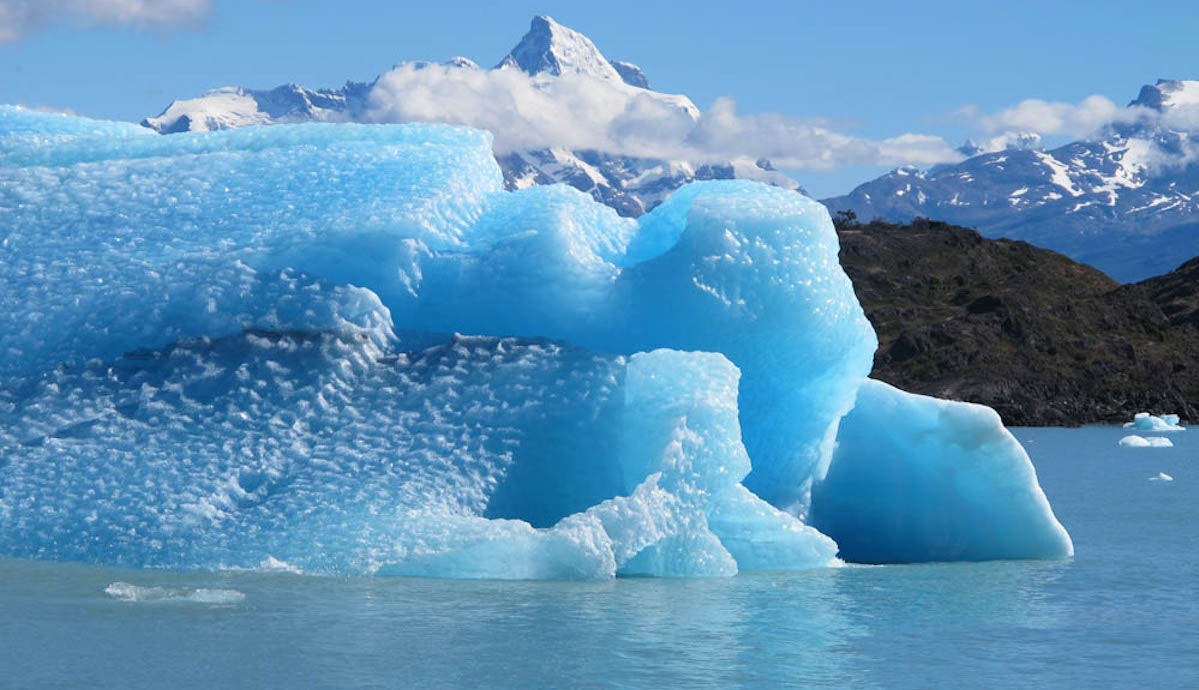
The Upsala Glacier in Argentina, like many of Earth's glaciers, has been thinning and retreating at a rapid pace. According to a new report, worldwide glacier thickness is at a record low. Credit: tienne Berthier, Université de Toulouse/NASA Goddard Research & Developments is a blog for brief updates that provide context for the flurry of news that impacts science and scientists today. The seventh edition of an annual report analyzing Earth’s “planetary vital signs” indicates that Earth systems are rapidly destabilizing, some at an accelerating rate. The report, published today in BioScience, analyzed 16 of these signs, including greenhouse gas emissions levels, ocean heat content and acidity, the mass of major ice sheets, the number of hot days, Earth’s surface temperature, and more. By tracking these vital signs each year, “we can see where things are getting worse and where progress is being made,” wrote report coauthor William Ripple in an email. Ripple is an ecologist at Oregon State University. This year, global sea level, global ocean heat content, worldwide glacier thickness, the mass of the Greenland ice sheet, and the atmospheric concentration of each of the three most common greenhouse gases are at record extremes. The report notes that in May of this year, levels of atmospheric carbon dioxide breached 428 parts per million, which is about 50% higher than pre-industrial levels of the gas. Researchers tracked 16 “planetary vital signs” in their analysis. Click image for larger version. Credit: Ripple et al. 2026, doi.org/10.1093/biosci/biag125 The rate of global warming is accelerating, according to the report, and has doubled from about 0.19°C (0.34°F) per decade from 1970-2010 to about 0.36°C (0.65°F) per decade from 2010 to present day. Ocean heat content is increasing at an accelerating rate as well. Fossil fuels, by far the main driver of human-caused climate change, remain the dominant fuel source for the world’s population. The report notes that worldwide consumption of oil, coal, and gas increased by 0.9% in 2025. Alarming Acceleration The report’s authors warn that accelerating warming trends raise the risk of parts of Earth’s climate system breaching so-called “tipping points,” or marks at which the affected processes are so destabilized that they cannot return to pre-climate change conditions. The slowing of the Atlantic Meridional Overturning Circulation (AMOC), the runaway drying and deforestation of the Amazon rainforest, and the abruptly accelerated melting of the Greenland and West Antarctic ice sheets are among the Earth system tipping points scientists have identified. Ripple wrote that the accelerating trends seen in the recent report were particularly concerning in light of the threat of approaching these tipping points. “Continued warming could trigger additional feedbacks and tipping points that would make climate change increasingly difficult to control.” Nico Wunderling, a climate scientist at the Potsdam Institute for Climate Impact Research who was not involved in the BioSicence report, wrote that the “worrying negative trends” present in the report “need to be watched closely,” particularly because the threat of reaching tipping points may increase as warming accelerates. There is some evidence, for example, that it is the rate of climate change rather than the actual global temperature that could trigger the slowing of AMOC. Renewables Boom Still, encouraging trends exist as well, mainly the rapid expansion of renewable energy capacity and battery storage. In 2025, for example, renewable energy surpassed coal in global electricity generation, an “important turning point,” Ripple wrote. “These developments show that we have some of the technologies needed to move away from fossil fuels. The challenge now is getting them deployed fast enough to actually reduce fossil fuel consumption.” Wunderling agreed that the scale and speed of solutions reported in the BioScience assessment were “particularly encouraging.” Though cutting emissions is necessary to slow climate change, it won’t be enough on its own, the report’s authors write. This conclusion supports a recent United Nations report indicating carbon removal will be necessary to avoid the worst impacts of climate change. Ripple hopes fellow scientists continue to see the importance in communicating the risks humanity faces due to climate change and the solutions that are available. “We need to make our science understandable to the public and policymakers,” he wrote. “Scientists have an important responsibility not only to conduct research but also to communicate what they are finding.” —Grace van Deelen (@gvd.bsky.social), Staff Writer These updates are made possible through information from the scientific community. Do you have a story about science or scientists? Send us a tip at [email protected]. Text © 2026. AGU. CC BY-NC-ND 3.0Except where otherwise noted, images are subject to copyright. Any reuse without express permission from the copyright owner is prohibited.
2026 State of the Climate Report Shows a Planet Reaching Its Limits
Full Article
Original Source
Read the full article at Eos →KhanList aggregates and links to publicly available news content. We do not host full articles from third-party sources. Always verify important information with original sources.