
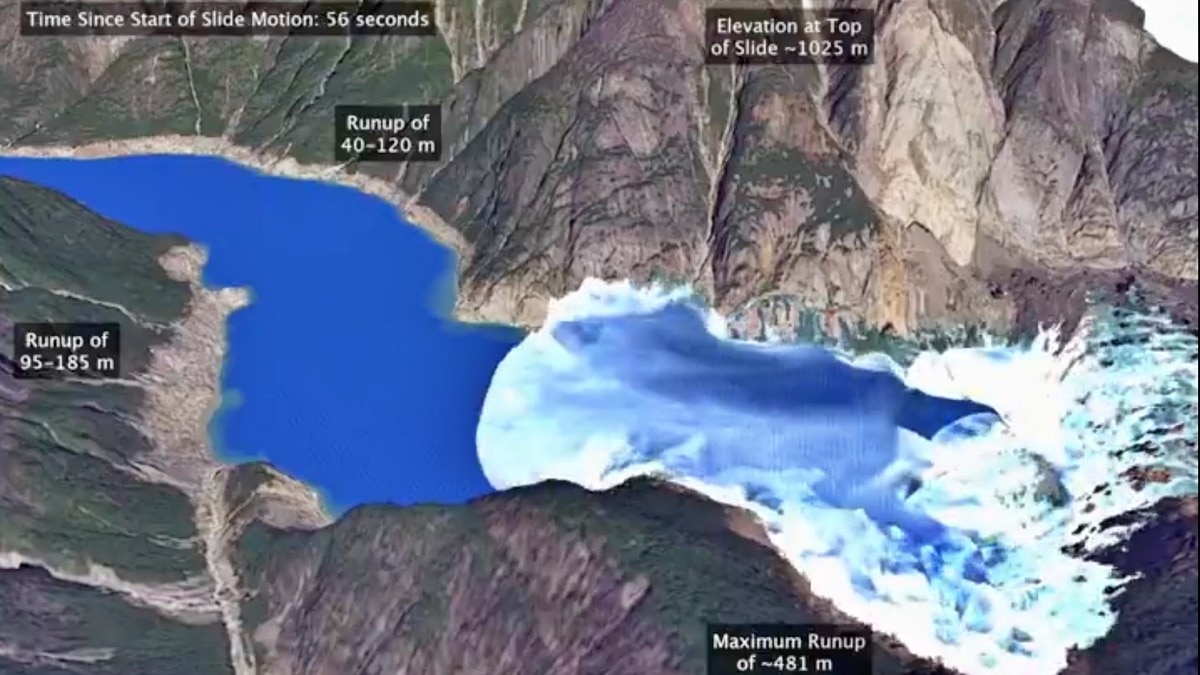
A landslide beside South Sawyer Glacier sent a huge tsunami through Alaska's Tracy Arm fjord on 10 August 2025. The near miss for passing tourists has sharpened concerns over glacier retreat, unstable slopes and the need for early warnings.The tsunami struck Tracy Arm fjord on August 10, 2025, after millions of tonnes of rock plunged into the water from a mountain. (Photo: X/UNDRR)New Delhi,Sep 28, 2026 13:24 ISTA massive landslide in Alaska triggered a 1,580-foot (481-metre) tsunami in August 2025, producing the second-highest tsunami wave recorded in history.The 1,580-foot tsunami towered as high as six-and-a-half Qutub Minars stacked on top of one another.The disaster unfolded just hours after tourists sailed past the location, unaware that the surrounding mountain was on the verge of collapse.The tsunami struck Tracy Arm fjord on August 10, 2025, after millions of tonnes of rock plunged into the water from a mountain beside South Sawyer Glacier. The resulting wave surged up the opposite side of the fjord, stripping vegetation and soil and exposing bare rock. Researchers from the Alaska Earthquake Center, in a new study, said the event highlights a growing danger across Arctic regions as glaciers retreat and mountain slopes become unstable.HOW A MOUNTAIN COLLAPSE TRIGGERED A GIANT WAVEThe previous evening, passengers aboard the Hanse Explorer had finished taking photographs and videos of South Sawyer Glacier before the vessel sailed away. Around 5:00 am the next morning, the mountainside collapsed into the fjord, transferring the enormous momentum of the falling rock into the water.The resulting tsunami sent water and debris soaring 1,580 feet above sea level, exceeding the height of Taipei 101, one of the world's tallest skyscrapers.Fortunately, no ships were nearby when the tsunami struck. However, the incident prompted some cruise operators to avoid Tracy Arm.Scientists say the conditions that triggered the disaster are not unique to Alaska and are increasingly appearing in Greenland and Norway.MELTING GLACIERS MAY BE DESTABILISING MOUNTAINSThe researchers identified several warning signs preceding the collapse.The glacier beneath the landslide site had retreated by more than a third of a mile in the preceding two months, while rapid ice calving and heavy rainfall further weakened the mountainside.Rainwater entering cracks in the rock increased pressure within fractures, potentially pushing the slope closer to failure.Most notably, thousands of small seismic tremors were recorded in the days before the landslide.Scientists believe that monitoring these signals alongside weather conditions and glacier retreat could help establish early-warning systems for ships and coastal communities.CAN SCIENTISTS PREDICT THE NEXT TSUNAMI?Researchers propose a three-stage alert system, progressing from elevated risk to immediate danger and an ongoing landslide.Seismic monitoring could potentially detect a major landslide within minutes, allowing authorities to issue warnings. Depending on distance, ships farther away could receive around 10 minutes of notice.No monitoring system operating at this scale currently exists in the US.Scientists say improved weather monitoring, seismic networks and communication systems could help reduce the danger as Arctic tourism continues to grow.The Alaska disaster demonstrates how rapidly changing glaciers can transform spectacular landscapes into hazardous environments, making early warnings increasingly important for protecting visitors and coastal communities.- Ends
2025 saw 2nd-highest tsunami wave: It was the size of 6.5 Qutub Minars
Full Article
Original Source
Read the full article at Indiatoday →KhanList aggregates and links to publicly available news content. We do not host full articles from third-party sources. Always verify important information with original sources.