
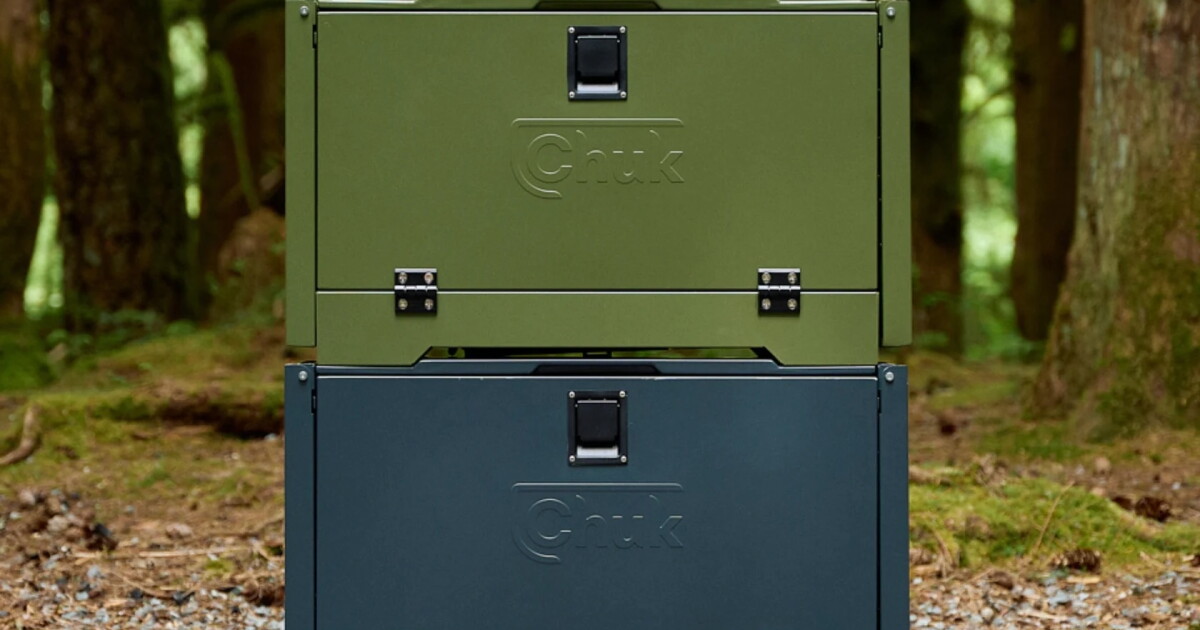
Nearly two years ago, we took a look at the Brio Kitchen Box that was running on Kickstarter at the time. We hadn't heard much about the project since, but then the full-blown production model showed up at Overland Expo Mountain West. Only it wasn't called the Brio – it was rebranded the Chuk Box. Happily, the name seems to be the only major change, as the box brings the same stackable portability and modular performance to car and camp. It wasn't even a Chuk Outdoors (or Brio) booth at which I stumbled upon the versatile kitchen box. It was at camper van component supplier GoCode's booth, where it just happened to be set up for the company's own cooking purposes. The rep with whom we spoke had nothing but good things to say about the unit. We stumbled upon the Chuk box at an unrelated booth at Overland Expo Mountain West, where it was closed with a stove on top and Rux cargo box peeking out from below Chuk Outdoors The stand-up aluminum box immediately brought me back to sometime in the early/mid-2010s, when retail chuck boxes seemed to be having a powerful moment ... such a moment, in fact, that a gorgeously crafted Austrian version bulldozed the generous limits of overland market excess a wee bit too far in asking over US$6,000 a pop. Other takes on the genre were more modestly priced, though still a hike from the build-it-yourself versions about which some commenters reminisced from their days in Scouts (and just tinkering in their own garages). As it turns out, the retail chuck box's "moment" has spilled over into a multi-decade-long run. It's just that the basic design has diversified so much with new formats and breakthroughs like portable electric faucet systems, the category is no longer defined merely by simple, front-loading box built to carry cooking equipment via a series of shelves and cubbies. Nowadays, the concept has mutated into something more like a full RV kitchen without the RV (or outside the RV), sometimes packed into a box burly enough to survive an active war zone. One even comes built around an oven. But we like that Chuk rolls things back to the basics, updating the classic chuck box with a few unique advantages. Things really took off for the creators after we last looked at it. Nearly a month later, Brio wrapped up a highly successful Kickstarter campaign on October 31, 2024, bringing in more than $220,000 – the humble chuck box proved it was still dirty with popularity. The original Brio Kitchen Box prototype Brio Outdoors Fast-forward a few months and as Brio was ramping up its development efforts, it ran into a branding issue: another company in the outdoors space had a name that ran too close (we're guessing maybe Breeo smokeless fire pits). So the startup held a naming contest and came up with "Chuk," a name that drew it even closer to nearly every competitor in the segment, albeit closer to the name of their generic product, not their trademarked brands. That's a big upgrade in branding, if you ask us. The "Chuk" name describes exactly what it is and the decoupled "k" in the purposeful misspelling really catches the eye. To us, "Brio" reads quite generic and forgettable in comparison. In fact, it seems the kind of branding revamp that could separate a successful new product from a forgotten failure. Chuk Outdoors began delivering its rebranded, refined production kitchen boxes to Kickstarter supporters in August 2025 and completed backer deliveries earlier this year. The Chuk box keeps the kitchen packed and ready to ride, you just worry about other camping gear and provisions Chuk Outdoors And that about brings us up to the production version that's currently sold out but returning to inventory in a few weeks. It looks similar to the 2024 Brio prototype but has gone through a serious development and refinement regimen, right down to the smallest hardware.Chuk admits in a blog post that its Kickstarter campaign was selling the vision of the box it planned and not so much the physical model it had in hand at the time. That one was still a really rough prototype and didn't work as ultimately intended. It took a trip to China, new prototypes from multiple manufacturers, and various iterations of moving components and locking mechanisms to evolve the box from photogenic but barely operable first attempt to backer-ready production model. The Kitchen Box as currently displayed on Chuk's website Chuk Outdoors The finalized box features legs that store out of the way up in the recessed base for travel, then spring out and lock in place to raise the top height to a comfortable working level between 32 and 34 in (81 and 86 cm) high. The disappear-away legs also allow multiple closed Chuk boxes to stack together neatly for the most efficient use of space during travel.When using a single Chuk box alone, its side worktops flip up like arms to complement the extended legs. Chuk estimates total setup time at 16 seconds, but you probably won't want to stopwatch it or anything – nothing wrong with enjoying the scenic route to a half-minute setup time or so. Adjustable feet help to level and stabilize the deployed kitchen box on uneven ground. Chuk has tested out a variety of readily available retail camping stoves and written a breakdown on its favorites. It's also developing its own dual-burner stoveChuk Outdoors Once the unit is raised and stable, the lid can either flip back for access to the top shelf, sized to hold various dual-burner portable stove models, or it can stay closed to extend the worktop a clean 57 inches (145 cm) from side to side. The front cupboard hatch door, meanwhile, folds down to access the interior and create another surface for work and storage.Inside, the Chuk box houses a series of three shelves that vary in depth to the extent that Chuk labels them a shelf, a tray and a drawer. Each secures and slides via a series of side rails that look very similar to the ones for adjusting height of the grates on my Camp Chef vault smoker. And as with that smoker, you can rearrange the height positions as needed. Chuk shows the flat shelf on top for holding the stove, the tray below for storing things like plates and utensils, and the drawer on bottom for taller and deeper wares like bowls, pots and gas canisters. Chuk equips each box with a triple stack with deep drawer, shallow tray and flat shelf Chuk Outdoors In terms of building out a group base camp kitchen, individual Chuk boxes can be stacked and lined up next to each other to grow out the continuous space. You can then have multiple cooks firing up stoves, grills and griddles and working together to prepare a feast for a small, ravenous army of campers or picnickers. This modular setup looks cool, but we're thinking actual camp cooks would prefer to separate the two individual stacks to have more elbow room while slicing, dicing and pan frying Chuck Outdoors That's it for the basic box, which is made from aluminum and designed to hold up to the abuse of constant travel and use outside. The non-corrosive aluminum shell is also built to keep rain and dust out. It weighs 32 lb (14.5 kg) empty and can be carried by one or two people with slide-up handles that nest neatly into recesses to maintain the box's neat-packing vertical walls.Those who want to take the Chuk box's functionality even further can add compatible accessories like the paper towel holder, garbage bag ring, lantern hanger, utensil organizer, storage hooks and cutting board. Then again, after spending $665 on the empty box, they might not be too eager to drop another $12 to $219 on options – at least that's the impression we got, loud and clear, from many of our readers during the start of the retail chuck box boom over a decade ago. Source: Chuk Outdoors
16-sec stackable camp box jumping-jacks into a solo or group cookery
Full Article
Original Source
Read the full article at Newatlas →KhanList aggregates and links to publicly available news content. We do not host full articles from third-party sources. Always verify important information with original sources.