
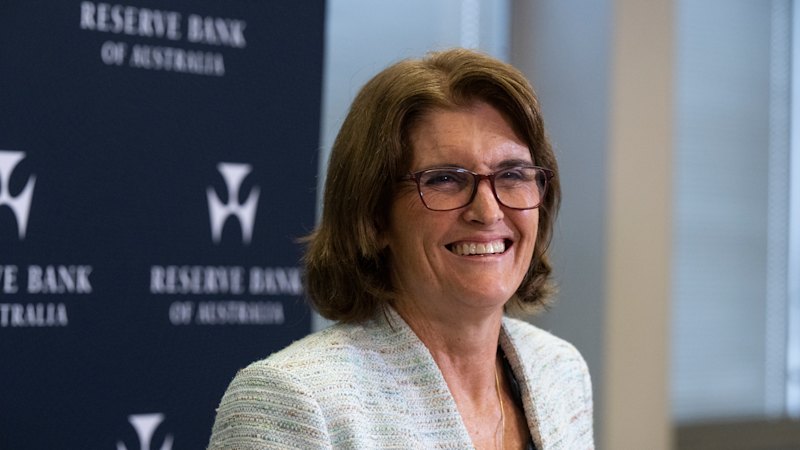
September 28, 2026 — 4:25amAcross 22 press conferences and 150,000 words, Reserve Bank governor Michele Bullock has headed a revolution in how interest rates are set in this nation.The person who is most central to Australians’ day-to-day economic fortunes stood up on February 6, 2024, to face her first press outing in charge of the central bank.Michele Bullock was all smiles at her first press conference as RBA governor in February 2024.Louise KennerleySince then, she has answered almost 600 questions while speaking directly to millions of borrowers, investors, business operators and people with savings.At that press conference, the first by an RBA governor outside the turmoil of the COVID pandemic, she spent an hour warning that the bank was “not ruling in or out anything”, explained the damage caused by inflation and reflected on how her children had saved to pay for tickets to Taylor Swift’s Eras Tour of Australia.While Bullock’s predecessor, Philip Lowe, had done a handful of press conferences during the pandemic, the event on February 6, 2024, marked a critical turning point in how the Reserve Bank would explain interest rates, the economy and even the inflationary impact of major touring artists.By most measures, Bullock – and the bank – affects the daily economic lives of Australians in more direct ways than Treasurer Jim Chalmers or his state counterparts. Each decision to cut, hike or hold rates has billions of dollars riding on it, the most visible being the potential change in millions of monthly mortgage payments.But until the press conferences began, the bank’s communication could only be described as cryptic. For instance, there were decades when the RBA did not even tell the public if official interest rates had been changed.Former Reserve Bank governor Phil Lowe at a rare pandemic-era press conference after the bank’s July board meeting in 2021. James BrickwoodThat had improved dramatically under a succession of governors, beginning with Bernie Fraser and then the significant steps taken by both Glenn Stevens and Lowe. But the independent review of the bank released in 2023 urged the RBA to take the next step – have the governor face a gaggle of journalists.In less than three years, she has arguably answered more questions from the media than the past five governors put together.Ahead of another critical press conference at which she is likely to confirm another interest rate rise for the nation’s borrowers, an analysis of every word uttered by Bullock across her 22 press appearances shows just how her communication with the public has changed, albeit with one constant. Uncertainty.The hold phase (2024)Bullock chaired her first meeting as RBA governor in October 2023. A month later, the bank pushed the official cash rate to 4.35 per cent. It would not change until early 2025.This was the start of the RBA’s “hold phase”.Her first press conference marked not only the bank’s new way to communicate with the public but a year-long period in which economists and the media tried to understand Bullock and her view of inflation and the economy.Philip Lowe had talked often about the “narrow path” the bank was trying to negotiate through, and out of, the pandemic. It was one of his defining analogies.But Bullock revealed her own key catchphrase early in that February press conference.“We are not ruling out what we might have to do next. We’re not ruling in or out anything.” (February 6, 2024)Bullock held eight press conferences during 2024. She used the term “not ruling in or out” 11 times in seven of those press grillings.That first occasion facing a room full of journalists also marked the initial utterance of an even more common refrain – that inflation is not good.Bullock has used a variation of the “inflation is bad” term on at least 21 occasions, or effectively every time she has conducted a press conference. Usually “high inflation is bad for everyone” or “inflation hurts all Australians”.While serious in her discussion about the economy, Bullock has proven to have a sense of mischief.At that very first press conference, she was asked about services inflation.Describing the concept of services as something “that you can’t drop on your foot”, she then went on to discuss whether Taylor Swift’s high-priced Eras Tour tickets were a sign of latent inflationary pressures.“Clearly, for a lot of people, Taylor Swift is very important,” she said.It was in August 2024 that she suggested those who knew exactly what the RBA should do might be showing overconfidence.“I’ve read commentators with absolute certainty that we must lower interest rates … I’ve also heard commentators with absolute certainty that we must raise interest rates now. I wish I had their certainty.” (August 6, 2024)The rate cut phase (2025)At her first press conference in 2025, Bullock confirmed news welcomed by home borrowers, business owners and Anthony Albanese – official interest rates would be cut.The quarter percentage-point reduction was, the governor said, recognition that inflation pressures had eased and wages growth was moderating. But it came with a large caveat.“The board judges it’s time to reduce a little bit of that restrictiveness, but we cannot declare victory on inflation just yet.” (February 18, 2025)War, particularly Russia’s invasion of Ukraine, had been a key factor in the oil price surge that contributed to the interest rate rises of 2022 and 2023. But another type of war was about to upend everything.On April 2, Donald Trump held court outside the White House where he announced his “liberation day tariffs”. From Brazilian soybean farmers to the penguins and seals of Australia’s Heard and McDonald Islands, no one was spared from the Trump tariff onslaught.The turmoil roiled financial markets, economies and the thinking of every central banker. The Reserve Bank briefly discussed a half percentage point cut to offset the expected fallout.“Since our last meeting, global economic and policy uncertainty has increased substantially following tariff announcements by the US administration … It’s been a complete rollercoaster, I’d have to say.” (May 20, 2025)Business operators, consumers and investors all prefer stability when it comes to the economy. But Trump, the leader of the world’s largest economy, was deliberately adding instability.At half of the governor’s press conferences, the Reserve also releases its quarterly outlook on the economy. These “statements on monetary policy” contain key forecasts on everything from inflation to household spending.Through the hold phase, these outlooks had contained the word uncertainty on 104 separate occasions. In the May report alone, released as the governor discussed the Trump rollercoaster, uncertainty got used 132 times.In Bullock’s own words, it was even worse than that.“The key point about the situation we’re in is it’s not just uncertain, it’s actually unpredictable.” (May 20, 2025)So common were Bullock’s references to uncertainty becoming that we created a measure of it.While Trump abandoned his liberation day tariffs (only to revisit them a year later), the Reserve Bank’s own faith in its fight against inflation started to weaken as the year progressed.At the last meeting of the year, Bullock noted that inflation had picked up, but it wasn’t yet clear whether it was a permanent lift or a passing phase.It was also the first time that she faced a question about data centres. The explosion in private sector spending on these was only just starting to be noticed. It would be an issue of much more importance as the bank entered the third distinct phase of Bullock’s tenure.The rate hike phase (2026)Bullock opened her first press conference of this year by confirming an increase in the cash rate – the first of three straight rate rises.“The recent run of data gives the board a clear enough view that the underlying pulse of inflation is too strong.” (February 3, 2026)The move was not unexpected. Inflation had clearly increased through the previous two months with little sign it would ease without tighter monetary policy.But this was on February 3. The uncertainty that had dominated her first two years facing press conferences was to climb again three weeks later when US and Israeli forces launched Operation Epic Fury against Iran.At the bank’s mid-March meeting, where the cash rate was lifted again, the impact of the Iran war was still being digested.“If the Middle East conflicts get worse or are not resolved soon, higher fuel costs will push inflation here even higher. There’s also a risk that global growth slows, which could flow on to lower growth here.” (March 17, 2026)While Donald Trump had said he expected the war to be over in four to five weeks, most outside observers were far more sceptical of a short conflict.Some of that scepticism was evident in the bank’s March decision. It was a 5-4 vote to hike.For a central bank, pushing up interest rates to deal with inflation that may be fuelled by an event beyond its control – such as a war in the Middle East – is the worst of all worlds. It was Bullock who first raised the prospect of an economic downturn.“We don’t want to see a recession or a large rise in unemployment if we can avoid it.” (March 17, 2026)The war caused havoc with the bank’s own key forecasts. In early February, the bank expected headline inflation would be 4.2 per cent by June, with underlying at 3.7 per cent.By May, with the war still going, it forecast inflation to hit 4.8 per cent in June (with underlying at 3.8 per cent). But in August, inflation was actually at 3.9 per cent with underlying at 3.6 per cent.At the May meeting, where the scary forecasts for an inflation spike were digested, the bank pushed up the cash rate for a third time this year. But, like her entire term so far in charge of the bank, the decision was grounded in events from overseas.“It’s quite possible that we wouldn’t have had to increase interest rates a third time if the shock hadn’t occurred, but the fact is the [oil] shock did occur.” (May 5, 2026)Now, financial markets are convinced the Reserve will drive up the cash rate to 4.6 per cent by year’s end – perhaps as soon as later this month. That would take the cash rate to its highest rate since 2011.The federal government and borrowers are bracing for the hit that will come as the bank struggles to get inflation within its 2-3 per cent target, something it has achieved in just 20 of the past 138 months going back to 2014.All of this analysis is up to Bullock’s last press conference in August. Since then, interest rates on government debt have soared, oil prices have pushed beyond $US100 a barrel, and Donald Trump has promised $US5000 cheques to voters and banned Canadian yoghurt (among other goods) for American consumers.When Bullock faces her next press conference on Tuesday, the only certainty is that the governor will talk again about the uncertainty facing her and the Reserve Bank.Start the day with a summary of the day’s most important and interesting stories, analysis and insights. Sign up for our Morning Edition newsletter.From our partners
150,000 words, zero guarantees: Bullock’s high-stakes interest rate revolution
Full Article
Original Source
Read the full article at Smh →KhanList aggregates and links to publicly available news content. We do not host full articles from third-party sources. Always verify important information with original sources.