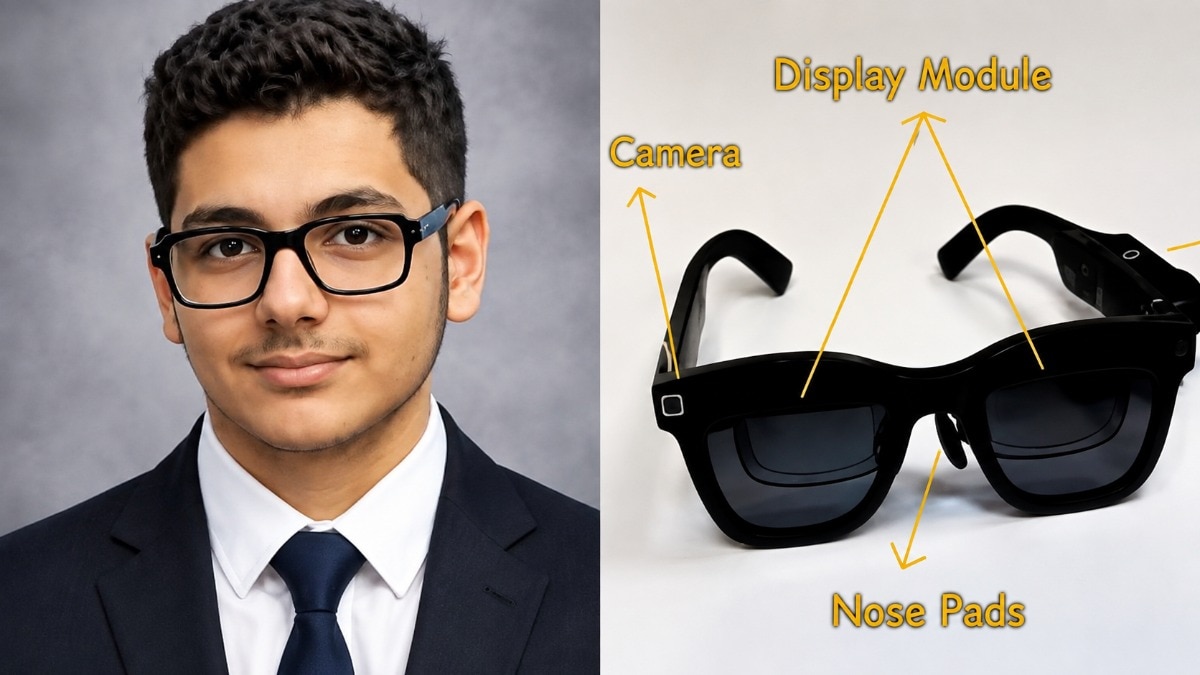
Delhi Class 10 student Paras Tickoo has built Hear Bright, an AI smart-glasses prototype for deaf users. The project turns his coding journey into an accessibility effort shaped by real-world feedback.For Paras Tickoo, the journey into coding began with a classroom experience that stayed with him long after the lesson ended.When he was in Class 4, Paras first learned about coding. Last year, he encountered the challenges faced by deaf and hard-of-hearing people. What might have been a brief introduction to a social issue became, for him, a question: Could technology help make everyday communication easier?The question has evolved into Hear Bright, an AI-powered smart-glasses prototype that aims to turn sounds and conversations into visual information.Now 15 and a Class 10 student in a New Delhi-based school, Paras is combining coding, artificial intelligence, computer vision and machine learning to build technology around a simple idea: communication should be accessible to everyone. “Their world may lack sound, but it should never lack connection,” Paras says.He describes the experience he wants Hear Bright to provide as “subtitles for life.”FROM CURIOSITY TO A PURPOSE Paras's interest in coding developed gradually. He has been learning with Codingal since 2021, beginning with visual programming before moving into web development, Python, computer vision and artificial intelligence.His early projects included a face-detection application and a hand-tracking drawing tool. Each project introduced him to a new way of thinking about technology, not simply as something to build, but as something that could interact with the real world.The idea for Hear Bright became more personal after Paras learned about the experiences of Saransh, a child from his hometown. Seeing how communication barriers could affect ordinary interactions made the problem tangible.TURNING SOUND INTO SOMETHING VISIBLEHear Bright is designed as an assistive smart-glasses system that can make important auditory information visible.A microphone captures speech and converts it into text that can be displayed to the wearer. Paras is also developing the system to recognise selected Indian Sign Language and custom gestures, with the goal of converting recognised gestures into spoken output.The glasses are additionally being designed to provide visual alerts for important environmental sounds, including alarms and sirens.The prototype brings together a camera, microphones, speakers, display modules, controls, a microcontroller and a 3D-printed frame.Behind the hardware is a collection of technologies that Paras has learned and adapted for the project, including MediaPipe, TensorFlow.js and Conv1D-based machine-learning models.THE HARDEST PROBLEM IS NOT ALWAYS THE HARDWAREOne of the biggest challenges has been gesture recognition.A hand gesture can look different depending on a person's position, the speed of the movement, lighting conditions and the angle of the camera. A model that recognises a gesture accurately in one situation may struggle when those conditions change.Paras has been addressing the problem by collecting gesture data, using computer vision to track hand movements and repeatedly training and refining his models.The system is still evolving, and Paras is candid about that.Rather than treating the prototype as a finished product, he has begun showing it to intended users and working with NGOs to understand what works in real-world situations and what needs to change.He wants Hear Bright to become lighter, wireless and easier to wear, while improving gesture-recognition accuracy, display quality, multilingual support and Bluetooth connectivity.INSPIRED BY THE WAY ELON MUSK THINKS ABOUT TECHNOLOGYParas counts Elon Musk among his biggest inspirations.For him, Musk's approach to ambitious technological problems is a source of motivation.Hear Bright may be a much smaller project than the technologies developed by the companies Musk has helped build, but the underlying lesson Paras takes from his inspiration is straightforward: difficult problems are worth attempting.For a teenager learning to code, that can be a powerful idea.LOOKING TOWARDS IIT - AND BEYONDParas's ambitions extend beyond Hear Bright.He hopes to pursue higher education at one of India's premier engineering institutions and has spoken to India Today about his aspiration to get into an IIT and continue learning there.For him, an IIT would not simply represent a prestigious academic destination. It would be an opportunity to deepen his understanding of technology, work with other young innovators and develop the skills needed to turn prototypes into solutions that can operate at scale.His journey so far suggests that he sees education and innovation as closely connected.Coding taught him how to build. Real-world problems taught him what to build for.MORE THAN A PROTOTYPEThere is still a long road ahead for Hear Bright.The technology needs further testing. Gesture recognition must become more reliable. The hardware needs to become lighter and more practical. The interface has to work naturally in everyday situations.And most importantly, the project needs continued feedback from the people it hopes to support.His journey began with an experience in Class 4, developed through years of coding education and experimentation, and has now reached national innovation platforms.The technology may change significantly as the project evolves. The purpose behind it is likely to remain the same.“Building this project taught me that technology becomes truly meaningful when it solves a real problem and improves someone else’s life.”Subtitles for life, indeed.- EndsPublished By: Rishab ChauhanPublished On: Aug 19, 2026 17:06 IST
15-year-old Delhi schoolboy inspired by Elon Musk is using AI to change lives
Full Article
Original Source
Read the full article at Indiatoday →KhanList aggregates and links to publicly available news content. We do not host full articles from third-party sources. Always verify important information with original sources.