
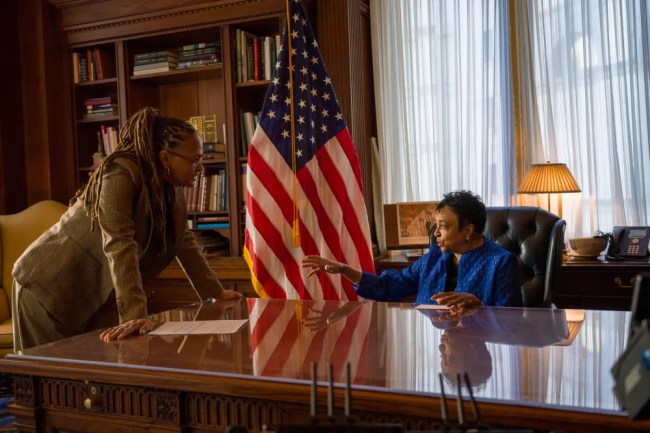
In the months leading up to the end of the American Civil War, Frederick Douglass spoke at the Massachusetts Anti-Slavery Society’s annual meeting in Boston about what would remain after the rebellion was defeated. “That enmity will not die out in a year,” he warned. “It will not die out in an age.” In Ava DuVernay’s new documentary “14th,” constitutional law expert Sherrilyn Ifill recalls Douglass’ words from his speech “What the Black Man Wants.” A distinguished attorney, Howard University law professor and former head of the NAACP Legal Defense Fund, Ifill is the closest thing the film has to a narrator. Her invocation of Douglass serves as a refrain, returning again and again to make one thing clear: we are living in one of the ages he predicted. The Fourteenth Amendment made birthright citizenship the law of the land, ensuring that formerly enslaved people and others born on American soil — like the children of Chinese railroad workers, for example — were citizens. But Ifill astutely explains one of its great failures: Against Douglass’ wishes, the amendment did not explicitly protect the right to vote. Douglass foresaw that leaving Black voting rights vulnerable would give the same people who fought to preserve slavery the opportunity to strip those rights away for generations. “14th” looks back at history as a necessary playbook for the present. We are living amid the gutting of the Voting Rights Act, widespread voter-suppression efforts and challenges by the Trump administration to birthright citizenship. The message is crystal clear: This isn’t just history. It’s right now. A companion piece to DuVernay’s 2016 documentary “13th,” which examined the constitutional amendment banning slavery through the lens of mass incarceration, “14th” arrives a decade later during the second Trump administration. It is a maximalist odyssey through American history, guided by leading thinkers including Ifill, Bryan Stevenson, David Blight and Jelani Cobb; commentators such as Van Lathan; and politicians including Alexandria Ocasio-Cortez, Jeff Flake and Stacey Abrams. Together they trace how the amendment transformed the country and what is at stake as its guarantees come under sustained attack. The two films share structural and visual DNA. Both rely on a series of talking heads to tell their stories. However, where “13th” placed its interview subjects against textures associated with prisons and hard labor, “14th” seats its experts in libraries, museums and universities, halls of learning that insist visually on the value of expertise at a moment when expertise itself is under attack. An animated five-pointed star represents the amendment’s five sections, each point gradually torn away as the documentary charts the erosion of its protections. In this sense, perhaps the most successful part of “14th” is that it performs a real public service. Its first section is also its strongest, offering vital information the filmmakers correctly assume many viewers do not know: who shaped the amendment, how Reconstruction transformed American citizenship and how many of the values we associate with multiracial democracy emerged from the constitutional revolution that followed the Civil War, not from the Constitution signed in 1787. But “14th” has so much to tell us that its refusal to edit more rigorously works against it in the end. More than 50 talking heads appear. DuVernay clearly wants to reach as broad an audience as possible, incorporating conservatives alongside progressive advocates, politicians, historians, attorneys, comedians and political influencers. The instinct makes sense in this era of hyperpolarization. Yet cinematically, the sheer number of interviewees dilutes the power of the strongest voices. Did we really need Hasan Piker in his Birkenstocks and wide-leg pants in order to reach young viewers? Probably not. By the time Gen Z political influencer Dean Withers appears for the first time near the end of the doc to deliver a sleepy sound bite that feels destined for the cutting-room floor, you start wondering why DuVernay is introducing another character when so many compelling figures already onscreen could have been reappeared and probably said it better. Even the captioning of subjects feels oddly inconsistent. Van Lathan is not identified until his second appearance. The same happens with historians Eric Foner and David Blight. These may sound like minor details, but in a work asking viewers to track dozens of people across several centuries of American political history, they add to the cognitive clutter. Sherrilyn Ifill could have solved much of this. Of the more than 50 interviewees, hers is the voice the documentary can’t help but return to. She grounds “14th,” and one wishes DuVernay had committed more fully to her as a narrative guide, as she speaks in a way that is accessible and engaging. (The study and application of the fourteenth amendment has been her life’s work.) Had the film stayed closer to her, she might have served as the connective tissue carrying viewers through its historical turns and accumulating reasons for despair. Instead, she disappears for stretches before returning with the Douglass refrain. To absorb and be impacted by material this dense, the broad audience DuVernay clearly wants to reach needs someone to hold its hand. Ifill could have been that person. The larger problem is not simply the talking-head format but the claustrophobia it creates. One of the most welcome sequences follows Devon Henry, the Black contractor responsible for removing Confederate monuments along Richmond’s famed Monument Avenue after white contractors refused the job. I found myself taking an involuntary deep breath when his sequence began. Suddenly, someone was walking. Moving through space without explaining something. For a moment, the movie opened up. Henry’s sequence demonstrates how powerful the documentary becomes when its formal choices carry as much weight as intellectual ideas. Carla Hayden’s appearance at the Library of Congress offers a similar reprieve. Instead of sitting posed with the camera capturing her face from a side angle — she actually gets the hero shot treatment -— she walks through one of the country’s great repositories of knowledge greeting visitors. The simple act of watching her move provides visual relief and the kind of impact words on their own rarely inspire. DuVernay does find inventive ways to animate the past though, and the archival material ranks among the film’s greatest strengths. Black life during Reconstruction appears not only in the South but in places we may not immediately associate with Black citizens like New Mexico or Boston. The images capture the extraordinary scope of Black efforts to educate themselves, build institutions and participate fully in citizenship after Emancipation. Archival photographs subtly come to life through animation, giving motion to otherwise static images and drawing a visual line from the people living through Reconstruction to those living now. The effect is simple but powerful: this is the past, but these were ordinary people moving through their own present just like us. Comedy provides another effective pressure valve. Clips from standup specials by George Carlin, Paul Mooney, Neal Brennan and Hasan Minhaj inject much needed comedic relief about American history. Once Mooney plants the seed of his joke about how unhappy white Americans seemed after slavery the later images of Confederate memorial groups and white crowds at lynchings take on a surreal resonance. Musically, “14th” feels like a hip-hop rock opera for the end of democracy, or perhaps a plea to save it, propelled by thumping beats. When an instrumental version of Kendrick Lamar’s “Alright” appeared, for example I instinctively snapped my fingers and thought, yes. But the documentary moved on so quickly that the cue barely had time to land. That moment encapsulates the larger problem with the film: “14th” does not lack compelling material. It just has too much of it. About two-thirds of the way through its hour-and-forty-minute runtime, I simply could not absorb any more, despite being deeply interested in the subject. The project might have benefited from an episodic structure, perhaps giving each section of the amendment room to breathe. (That is of course easy for me to suggest from outside the realities of documentary financing and Netflix distribution, but the formal choices contribute to unecessarily exhausting ride.) DuVernay has said she did not want the movie to “feel like medicine,” and the “14th” is energetic, accessible and frequently entertaining. But in casting such a wide net, the film overloads the viewer with information to the point of suffocation. That leads to a certain irony: “14th” arrives in an era that already feels like too much, one in which overwhelm about politics has become part of daily life. The documentary wants to move viewers beyond despair, yet its sheer density risks reproducing the paralysis it hopes to overcome. By the end, Ifill argues that we are once again standing at an inflection point comparable to the one the architects of Reconstruction faced. The people who emerged from the Civil War had to imagine a fundamentally different country and then write that vision into law. Americans now have an opportunity, and perhaps an obligation, to debate in good faith what the next iteration of democracy should be, she argues. That may be the most important idea in “14th.” The amendment was revolutionary because it imagined an America that had never existed before. Which brings us back to Douglass, speaking in January 1865, just over three months before the Civil War ended. “When the tall heads of this rebellion shall have been swept down,” he warned in “What the Black Man Wants,” its leaders might disappear, but the “rank undergrowth of treason” would remain. That spirit, he said, and Ifill wisely recounts, would pass “from sire to son.” “That enmity will not die out in a year. It will not die out in an age.” More than 160 years later, “14th” makes the unsettling case that the age Douglass warned us about is still not over. And where do we go from here? That is up to us. Grade: B “14th” premiered at the 2026 New York Film Festival. Netflix will release it in select theaters on Friday, November 27, and then on Netflix on Friday, December 4.
’14th’ Review: Ava DuVernay’s Overstuffed Netflix Documentary Finds Us Living in the Age Frederick Douglass Warned Us About
Full Article
Original Source
Read the full article at Indiewire →KhanList aggregates and links to publicly available news content. We do not host full articles from third-party sources. Always verify important information with original sources.