
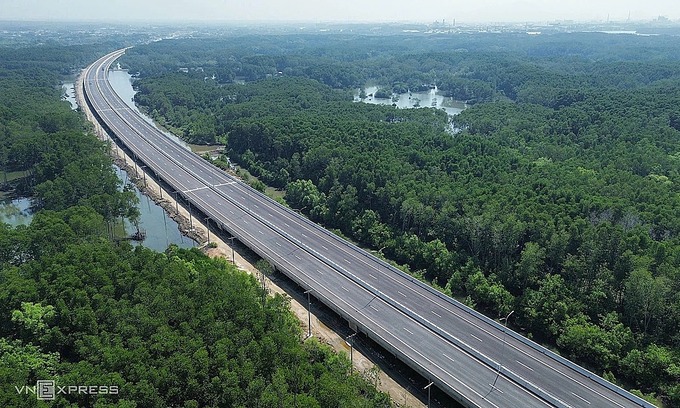
The Ben Luc-Long Thanh Expressway is set to open fully by Sept. 30, letting Mekong Delta traffic reach Long Thanh airport an hour faster without passing through downtown Ho Chi Minh City. Workers are racing to lay asphalt, run load tests and install lighting and safety fixtures on Phuoc Khanh Bridge, the last major structure on the route. The 3.1 km bridge spans the Long Tau River, linking Can Gio in Ho Chi Minh City with Nhon Trach in Dong Nai.Phuoc Khanh and the National Highway 51 interchange are due to be finished by the end of the month, said Dang Huu Vi, deputy director of the Southern Expressways Project Management Board under the Vietnam Expressway Corporation (VEC).The nearly 58 km expressway starts at an interchange with the Ho Chi Minh City-Trung Luong Expressway and Ring Road 3 in Tay Ninh Province, crosses southern Ho Chi Minh City and ends at National Highway 51 in Dong Nai.It has four lanes plus two emergency lanes and a design speed of 100 kph. Its budget, initially set at VND31.32 trillion, was later revised down to more than VND29.5 trillion (US$1.13 billion).Because the route crosses a web of rivers, canals and mangrove forest, about 20 km of it is carried on bridges and viaducts.The largest are two cable-stayed bridges, Binh Khanh and Phuoc Khanh, with towers up to 155 m tall. Both offer 55 m of navigational clearance, enough for ships of up to 30,000 metric tons to pass beneath.12 years of setbacksConstruction began in 2014 on a five-year schedule, but work ground to a halt in 2019 with about 80% of the project done, stalled by procedural and funding problems.After VEC was transferred to a new managing agency without a clear designation of who held investment decision-making authority, procedures to extend loan agreements, revise the project and allocate counterpart funding could not move forward. Many contractors left, and the two big bridges in the middle of the route sat unfinished for years.Construction resumed in late 2023 once those obstacles were cleared. The 2.8 km Binh Khanh Bridge over the Soai Rap River was completed in late 2025 but has had to wait for Phuoc Khanh, where work restarted in April 2025 after VEC picked a new contractor.The project is now more than 99% complete, with about 55 km finished. Nearly 30 km at the two ends are already in use, connecting with the Ho Chi Minh City-Trung Luong Expressway, National Highway 1, Nguyen Van Tao Street, Phuoc An Road and National Highway 51.The remaining 25 km or so cannot open until Phuoc Khanh and the interchanges are complete. VEC is inspecting the whole route, fixing defects, running load tests and signing off on traffic safety systems before opening it to through traffic. A section of the Ben Luc-Long Thanh Expressway crosses mangrove forest in Dong Nai City. Photo by VnExpress/Phuoc Tuan New corridor for the Mekong DeltaThe expressway adds a new route along southern Vietnam's east-west axis, said Bui Van Quan, chairman of the Ho Chi Minh City Transport Association. Its western end ties into the Ho Chi Minh City-Trung Luong Expressway and Ring Road 3, and its eastern end into National Highway 51 and the Bien Hoa-Vung Tau Expressway.That lets vehicles bound from the Mekong Delta for Dong Nai, Long Thanh airport or Vung Tau skirt the south of Ho Chi Minh City rather than cross it. The trip now runs through several congested roads and takes about two hours, stretching to four or five in heavy traffic, he said.Via Ben Luc-Long Thanh, he estimated, it should take 40-45 minutes, more than an hour faster and with more predictable travel times."The expressway will bring Long Thanh airport and the beaches of Vung Tau closer to some 18 million people in the Mekong Delta," Quan said.Long Thanh International Airport, Vietnam's largest by area at 5,000 hectares, is scheduled to begin commercial operations on Dec. 1.The route will also give the Southern Key Economic Region a diversion corridor, linking the Mekong Delta's producers with Long Thanh airport, the Cai Mep-Thi Vai port cluster, and industrial parks and tourism hubs to the east, cutting the time and cost of moving goods, Quan added.The region's seaports handle more than 65% of Vietnam's container volume, or nearly 18 million TEUs a year, said Dang Thi Minh Phuong, chairwoman of the Ho Chi Minh City Logistics and Seaport Association. Cai Mep-Thi Vai alone can take 24,000-TEU mother ships, but the roads serving it have not kept pace.Completing Ben Luc-Long Thanh along with Ring Road 3, the Bien Hoa-Vung Tau Expressway and Phuoc An Bridge will widen the ports' logistics hinterland and give Mekong Delta cargo easier access to the sea, she said.The expressway is also a link in the Greater Mekong Subregion's Southern Economic Corridor, which runs Bangkok-Phnom Penh-Ho Chi Minh City-Vung Tau, and was built to improve east-west traffic south of Ho Chi Minh City and move more Mekong Delta freight to export gateways.For Ho Chi Minh City, it is expected to take through-traffic off urban arteries. The Asian Development Bank (ADB), a co-financier of the project, has noted that the lack of east-west river crossings south of the city forces vehicles into the center, adding to congestion, travel time and transport costs.Project documents forecast average traffic of 40,000-70,000 passenger car units a day on the main sections by 2036. The expressway opens with four lanes and is slated for widening to eight once traffic reaches capacity, according to the ADB.Ho Chi Minh City is also building a nearly VND3 trillion ($115 million) interchange linking the expressway with Rung Sac Road in Can Gio, due for completion in 2028, and finishing an interchange with National Highway 50 to improve access from the city's south.
$1.1B expressway to cut Mekong Delta trips to Vietnam's largest airport Long Thanh by over an hour
Full Article
Original Source
Read the full article at E →KhanList aggregates and links to publicly available news content. We do not host full articles from third-party sources. Always verify important information with original sources.