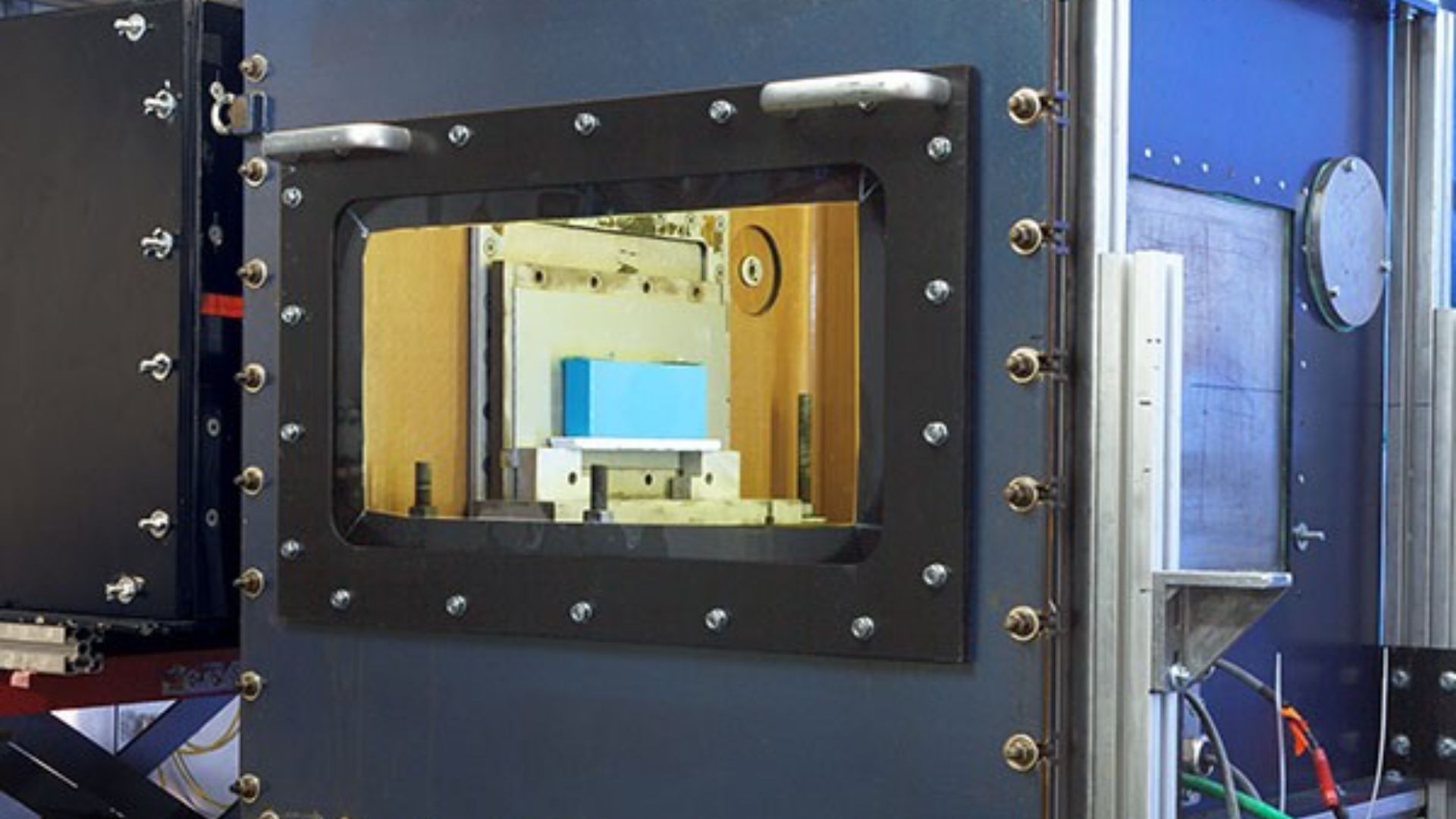
Battery engineers could soon be able to see exactly what happens inside a lithium-ion cell when it fails. On August 13, Germany’s Fraunhofer Institute for High-Speed Dynamics, Ernst-Mach-Institut (Fraunhofer EMI), announced that its high-speed X-ray technology is being prepared for industrial use with Volkswagen’s battery company, PowerCo. The system captures what happens inside large prismatic battery cells as they operate under harsh conditions. Fraunhofer EMI describes it as a “globally unique high-speed X-ray system.” This technology could help European automakers better study battery safety and improve future cell designs. Battery failures can happen quickly, which makes it hard for engineers to know exactly what goes on inside a cell. Usually, they rely on computer simulations, destructive tests, or measurements from outside the cell. Fraunhofer EMI’s system lets researchers see inside the cell as it is tested. It uses high-performance X-ray imaging along with a special battery test chamber and sensors that simultaneously monitor temperature, pressure, voltage, and gas flow. The system can record up to 1,000 images every second. This allows researchers to watch gas forming, materials moving, and cracks spreading in great detail. “Recording up to 1,000 images per second, it reveals processes such as gas formation, material displacement, and crack propagation inside the cell at extremely high resolution—events that until now have remained hidden from view.” The Fraunhofer EMI has developed a globally unique high-speed X-ray system that makes dynamic processes inside large-format prismatic cells visible in real time for the first time. (Image credit: Fraunhofer EMI) Built to withstand thermal runaway The technology also needed to handle the harsh conditions that occur when lithium-ion batteries enter thermal runaway. Fraunhofer EMI created a protective chamber to shield sensitive X-ray equipment and keep it safe during these tests. Dr Sebastian Schopferer, Head of Battery Safety at Fraunhofer EMI, said: “Our in-situ method allows us to see what happens inside a cell in fractions of a second—in real time and at the highest resolution. This fundamentally changes how we understand battery design and safety.” Fraunhofer EMI has already used the system to study how materials are ejected during thermal runaway and how failures spread in multi-cell battery setups. The institute said that several German automakers, including Volkswagen and Audi, have used this data. “The resulting data enables engineers to assess cell designs based on directly observed processes and refine simulation models with greater precision—delivering direct added value for product development and certification processes.” Still image from an X-ray video recorded during a nail penetration test of a prismatic lithium-ion cell. (Image credit: Fraunhofer EMI) PowerCo prepares industrial deployment The next step is to adapt the technology for use in industrial battery development. Fraunhofer EMI will share its expertise in materials research, battery testing, and high-speed imaging. PowerCo will offer production requirements and access to its cell designs. PowerCo said that results from the partnership are already helping to develop better production cells. A dedicated X-ray system is planned for PowerCo’s site in Salzgitter, Germany, by 2028. The system will work with different cell formats and battery chemistries, so it can keep up as battery technology evolves. A closer look at future battery cells Speaking about the new technology, HW Vassen, CTO at PowerCo, highlighted, “With in-situ high-speed X-ray imaging, we are taking battery research to a new level.” “For the first time, we can make the dynamic processes inside cells visible in real time and in slow motion. This unprecedented depth of insight allows us to optimize battery cell safety and design in a highly targeted way and bring innovations into industrial use much faster. Together with Fraunhofer EMI, we are advancing high technology made in Europe and are strengthening Europe’s role in the battery industry.”Get the latest in engineering, tech, space & science - delivered daily to your inbox.A versatile writer, Sujita has worked with Mashable Middle East and News Daily 24. When she isn't writing, you can find her glued to the latest web series and movies.
1,000 images per second: New battery X-ray tech reveals hidden failures in blink of an eye
Full Article
Original Source
Read the full article at Interestingengineering →KhanList aggregates and links to publicly available news content. We do not host full articles from third-party sources. Always verify important information with original sources.