
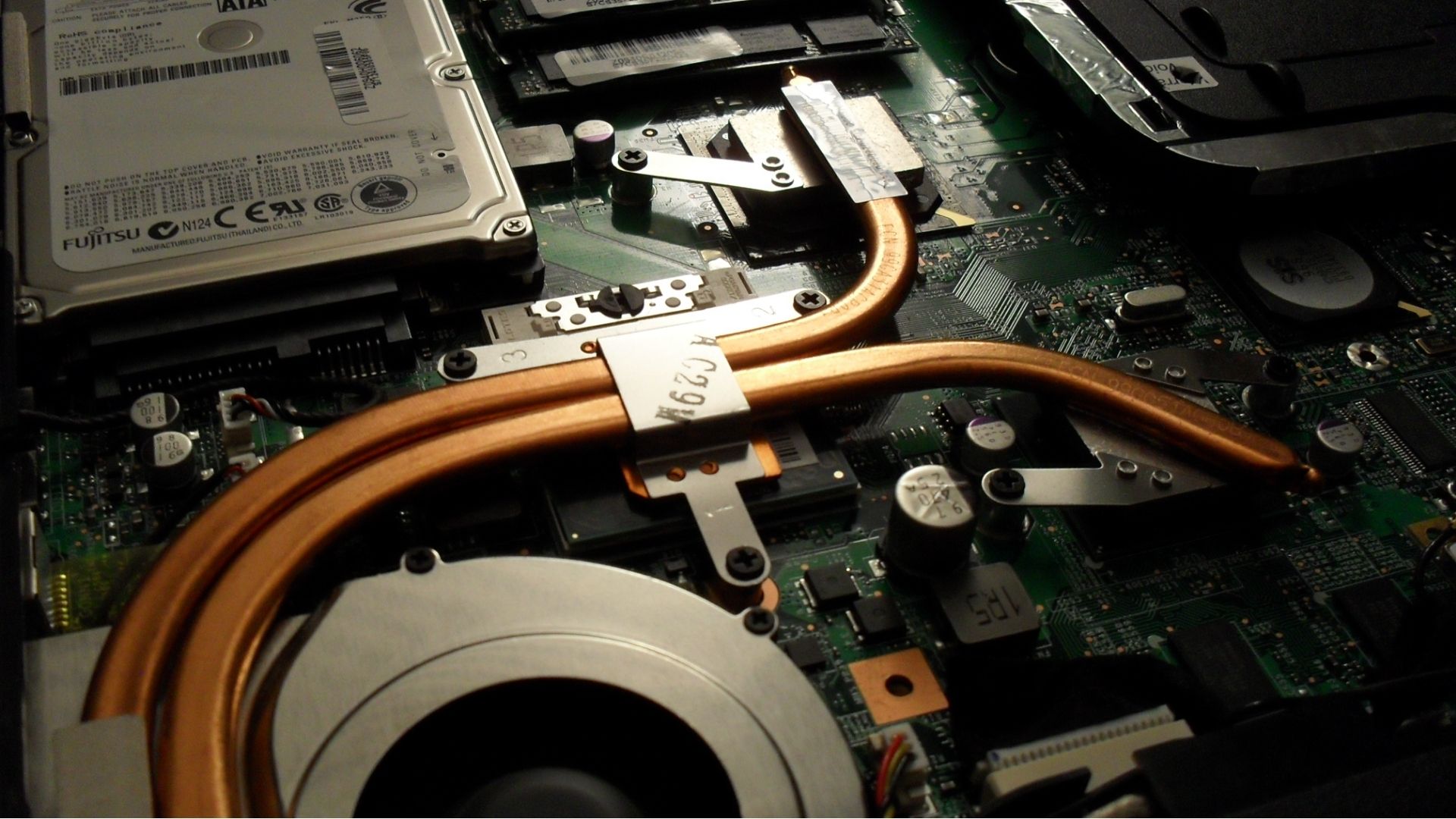
Extreme heat does more than make a machine uncomfortable. It can soften metals, damage electronic circuits, break down lubricants, and cause vital components to crack. The challenge is growing as data centers become more powerful and aircraft engines run hotter. Engineers are responding with cooling systems and advanced materials that either remove heat or help machines withstand it. 1. Liquid and immersion cooling Air cooling struggles when thousands of processors are packed inside a data center. Direct-to-chip cooling solves this problem by circulating liquid through cold plates mounted on processors and other heat-producing components. Immersion cooling goes further by placing entire servers inside a dielectric liquid that does not conduct electricity. A Lawrence Berkeley National Laboratory study found that open-bath immersion can cool high-density electronics without conventional compressor-based cooling. Single-phase systems keep the cooling fluid in liquid form as it absorbs heat. Two-phase systems allow the fluid to boil near hot components before condensing and returning to the bath. 2. Microchannels, jet impingement, and spray cooling Some electronic components produce too much heat across a small area for standard liquid systems. Microchannel cooling addresses this by moving coolant through tiny passages located close to the heat source. Jet impingement directs high-speed liquid at a hot surface through small nozzles. This creates a thin thermal boundary layer and improves heat transfer at the point of impact. Spray cooling covers a surface with fine droplets that absorb heat and evaporate. The US Department of Energy is supporting advanced chip-level cooling systems that include two-phase cold plates and impingement jets. 3. Thermal barrier coatings Wikimedia Commons Thermal barrier coatings are thin ceramic layers placed over heat-resistant metal components. Their low thermal conductivity slows the movement of heat into the metal underneath. A complete coating system usually includes a ceramic top layer and a metallic bond coat. A thermally grown oxide layer also develops between them during operation. These systems allow turbine components to face temperatures that would weaken an unprotected alloy. The US National Energy Technology Laboratory describes thermal barrier coatings as critical to the safe and efficient operation of gas turbine engines. 4. Superalloys and heat-resistant alloys Nickel-based superalloys form the structural backbone of jet engines and gas turbines. They retain mechanical strength while facing high temperatures and enormous rotational forces. Single-crystal turbine blades remove the grain boundaries found inside ordinary metals. These boundaries can become weak points where cracks or deformation begin under prolonged heat. The best turbine-grade nickel superalloys can operate at temperatures approaching 1,100°C. Coatings and internal cooling protect them when the surrounding gas becomes even hotter, according to a US Department of Energy assessment. 5. Ceramic matrix composites Ceramic matrix composites contain ceramic fibers embedded inside a ceramic matrix. The fibers help stop cracks from moving freely through the material. These composites can tolerate higher temperatures than many metals without carrying the same weight. They also need less cooling air inside a turbine. GE Aerospace says its ceramic matrix composites are about one-third the density of comparable metal parts. They also require less than half as much cooling airflow in engines such as the GE9X. 6. Ablative thermal protection systems Ablative shields protect spacecraft by slowly destroying themselves. Their outer layers char or vaporize while carrying heat away from the vehicle. The gases released during this process can create a protective boundary near the shield. This helps reduce heat transfer from the superheated shock layer surrounding a returning spacecraft. NASA’s Phenolic Impregnated Carbon Ablator has protected Stardust and OSIRIS-REx. It was also used by Mars Science Laboratory and Mars 2020, according to NASA. 7. Regenerative cooling Wikimedia Commons Rocket engines produce temperatures far beyond the limits of their chamber walls. Regenerative cooling prevents those walls from overheating by sending fuel or another coolant through channels built into them. The moving fluid absorbs heat before reaching the combustion chamber. This cools the engine while warming the fuel before combustion. The method is also being studied for scramjets that operate under intense aerodynamic and combustion heating. Research published in Applied Thermal Engineering describes regenerative cooling as a key approach for protecting scramjet combustion chambers. 8. Phase-change materials Phase-change materials absorb heat while shifting from one physical state to another. Many systems use a material that melts as temperatures rise. The transition allows the material to store thermal energy without experiencing an equally sharp temperature increase. It can release that energy later when it cools and solidifies. This makes phase-change materials useful during short bursts of intense heat from electronics or batteries. NASA says these systems can control temperature peaks and protect components that experience repeated thermal cycling. 9. Wide-bandgap semiconductors Ordinary silicon electronics can fail when high temperatures create unwanted electrical activity inside the material. Wide-bandgap materials such as silicon carbide and gallium nitride require more energy to move electrons into a conductive state. They can therefore support high-power electronics at temperatures and voltages that challenge conventional silicon. Silicon carbide has become especially important for aircraft engines and planetary exploration systems. NASA tested silicon carbide circuits under simulated Venus surface conditions at around 460°C. The devices operated for 521 hours without cooling or protective packaging, according to the space agency. 10. Heat pipes and two-phase heat spreaders Wikimedia Commons Heat pipes use a sealed fluid to transport heat away from vulnerable components. The fluid evaporates near the heat source and moves toward a cooler section. It then condenses and releases the stored heat. A wick or internal channel returns the liquid so the cycle can begin again. Vapor chambers use the same principle to spread heat across a wider surface. NASA lists heat pipes and other two-phase devices among the thermal-control systems used to protect spacecraft hardware. Machines need layers of protection No single material or cooling system can solve every extreme-heat problem. A technology suited to an AI server may be ineffective inside a rocket engine or atmospheric-entry vehicle.The most resilient machines combine several forms of protection. They resist some of the heat, carry some away, and continue functioning when the rest gets through.Get the latest in engineering, tech, space & science - delivered daily to your inbox.Atharva is a full-time content writer with a post-graduate degree in media & amp; entertainment and a graduate degree in electronics & telecommunications. He has written in the sports and technology domains respectively. In his leisure time, Atharva loves learning about digital marketing and watching soccer matches. His main goal behind joining Interesting Engineering is to learn more about how the recent technological advancements are helping human beings on both societal and individual levels in their daily lives.
10 Technologies keeping machines alive in the world’s hottest environments
Full Article
Original Source
Read the full article at Interestingengineering →KhanList aggregates and links to publicly available news content. We do not host full articles from third-party sources. Always verify important information with original sources.