
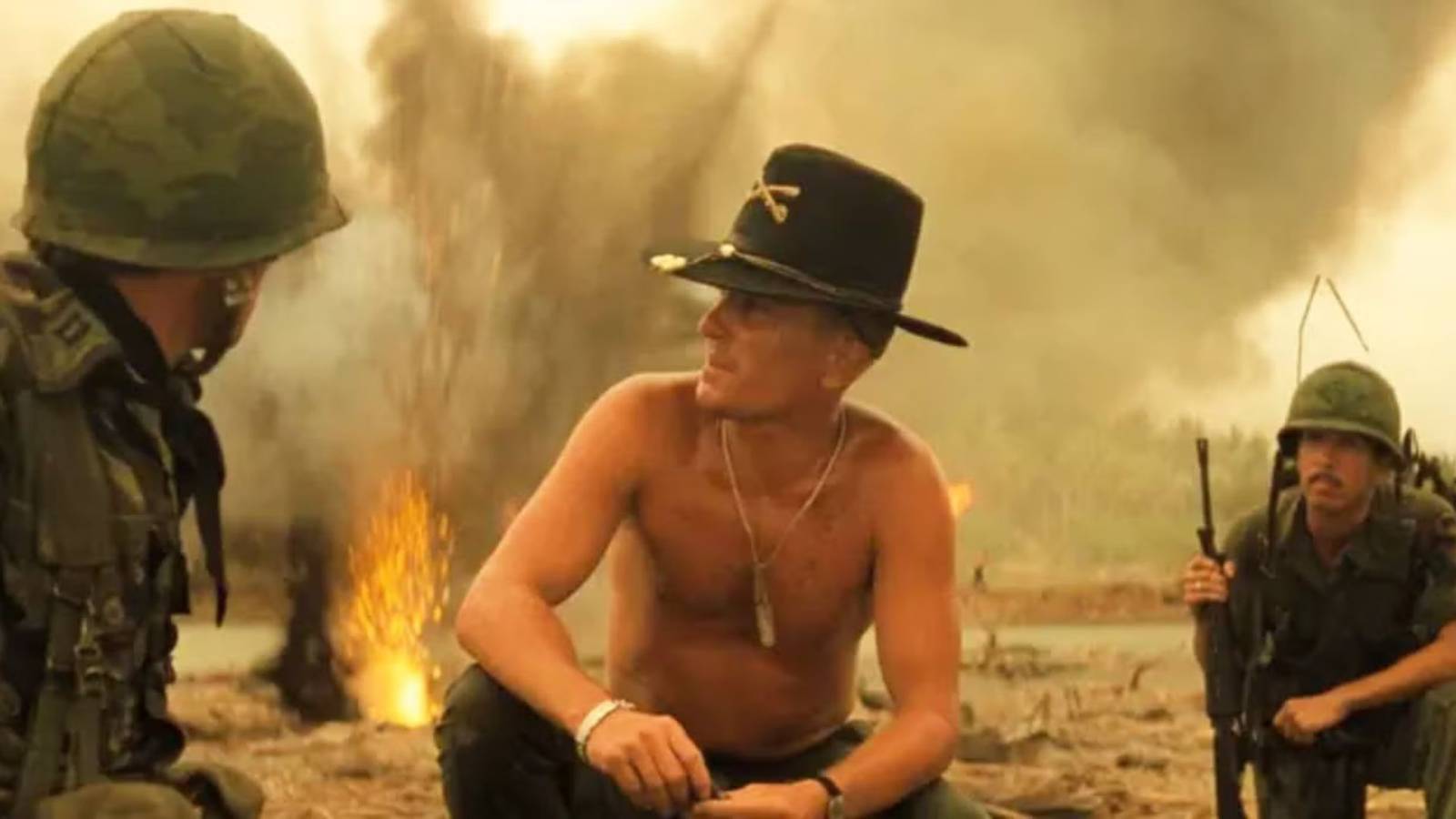
Published Oct 27, 2026, 8:11 AM EDT Senior Music Editor at Screen Rant, Sarah's love of sound and story drive the beat. A globetrotting brand whisperer and award-winning journalist, she’s built cross-cultural narratives around the world—but music has always been her true north. She launched DJ Mag North America, successfully introducing the iconic UK brand to the U.S. market. Previously, she carved a space for EDM inside the pages of VIBE, blending electronic and hip-hop culture long before it was trendy. A helicopter assault set to Wagner, a deranged colonel living beyond military law, and the smell of napalm in the morning. Francis Ford Coppola packed enough unforgettable imagery into Apocalypse Now to secure its place among cinema's greatest war movies. Suggesting that 10 other films might be better almost sounds like sacrilege. Almost. Released in 1979, Apocalypse Now follows Captain Benjamin Willard (Martin Sheen) on a mission to assassinate Colonel Walter Kurtz (Marlon Brando), whose command during the Vietnam War has descended into terrifying madness. The resulting journey is a hypnotic exploration of violence, power, and the increasingly fragile distinction between civilization and savagery. Coppola's extraordinary achievement has influenced generations of filmmakers, and its iconic opening sequence remains among the greatest in war movie history. Yet other directors have approached warfare with equally remarkable results, sometimes capturing aspects of conflict that Apocalypse Now deliberately leaves unexplored. Steven Spielberg reconstructed the D-Day landings with astonishing immediacy, while Stanley Kubrick exposed the institutional absurdity that sends ordinary people toward almost certain death. Elsewhere, filmmakers have examined war through the experiences of children and civilians, producing devastating portraits of survival without the familiar conventions of battlefield heroism. The following 10 films deserve serious consideration alongside Coppola's masterpiece. While the war movies with the most realistic combat often receive the greatest praise, technical accuracy alone doesn't determine cinematic greatness. These selections earn their rankings through extraordinary filmmaking, emotional impact, and the lasting truths they reveal about humanity at war. 10 All Quiet On The Western Front (2022) Edward Berger's German-language adaptation of Erich Maria Remarque's classic novel follows Paul Bäumer (Felix Kammerer), a teenager who enthusiastically joins the German army during World War I. His romantic expectations of military glory collapse almost immediately upon reaching the Western Front, where death, exhaustion, and appalling conditions reduce young soldiers to desperate survivors. The film's relentlessly grim depiction of trench warfare makes the machinery of conflict feel terrifyingly impersonal. Berger's decision to juxtapose the soldiers' suffering with negotiations among political leaders reinforces the enormous distance between those directing the war and those dying in it. Although the 2022 adaptation makes significant changes to Remarque's novel, its extraordinary cinematography and uncompromising depiction of combat make it a worthy contender. Image via MovieStillsDB Stanley Kubrick's Full Metal Jacket approaches the Vietnam War through two dramatically different experiences. The first follows young Marine recruits enduring brutal training under Gunnery Sergeant Hartman (R. Lee Ermey), whose psychological abuse contributes to a horrifying tragedy. The second accompanies Private Joker (Matthew Modine) into Vietnam, where his experiences challenge everything the military supposedly prepared him to understand. Kubrick's methodical direction makes the training sequences particularly disturbing, revealing how systematically the recruits are conditioned to abandon their individuality. The film's infamous final sequence offers an especially bitter commentary on that transformation. Where Apocalypse Now approaches the Vietnam War as a descent into madness, Full Metal Jacket suggests that the madness began long before its soldiers reached the battlefield. 8 The Bridge On The River Kwai (1957) David Lean's The Bridge on the River Kwai stars Alec Guinness as Colonel Nicholson, a British officer imprisoned by Japanese forces during World War II. Determined to preserve military discipline and the dignity of his men, Nicholson becomes increasingly obsessed with constructing an exceptional railway bridge for his captors. His dedication gradually develops into something dangerously removed from the realities of war. Guinness delivers one of the greatest performances of his career, portraying a man whose understanding of honor becomes inseparable from destructive pride. Lean's spectacular filmmaking gives the story enormous scope, although its greatest strength lies in Nicholson's psychological deterioration. Among the classic war films that have aged exceptionally well, The Bridge on the River Kwai remains a compelling examination of how military duty can become dangerously irrational. 7 Grave Of The Fireflies (1988) Isao Takahata's Grave of the Fireflies offers an almost unbearable perspective on World War II through the experiences of two Japanese children. Following the destruction of their home during an American bombing raid, teenage Seita attempts to protect his little sister, Setsuko, as their country approaches defeat. Without dependable adult support, their struggle to survive becomes increasingly desperate. Studio Ghibli's extraordinary animation brings remarkable tenderness to a story defined by hunger, abandonment, and the devastating consequences of war. The film's inclusion among the bleakest movies of all time reflects how completely it dismantles the comforting notion that innocence provides protection from suffering. By concentrating on children rather than soldiers, Grave of the Fireflies exposes the human cost of warfare with exceptional emotional power. 6 The Battle Of Algiers (1966) Gillo Pontecorvo's The Battle of Algiers recreates the Algerian struggle for independence from French colonial rule, focusing on the urban insurgency and counterinsurgency campaigns of the 1950s. Filmed with an almost documentary-like authenticity, the Italian-Algerian production depicts bombings, military repression, and the escalating violence that transforms a city into a battleground. Pontecorvo's refusal to reduce the conflict to conventional heroes and villains gives the movie extraordinary political complexity. Its influence extends far beyond traditional war cinema, inspiring filmmakers including those behind Andor and One Battle After Another. Few war movies examine the relationship between political power and civilian resistance with comparable intelligence. The result feels remarkably immediate despite being released 60 years ago. 5 The Thin Red Line (1998) Terrence Malick returned to filmmaking after a 20-year absence with The Thin Red Line, an extraordinary adaptation of James Jones' novel about American soldiers fighting on Guadalcanal during World War II. Jim Caviezel, Sean Penn, and Nick Nolte lead an enormous ensemble, although Malick approaches their experiences through fragmented memories and philosophical reflections rather than conventional military storytelling. The film's breathtaking images of the natural world provide an unsettling contrast to the violence unfolding around its characters. Malick frequently interrupts combat sequences with moments of unexpected beauty, questioning how humanity can inflict such destruction within an otherwise indifferent landscape. Released the same year as Saving Private Ryan, The Thin Red Line offers a radically different perspective on warfare, achieving an almost spiritual intensity that makes it difficult to forget. 4 Das Boot (1981) Wolfgang Petersen's Das Boot places audiences aboard a German U-boat during World War II, following its increasingly exhausted crew through a dangerous Atlantic patrol. Jürgen Prochnow delivers a remarkable performance as the submarine's unnamed captain, whose experience cannot fully prepare his men for the physical and psychological horrors of underwater warfare. The film's claustrophobic setting creates almost unbearable suspense, particularly when enemy depth charges threaten to destroy the vessel. Petersen spends considerable time establishing the personalities and relationships of his characters, ensuring that their suffering remains deeply personal. Widely regarded as one of the greatest submarine movies ever made, Das Boot accomplishes something extraordinary by making the audience fear for German sailors while never romanticizing the conflict they serve. 3 Paths Of Glory (1957) Stanley Kubrick's Paths of Glory follows Colonel Dax (Kirk Douglas), a French officer whose soldiers are ordered to undertake a disastrous assault during World War I. When the offensive fails, senior commanders seek to protect their reputations by accusing innocent men of cowardice. Dax attempts to defend the soldiers against a military establishment more concerned with appearances than justice. Kubrick exposes the hypocrisy of military leadership with extraordinary precision, contrasting the luxurious surroundings of senior officers with the appalling conditions endured by ordinary soldiers. Douglas gives a commanding performance as a man attempting to preserve his principles within a fundamentally corrupt system. The film's controversial anti-war message challenged prevailing conventions and remains devastatingly effective. Its comparatively straightforward narrative makes the institutional cruelty impossible to dismiss. 2 Saving Private Ryan (1998) Steven Spielberg's Saving Private Ryan begins with one of the most astonishing sequences ever committed to film: the Allied landings on Omaha Beach during D-Day. Tom Hanks stars as Captain John Miller, whose surviving men receive orders to locate Private James Ryan (Matt Damon), a soldier whose three brothers have been killed in combat. The film's extraordinary realism transforms familiar images of World War II into something horrifyingly immediate. Spielberg's recreation of the Normandy invasion has received considerable praise from military historians, while the subsequent mission raises difficult questions about duty and sacrifice. What distinguishes Saving Private Ryan is its ability to combine spectacular filmmaking with intimate human relationships. Few war movies make audiences feel the physical terror of combat so completely. 1 Come And See (1985) Elem Klimov's Come and See follows Florya (Aleksei Kravchenko), a Belarusian teenager who joins Soviet partisans during the Nazi occupation of his homeland in World War II. Initially excited by the prospect of military adventure, Florya encounters atrocities that gradually destroy his understanding of the world. His transformation is almost physically visible, as the young boy becomes increasingly unrecognizable beneath the weight of his experiences. Klimov approaches warfare with an almost unbearable intensity, using unsettling sound design and extraordinary close-ups to immerse viewers in Florya's psychological deterioration. The film's unflinching depiction of the horrors of World War II makes conventional cinematic heroism seem almost irrelevant. While Apocalypse Now examines war's descent into madness through an extraordinary journey, Come and See forces audiences to confront the destruction of innocence itself. Its refusal to provide emotional distance makes it arguably the greatest anti-war movie ever made. Release Date October 17, 1985 Runtime 142 Minutes Director Elem Klimov Writers Elem Klimov, Ales Adamovich
10 Greatest War Movies Better Than Apocalypse Now, Ranked
Full Article
Original Source
Read the full article at Screenrant →KhanList aggregates and links to publicly available news content. We do not host full articles from third-party sources. Always verify important information with original sources.