
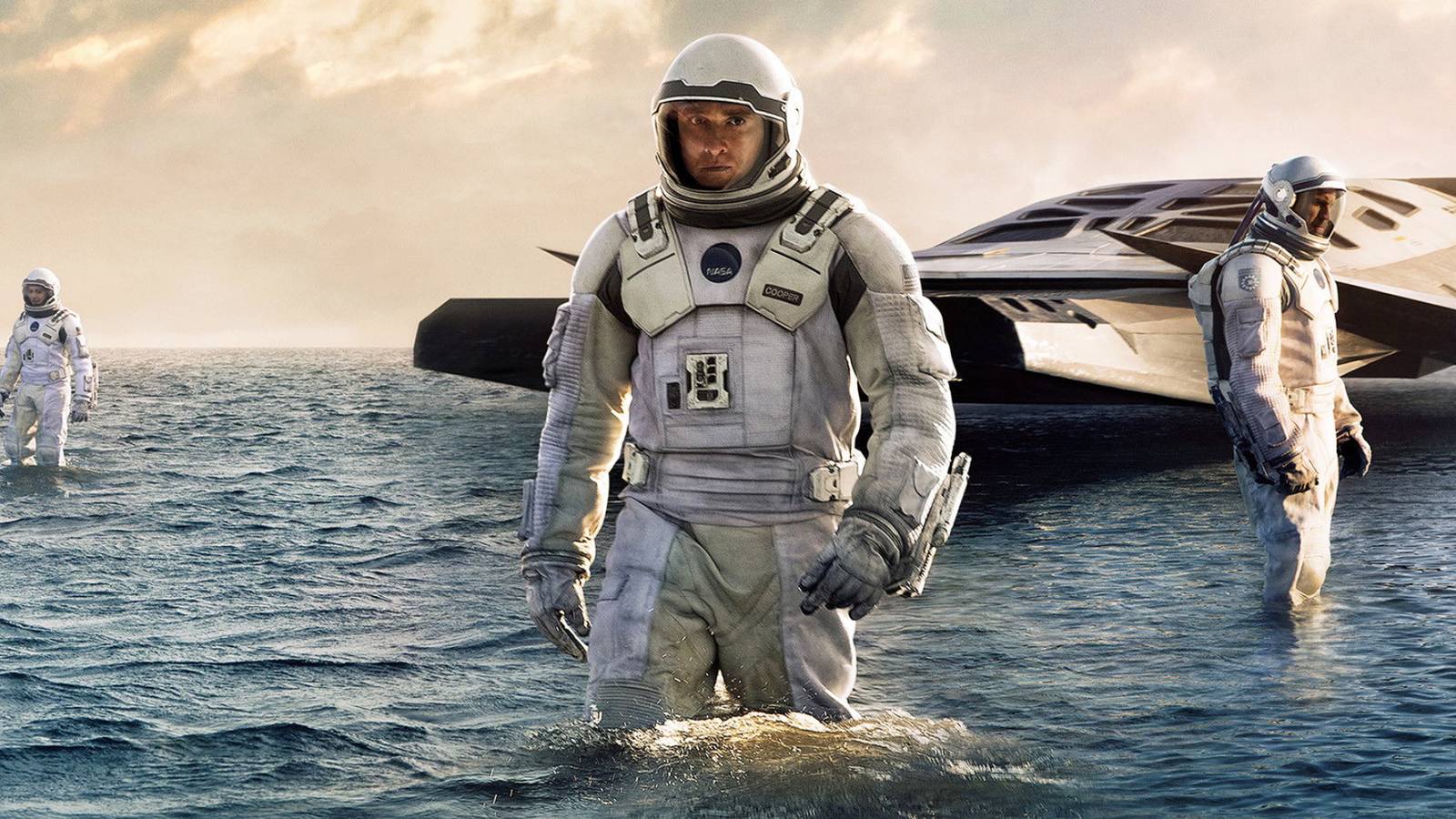
Image via Paramount Pictures Published Oct 18, 2026, 5:26 AM EDT Luc Haasbroek is a writer and videographer from Durban, South Africa. He has been writing professionally about pop culture for eight years. Luc's areas of interest are broad: he's just as passionate about psychology and history as he is about movies and TV. He's especially drawn to the places where these topics overlap. Luc is also an avid producer of video essays and looks forward to expanding his writing career. When not writing, he can be found hiking, playing Dungeons & Dragons, hanging out with his cats, and doing deep dives on whatever topic happens to have captured his interest that week. Sign in to your Collider account Christopher Nolan's Interstellar is rightly regarded as one of the best sci-fi movies of the 21st century, thanks to its stunning visuals, intriguing exploration of time travel and time dilation, and striking depiction of alien planets and futuristic structures. Sadly, sci-fi films this ambitious and creative are hard to come by. However, fans of the movie might find this itch for speculative ideas and mind-bending concepts scratched by sci-fi literature. This list will include ten books that are fantastic genre tales, intellectually stimulating, and entertaining to boot. They examine similar concepts to Interstellar, blending hard science with humanistic storytelling. There won't be a ranking; instead, the list aims to recommend literature that will surely satisfy fans of Nolan's masterpiece. Readers who like space exploration, alien civilizations, and philosophical musings ought to give them a try. 10 '2061: Odyssey Three' (1987) Image via Del Rey "Only time is universal." 2061 is the third installment in genre legend Arthur C. Clarke's Space Odyssey series, delving into alien minds and cosmic mysteries. It sees Dr. Heywood Floyd embarking on what he believes will be a final journey—this time to Halley's Comet. However, his voyage soon takes an unexpected turn when his vessel receives a distress call from Europa, a moon that has been strictly off-limits ever since the alien intelligence known as the Monolith transformed Jupiter into a second sun. Though some of the action sequences are underwhelming, 2061 stands out with its rigorous scientific speculation and philosophical musings. His talent lies in describing the marvels of the universe. Clarke's writing alternates between the precise and the poetic, painting a vision of the future in which humanity's insatiable curiosity drives both progress and peril. In this regard, it's not all that far off from our world. 9 'Red Mars' (1992) Image via Random House "History is a wave that moves through time slightly faster than we do." Kim Stanley Robinson's Red Mars, the first in a trilogy, is the definitive novel on Martian colonization. The story follows the first hundred colonists sent to transform Mars into a livable world. Some believe in preserving the planet's barren beauty, while others push for full-scale terraforming, a process that would take centuries but could create a second Earth. The narrative sprawls across a vast ensemble of characters and an expansive timeline, nicely shifting perspectives to throw certain characters in a new light. As settlements grow and tensions rise, Red Mars becomes a tale of politics and conflict, with humanity's old foibles threatening to wreck its cutting-edge creations. The Mars society depicted here is anything but utopian — it's chaotic and deeply human, with great technical knowledge but few answers to social and personal problems. Elon should take heed. 8 'The Three-Body Problem' (2008) Image via Chongqing Press "Weakness and ignorance are not barriers to survival, but arrogance is." The Three-Body Problem offers a thoughtful update to a first-contact story. It ranges from China's Cultural Revolution to a speculative future, all of it overshadowed by an alien civilization known as the Trisolarans. After receiving a transmission from Earth, these beings decide that humanity is a potential threat and prepare to invade. Critics flipped out over The Three-Body Problem, and for good reason. It's intelligent and creative, and the Chinese setting helps to set it apart from a lot of other recent sci-fi novels. The result is a strong mix of thrills and big-brain ideas. The book's fans include Barack Obama, who praised its "immense scope" and said it was "fun to read, partly because my day-to-day problems with United States Congress seem fairly petty." Those curious may also want to check out the TV adaptation, co-created by Game of Thrones' David Benioff and D.B. Weiss. 7 'The Lathe of Heaven' (1971) Image via Avon Books "Love doesn't just sit there, like a stone; it has to be made, like bread, remade all the time, made new." Ursula K. Le Guin was a giant of sci-fi and fantasy, probably best known for her Earthsea series. One of her strongest sci-fi novels is The Lathe of Heaven. It revolves around George Orr, a man with a terrifying gift—his dreams alter reality itself. What he dreams at night becomes the new truth, rewriting history, the present, and even people’s memories. Soon, Orr's psychiatrist begins manipulating this power to reshape the world according to his ideals. From here, The Lathe of Heaven expands into a cautionary tale on the dangers of playing God. It draws on real-world philosophy, commenting on everything from utilitarianism and behaviorism to Taoism. The premise, intricate plot, and imaginative world-building are strong enough to carry the story, even in the absence of deeply fleshed-out characters. Overall, it breezes by at a lean 184 pages. 6 'The Forever War' (1974) Image via St. Martin's Press "The only thing you can't trade for your heart's desire is your heart." The Forever War focuses on William Mandella, a reluctant soldier drafted into an interstellar war against an alien race known as the Taurans. Due to the effects of relativistic time dilation, every time Mandella returns from a battle, centuries have passed on Earth. What begins as a simple conflict soon spirals into an existential nightmare as he watches his homeworld change beyond recognition. The Forever War is very much an anti-war story, drawing on Joe Haldeman's experiences in Vietnam. In this regard, the novel is the author's response to Robert Heinlein's classic Starship Troopers. The characters' return to a world they can no longer understand or fit into becomes a metaphor for traumatized soldiers unable to assimilate back into normal society. Interstellar plans are bound to enjoy its take on time distortion, which again is mined for both drama and horror. Collider Exclusive · Sci-Fi Survival Quiz Which Sci-Fi World Would You Survive? The Matrix · Mad Max · Blade Runner · Dune · Star Wars Five universes. Five completely different ways the future went wrong — or sideways, or up in flames. Only one of them is the world your instincts were built for. Eight questions will figure out which dystopia, galaxy, or desert wasteland you'd actually make it out of alive. 💊The Matrix 🔥Mad Max 🌧️Blade Runner 🏜️Dune 🚀Star Wars TEST YOUR SURVIVAL → 01 You sense something is deeply wrong with the world around you. What do you do? The first instinct is often the truest one. APull on every thread until I understand the system — then figure out how to break it. BStop asking questions and start stockpiling — food, fuel, weapons. Questions don't keep you alive. CKeep my head down, observe carefully, and trust no one until I know who's pulling the strings. DStudy the patterns. Every system has a rhythm — learn it, and you learn how to survive it. EFind the people fighting back and join them. You can't fix a broken galaxy alone. NEXT QUESTION → 02 In a world of scarcity, what resource do you guard most fiercely? What we protect reveals what we believe survival actually requires. AKnowledge. If you understand the system, you don't need resources — you can generate them. BFuel. Everything else — movement, power, escape — runs on it. CTrust. In a world of fakes and informants, a truly reliable ally is rarer than any commodity. DWater. And after water, information — the two things empires are truly built on. EShips and credits. The galaxy is big — you survive it by being able to move through it freely. NEXT QUESTION → 03 What kind of threat keeps you up at night? Fear is useful data — if you're honest about what you're actually afraid of. AThat reality itself is a lie — that everything I experience has been constructed to keep me compliant. BA raid. No warning, no mercy — just the roar of engines and then nothing left. CBeing identified. Once someone with power decides you're a problem, you're already out of time. DBeing outmanoeuvred — losing a political game I didn't even know I was playing. EThe Empire tightening its grip until there's nowhere left to run. NEXT QUESTION → 04 How do you deal with authority you don't trust? Every dystopia has a power structure. Your approach to it determines everything. ASubvert it from the inside — learn its rules well enough to weaponise them against it. BIgnore it and stay out of its reach. The further from any power structure, the better. CAppear to comply while doing exactly what I need to do. Visibility is the enemy. DManoeuvre within it carefully. You can't beat a system you refuse to understand. EResist openly when I have to. Some things are worth the risk of being seen. NEXT QUESTION → 05 Which environment could you actually endure long-term? Survival isn't just tactical — it's physical, psychological, and very much about where you are. AUnderground bunkers and server rooms — cramped, artificial, but with access to everything that matters. BOpen wasteland — brutal sun, no shelter, constant movement. At least the threat is honest. CA dense, rain-soaked city where you can disappear into the crowd and nobody asks questions. DMerciless desert — extreme heat, no water, and something enormous living beneath the sand. EThe fringe — backwater planets and busy spaceports where the Empire's attention rarely reaches. NEXT QUESTION → 06 Who do you want in your corner when things fall apart? The company you keep is the clearest signal of who you actually are. AA tight crew of believers who've seen behind the curtain and have nothing left to lose. BOne or two people I'd trust with my life. Any more than that and someone talks. CNobody, ideally. Alliances are liabilities. I work alone unless I have no choice. DA community bound by shared hardship and mutual survival — people who need each other to last. EA ragtag team with wildly different skills and total commitment when it counts. NEXT QUESTION → 07 Where do you draw the line — if you draw one at all? Every survivor eventually faces a moment that tests what they're actually made of. AI won't harm the innocent — even the ones who'd report me without hesitation. BI do what I have to to protect the people I've chosen. Everything else is negotiable. CThe line shifts depending on who's asking and what's at stake. DI draw a long-term line — nothing that compromises my people's future, even if it'd help now. ESome lines, once crossed, can't be uncrossed. I know which ones they are. NEXT QUESTION → 08 What would actually make survival worth it? Staying alive is one thing. Having a reason to is another. AWaking others up — dismantling the illusion so no one else has to live inside it. BFinding somewhere — or someone — worth protecting. A reason to keep moving. CAnswers. Understanding what I am, what any of this means, before time runs out. DLegacy — shaping the future in a way that outlasts me by generations. EFreedom — for myself, for others, for every world still living under someone else's boot. REVEAL MY WORLD → Your Fate Has Been Calculated You'd Survive In…Your answers point to the world your instincts were built for. This is the universe your temperament, your survival instincts, and your particular brand of stubbornness were made for. The MatrixYou took the red pill a long time ago — probably before anyone offered it to you. You're a systems thinker who can't help but notice the seams in things. You're drawn to understanding how the system works before figuring out how to break it. You'd find the Resistance, or it would find you — your instinct for spotting constructed realities is the machines' worst nightmare. You function best when you have access to information and the freedom to act on it. The Matrix built an airtight prison. You'd be the one probing the walls for the door. Mad MaxThe wasteland doesn't reward the clever or the well-connected — it rewards those who are hard to kill and harder to break. That's you. You don't need comfort, community, or a cause larger than the next horizon. You need a vehicle, a clear threat, and enough fuel to outrun it — and you're good at all three. You are unsentimental enough to survive that world, and decent enough — just barely — to be something more than another raider. In the wasteland, that distinction is everything. Blade RunnerYou'd survive here because you know how to exist in moral grey areas without losing yourself completely. You read people accurately, keep your circle small, and ask the questions others prefer not to answer. In a city where humanity is a legal designation rather than a feeling, you hold onto something that keeps you functional. You're not a hero. But you're not lost, either. In Blade Runner's world, that distinction is everything. DuneArrakis is the most hostile environment in the known universe — and you are precisely the kind of person it rewards. Patience, discipline, and political awareness are your core strengths — and on Arrakis, they're survival tools. You understand that the long game matters more than any single victory. Others come to Dune and are consumed by it. You'd learn its logic and earn its respect. In time, you wouldn't just survive Arrakis — you'd begin to reshape it. Star WarsThe galaxy far, far away is vast, loud, and in a constant state of violent political upheaval — and you wouldn't have it any other way. You find meaning in being part of something larger than yourself — a cause, a crew, a rebellion. You'd gravitate toward the Rebellion, or the fringes, or whatever pocket of the galaxy still believes the Empire's grip can be broken. You fight — not because you have to, but because standing aside isn't something you're capable of. In Star Wars, that willingness is what makes all the difference. ↻ RETAKE THE QUIZ 5 'Exhalation: Stories' (2019) Image via Alfred A. Knopf "What makes us human is that we know we are, but we don't know what that means." Though technically a short story collection rather than a novel, Ted Chiang's Exhalation is just so good that it deserves a spot on this list anyway. Each story presents a deeply philosophical dilemma wrapped in a thought-provoking sci-fi premise. One of the standout stories, "The Merchant and the Alchemist's Gate," examines time travel through the lens of an Arabian Nights-style fable, where a merchant discovers a portal that allows him to visit both the past and the future. Not every story is on this level, but, as a whole, the collection charms with its elegant, precise prose and genuine emotion. Chiang's creativity is seemingly boundless, serving up one juicy conceit after another. Though some of the scenarios are fairly out there, Chiang still makes them relatively accessible, meaning that this book isn't just for sci-fi diehards. "For small creatures such as we, the vastness is bearable only through love." A landmark first-contact story, Carl Sagan's Contact centers on Dr. Ellie Arroway, a radio astronomer who has dedicated her life to searching for extraterrestrial intelligence. When she detects a signal from the star Vega, the world is thrown into chaos. The signal contains blueprints for an advanced machine that appears to be an invitation. But can it be trusted? Sagan is most famous as a science educator, penning several popular science books and helming the influential documentary Cosmos. Contact is one of his few works of fiction, but it's arguably just as strong as his more well-known nonfiction. The plot is engaging, kicking into high gear in the third act, jam-packed with philosophical debates and thoughtful analysis of concepts like wormholes, cryogenics, and messages hidden within numbers. The movie adaptation with Jodie Foster is also worth watching. 3 'Foundation' (1951) Image via Gnome Press "Violence is the last refuge of the incompetent." Isaac Asimov's Foundation is a cornerstone of the genre, inspiring countless writers who followed. It's about Hari Seldon, a mathematician who develops a revolutionary theory called psychohistory, allowing him to predict the broad movements of history with incredible accuracy. He foresees the imminent collapse of the Galactic Empire, an event that will lead to a dark age lasting thousands of years. Seldon races to try and avert outright catastrophe. The world-building in this novel is impressively vast and deeply intellectual, challenging readers to consider the nature of progress and the cycles of history. It would prompt other sci-fi giants like Douglas Adams and Frank Herbert to write their spacefaring sagas in response. The novel influenced not just fiction writers but many academics, including Carl Sagan, psychologist Martin Seligman, and economist Paul Krugman. It's truly a towering work, comparable in impact to The Lord of the Rings. 2 'The Sirens of Titan' (1959) Image via Delacorte "A purpose of human life, no matter who is controlling it, is to love whoever is around to be loved." While not as famous as the author's masterwork Slaughterhouse-Five, The Sirens of Titan by Kurt Vonnegut is just as gripping (plus a lot more absurd and satirical). It focuses on Malachi Constant, the richest man on Earth, who is unwittingly pulled into an interplanetary adventure spanning Earth, Mars, and Saturn's moon, Titan. Along the way, he becomes entangled in a war he doesn’t understand and realizes he has been manipulated by forces beyond his control. Part adventure, part comedy, Sirens weaves together themes of war and its lingering consequences, dysfunctional family dynamics, government corruption, and religious zealotry. It also looks at issues of free will and the meaning of human life—you know, light reading stuff. Though sometimes challenging, Siren also manages to be suspenseful and well-paced, keeping the reader invested. 1 'Hyperion' (1989) Image via Doubleday "The truth is, it’s not the future that scares me. It’s the past." Another sci-fi classic, Dan Simmons' Hyperion is one of the most ambitious and beautifully written works in the genre. Structured similarly to The Canterbury Tales, it follows seven pilgrims on a journey to the distant world of Hyperion, where a mysterious, godlike entity known as the Shrike awaits them. Each traveler has a reason for seeking out the Shrike, and as they share their stories, a picture of a vast and complex universe begins to emerge. The whole Hyperion universe is vivid and meticulously crafted, drawing heavily on mythology and classic literature, including the work of Geoffrey Chaucer and John Keats. Indeed, the series is bursting at the seams with inventive ideas, not least the enigmatic, terrifying Shrike itself, a vicious being able to manipulate time. It's known to impale its victims on the Tree of Pain, a huge, metallic structure that exists in some far-flung moment in time. Gnarly stuff.
10 Great Books To Read if You Love 'Interstellar'
Full Article
Original Source
Read the full article at Collider →KhanList aggregates and links to publicly available news content. We do not host full articles from third-party sources. Always verify important information with original sources.