
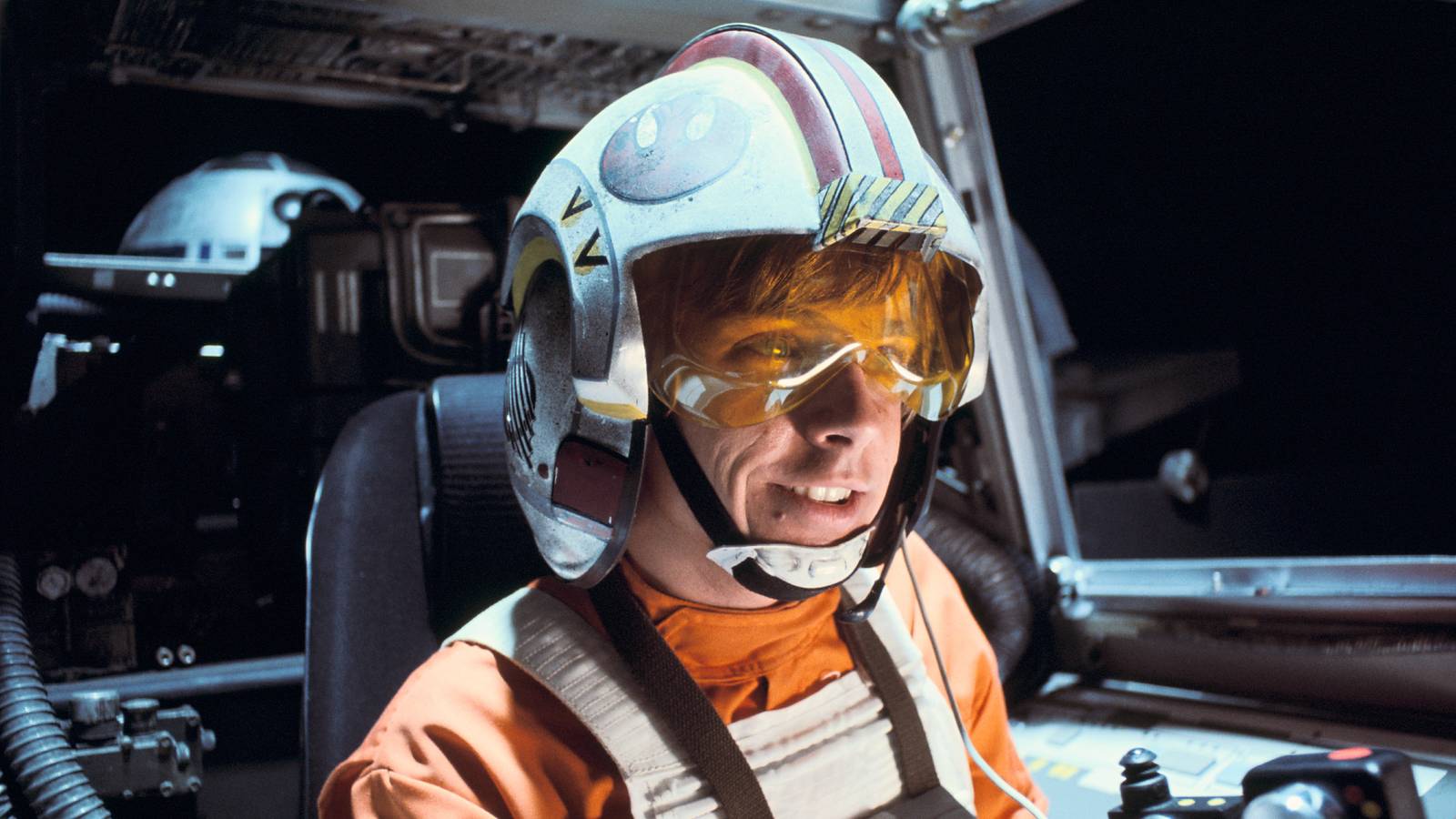
While often considered the paragon of science fiction, there are several sci-fi masterpieces that are better than Star Wars. Science fiction can take audiences anywhere. One minute, viewers are contemplating humanity's place in the universe; the next, they're watching dinosaurs chase people or a teenager accidentally erase himself from existence. Few genres offer filmmakers so much freedom to experiment with ideas, visual styles, and wildly imaginative storytelling. Star Wars deserves its place among cinema's most influential franchises. George Lucas created an extraordinary universe filled with memorable characters, spectacular battles, and mythology that continues to captivate audiences across generations. However, science fiction isn't confined to space operas, lightsabers, and battles between good and evil. Some of the genre's finest films are stranger, darker, funnier, or considerably more interested in asking difficult questions than providing easy answers. From groundbreaking silent cinema to modern blockbusters, the following movies are science fiction at its most inventive. They feature groundbreaking effects, ingenious screenplays, unforgettable performances, and ask questions about the nature of humanity. They make audiences question reality and demonstrate just how much the genre can accomplish. 2001: A Space Odyssey (1968) Stanley Kubrick's 2001: A Space Odyssey begins with prehistoric apes and ends somewhere that makes considerably less immediate sense. In between, humanity develops space travel, a crew heads towards Jupiter, and an increasingly unsettling computer named HAL 9000 develops a serious attitude problem. Kubrick and science-fiction author Arthur C. Clarke created something that refuses to behave like a conventional adventure. Entire sequences unfold without dialogue, leaving the classical music score and the imagery to do the talking. HAL provides 2001’s most unnerving scenes, particularly when his calm, polite voice becomes more frightening than any monster could be. The climactic Star Gate sequence is an extraordinary psychedelic trip that still invites arguments about what viewers have actually witnessed. While Star Wars makes space an exhilarating playground, 2001: A Space Odyssey makes it vast, mysterious, and occasionally incomprehensible. Metropolis (1927) Long before Hollywood started blowing up futuristic cities, Fritz Lang was building one of cinema's most extraordinary. Metropolis takes place in a towering urban nightmare where wealthy elites enjoy spectacular luxury while workers toil underground to keep the whole operation running. Metropolis follows Freder, the privileged son of the city's ruler, who discovers the brutal conditions endured by its working class. His growing outrage gives Lang an excuse to unleash a production design that is still astonishing nearly a century later. Skyscrapers loom over congested streets, machines swallow workers whole, and the robot Maria provides one of science fiction’s earliest and most iconic images. Metropolis's politics can be heavy-handed, and its proposed reconciliation between workers and rulers is hardly revolutionary. Its visual imagination, however, is in a league of its own, influencing countless movies and music videos. Alien (1979) Alien is a terrifyingly claustrophobic onslaught fusing science fiction with horror. The crew of the commercial spaceship Nostromo investigates a distress signal and discovers an extraterrestrial organism with a rather unpleasant approach to reproduction. Soon, the ship's narrow corridors become hunting grounds, and nobody can be certain where the creature is hiding. Scott's greatest achievement is making the Nostromo inherently inhospitable. Every location has looming, seemingly endless shadows in which the creature could be hiding. H.R. Giger's monster design only makes matters worse. The Xenomorph’s biomechanical appearance is so unsettling that even its silhouette feels wrong. Sigourney Weaver's Ellen Ripley is Alien's secret weapon. She's resourceful, practical, and increasingly willing to ignore the decisions of people who clearly have no idea what they're doing. Her survival never feels guaranteed but always wholly earned. Star Wars offers exciting encounters with strange creatures. Alien warns against that idea. The Matrix (1999) The Matrix depicts a world in which humanity is trapped inside a computer simulation. Thomas Anderson, a programmer who moonlights as hacker Neo, discovers that the familiar world is an elaborate illusion. His subsequent escape involves martial arts training, philosophical revelations, and learning that gravity is apparently more of a suggestion than a rule. The Matrix's intellectual ambitions are surprisingly playful. Its questions about free will, perception, and control sit alongside leather coats, ridiculous sunglasses, and some of the most influential action sequences of the late 1990s. The bullet-time effect, which lets the camera glide around frozen action, became so popular that filmmakers spent years trying to copy it. Beneath the spectacle, The Matrix has an enduring sting. Neo's enemies control what people perceive, making ignorance a tool of oppression and knowledge an act of rebellion. Blade Runner (1982) Ridley Scott's Blade Runner imagines a future Los Angeles where enormous advertisements tower overcrowded streets, the rain never seems to stop, and humanity has developed artificial people only to deny them the right to live freely. Harrison Ford plays Rick Deckard, a former police officer assigned to hunt down escaped replicants. These genetically engineered beings have returned to Earth seeking a longer lifespan, and their desperation makes them considerably more interesting than the humans pursuing them. Blade Runner's neon-lit streets and decaying architecture are spectacular, but its greatest achievement is making the replicants' plight genuinely moving. Roy Batty, played by Rutger Hauer, begins as a frightening adversary before revealing the terror of a life that is running out far too soon. His final moments have become legendary for good reason. Interstellar (2014) Christopher Nolan's Interstellar sends Matthew McConaughey on a mission to save humanity, and the most devastating obstacle is time. McConaughey plays Cooper, a former pilot recruited to search for a habitable planet as environmental collapse threatens Earth. His journey through a wormhole takes him to worlds where the laws of physics have consequences far beyond the immediate mission. One expedition to a water-covered planet is particularly brutal. Because of gravitational time dilation near a black hole, a few hours on the surface correspond to years elsewhere. When Cooper returns to his spacecraft, the emotional cost of that decision is waiting for him in the form of decades of lost time. Nolan's scientific ambitions are matched by Interstellar’s visual grandeur. The black hole Gargantua, developed with scientific consultation, is a remarkable cinematic achievement. Hans Zimmer's organ-heavy score gives the whole enterprise an almost religious intensity. Back to the Future (1985) Robert Zemeckis' Back to the Future takes one of science fiction's most complicated concepts and uses it to explore teenage angst and identity. Michael J. Fox stars as Marty McFly, who accidentally travels from 1985 to 1955 in a DeLorean time machine built by eccentric scientist Doc Brown, played by Christopher Lloyd. Unfortunately, Marty interferes with his parents' first meeting, putting his own existence in jeopardy. The screenplay is a marvel of construction. Seemingly minor details return at exactly the right moment, while the clock tower, the lightning strike, and the DeLorean's fuel requirements all become crucial to the climax. Fox makes Marty effortlessly likable, while Lloyd's manic enthusiasm ensures that even the explanations about temporal mechanics are entertaining. Back to the Future's time-travel logic might give physicists a headache, but its storytelling is practically immaculate. Jurassic Park (1993) Steven Spielberg's Jurassic Park follows a group of experts visiting Hammond's new theme park, where genetically engineered dinosaurs are about to become the latest attraction. Unfortunately, the security systems fail, the animals escape, and the visitors discover that prehistoric predators aren't particularly interested in following park rules. The first appearance of a Brachiosaurus captures the genuine wonder of the premise. Spielberg lets his characters gape in amazement, giving audiences a moment to appreciate the sheer impossibility of seeing a living dinosaur. Later, the Tyrannosaurus attack demonstrates just how quickly that wonder can become panic. Jurassic Park’s combination of practical animatronics and pioneering computer-generated imagery makes the dinosaurs feel startlingly real. They have weight, movement, and an unnerving unpredictability that many modern digital creatures struggle to match. It’s endlessly entertaining and one of the greatest movies ever made. Arrival (2016) When enormous alien spacecraft appear around the world in Denis Villeneuve's Arrival, humanity faces a serious language barrier. Amy Adams plays Louise Banks, recruited to decipher the extraterrestrials' complicated written language before international panic spirals out of control. Their circular symbols don't resemble human writing, and understanding them requires Louise to reconsider how language communicates meaning in the first place. That's where Arrival gets particularly clever. Rather than treating communication as a convenient way to deliver exposition, it makes language central to its biggest ideas about time, memory, and perception. The mystery surrounding Louise's experiences gradually reshapes the audience's understanding of what they've been watching. The aliens are equally memorable. Their enormous spacecraft, fog-shrouded interiors, and unfamiliar biology create a genuine sense of encountering something beyond human experience. Arrival manages to make a conversation more suspenseful than a space battle, and its final revelations hit harder because the film has earned them. Solaris (1972) Most space missions go wrong because of mechanical failures, hostile environments, or insufficient oxygen. In Andrei Tarkovsky's Solaris, the biggest problem is that the astronauts' memories have seemingly started showing up in person. Psychologist Kris Kelvin travels to a space station orbiting the mysterious planet Solaris, where the surviving crew members are experiencing disturbing manifestations connected to their pasts. Kelvin soon finds himself confronting the reappearance of his deceased wife, Hari, raising questions about whether the figure before him is a person, a copy, or something else entirely. Solaris moves deliberately, allowing its eerie science fiction atmosphere and philosophical questions to settle in. Solaris demands patience, but rewards it with a haunting exploration of grief, consciousness, and humanity's frustrating habit of interpreting the unknown through its own emotional baggage. Scratch & Peek Identify the cover art while scratching off as little foil as possible. Release Date September 26, 1972 Runtime 167 Minutes Director Andrei Tarkovsky Writers Stanislaw Lem, Fridrikh Gorenshteyn, Andrei Tarkovsky
10 Best Sci-Fi Movies That Are Better Than Star Wars
Full Article
Original Source
Read the full article at Screenrant →KhanList aggregates and links to publicly available news content. We do not host full articles from third-party sources. Always verify important information with original sources.