
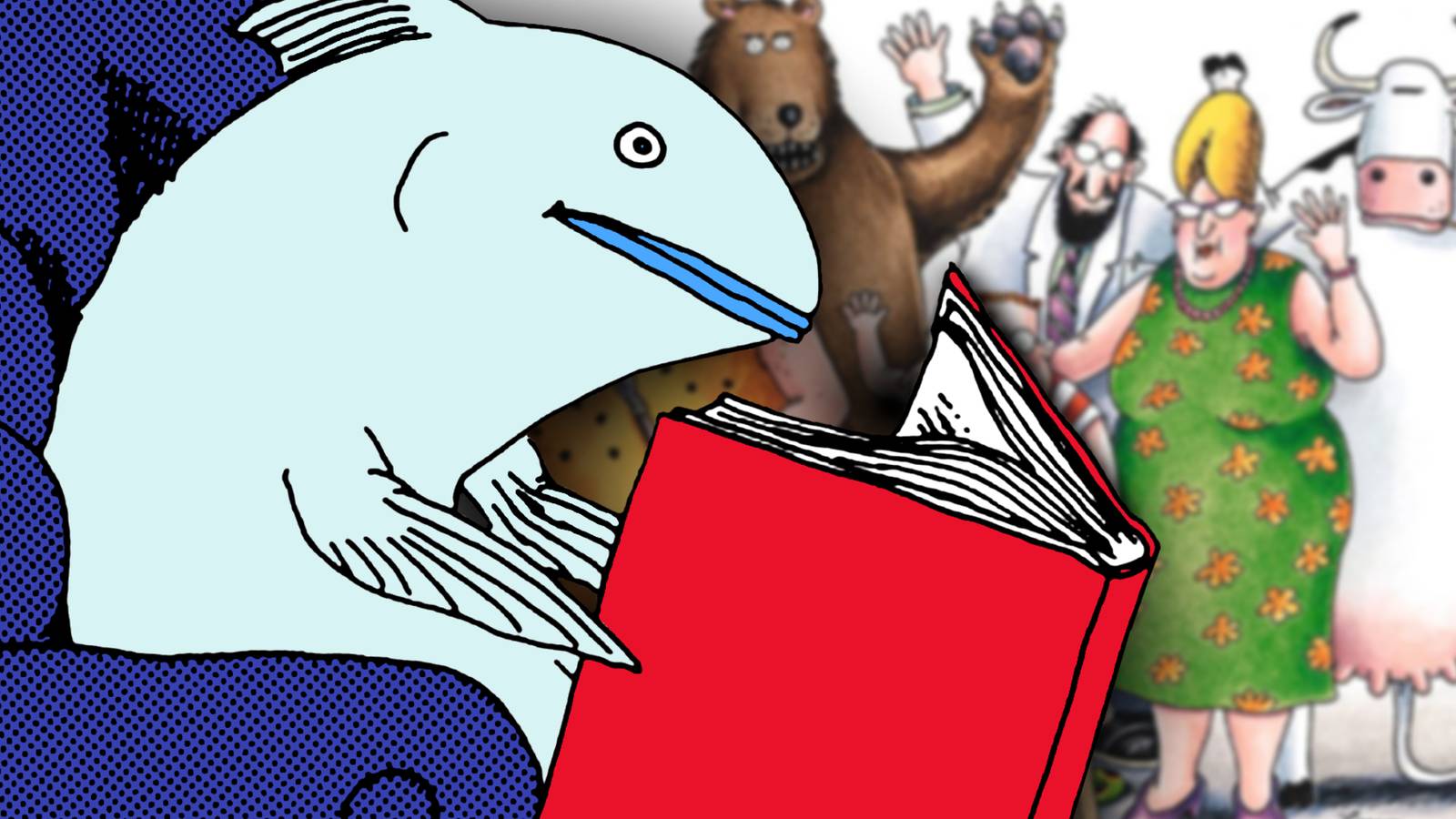
Published Oct 26, 2026, 6:00 PM EDT Robert Wood is a writer and editor based out of Cheshire, England. He is the author of 'The False Elephant: and 99 Other Unreasonably Short Stories' - 100 stories, each told in exactly 100 words. Rob got into comics via Bendis' Ultimate Spider-Man and the UK anthology 'The Mighty World of Marvel,' which was running Frank Miller's Daredevil, Classic Hulk and Contest of Champions II. Prior to journalism, he worked in copywriting and copyedited for Oxford University Press. He is on X as @PinchTwigs and Instagram as roobwoodjourno. There's no question that The Far Side's Gary Larson has a gift for language, so it's no surprise that so many of his comics have a literary bent, referencing some of the planet's best-loved books. In this list, we're looking over the best literary references in Far Side history, from well-known classics to beloved writers. Of course, this being Gary Larson, there'll also be cows, cowboys and fish who can read. Enjoy these awesome throwbacks to The Far Side's prime, and let us know in the comments what other Larson strips should be included on this list... Herman Melville's Moby Dick Of all the books on this list, Larson seems to have liked joking about Moby Dick most. The classic story sees Captain Ahab dedicating his life to slaying the titular white whale, destroying himself in the process. There are multiple Moby Dick comics across The Far Side, including his parents calling him 'Richard', Ahab encountering a 'Save the Whales' activist, and Melville himself struggling over his iconic first line, "Call me Ishmael." However, we're choosing the strip above as the best of the best. The comic shows Moby Dick accidentally rear-ending Ahab, leading to yet another confrontation. The joke hinges on Moby's incredible bad luck to have crashed into the one person who hates him most in the world. Ahab was even driving with his harpoon in the car! Louisa May Alcott's Little Women Custom Image by Robert Wood (from Gary Larson) Little Women is the definitive coming-of-age novel, following sisters Meg, Jo, Beth and Amy as they journey out of childhood and into the complex waters of womanhood, while also exploring proto-feminist ideas of self-determination and financial independence. NONE of that matters for Larson's joke, which sees three tiny guys reading the book together, seemingly hoping for relatable content about other diminutive characters. Salman Rushdie's The Satanic Verses As smart as Gary Larson is, he's also prone to groan-worthy puns - in this case, playing on the fishiness inherent to the name of acclaimed author Salman Rushdie. Not content to leave it there, his book's title is transformed into 'The Atlantic Verses' for another aquatic gag. Given the furor that rose up around Rushdie's real-life book - including a fatwa declared on Rushdie himself and attacks on various translators and publishers - it's hard not to read into the fish's blank expression. Does the fish looked phased by the famously tough read, or are they about to explode into anger at the subject matter? Rushdie appears elsewhere in The Far Side, with Larson imagining him hiding out with Elvis Presley. Rushdie went into hiding for almost a decade after publishing The Satanic Verses, facing multiple violent attacks in his life since, making this one of Larson's darkest gags. Oscar WIlde's The Picture of Dorian Gray Oscar Wilde's novel tells the story of a hedonist who gains immortality through a painting that ages and decays on his behalf, driving him to increasingly extreme displays of sadism and narcissism. Larson imagines that if the title character had simply had another painting made of his dog, he might have spent his days engaged in far healthier pursuits. Stephen King's Oeuvre In this comic strip, Gary Larson pokes fun at horror impresario Stephen King by suggesting that the mind behind IT, Carrie, The Shining and Pet Sematary has to have emerged from a pretty creepy childhood. In Larson's view, even Stephen King's childhood ant farm had a macabre spin. King doesn't appear to have taken offense to Larson's joke, writing the foreword for 1985's The Far Side Gallery 2, and saying: [Larson] does what artists and humorists are supposed to do: he sees what I could see if I could have his eyes. I don't have them, but thank God they are on loan. Edgar Allan Poe's The Tell-Tale Heart Larson was a fan of 'first draft' gags showing various famous figures struggling to formulate their most iconic phrases. In this strip, Edgar Allan Poe is drafting out his horror classic of a murderer tormented by the beating of his victim's hidden heart, but can't quite land on the perfect organ. Not only is the human heart potent imagery, but its literal beating is a major part of Poe's narrative, making it even more ludicrous that he might first have contemplated using the bladder or spleen. Watty Piper's The Little Engine That Could This classic folktale was first adapted into a book in 1930, depicting an underdog train who makes it up a mountain by believing in its capabilities. Larson pulls off the classic 'add death to a children's story' joke by keeping the story as is, but adding a classic damsel tied to the tracks ahead. Homer's The Iliad and The Odyssey Originating from the oral tradition, The Iliad and The Odyssey have been adapted countless times - most recently in Christopher Nolan's blockbuster 2026 movie. Larson uses the 'high culture' perception of these stories to set up the idea of a cowboy throwing trivia questions at a rival after gunning them down, all for the punch line of a pun on "You can't shoot first and ask questions later." Larson was a HUGE fan of The Odyssey's Trojan Horse for gag potential, with multiple strips playing with the idea of soldiers hiding inside a gigantic animal of some form or another. Larson seems particularly concerned with the toiletry needs of the Greek warriors inside the horse, with multiple strips showing them beset by their bladders while waiting for the Trojans to go to sleep. Washington Irving's The Legend of Sleepy Hollow Washington Irving's short horror story sees Ichabod Crane beset by a headless specter. Larson imagines the everyday falling out that motivated this rivalry, and the two characters resolving their differences in The People's Court rather than the shadowy roads of Sleepy Hollow. In an extra gag specifically for book lovers, Ichabod Crane is shown as particularly gangly - the iconic stature of the superstitious teacher. Honorable Mentions: Classic Horror Novels A pause in our list for some honorable mentions! Larson loved classic horror figures like Dracula and Frankenstein, and most of them started out in literature. From Psycho to Jaws, a lot of classic horror movies started out as novels, though it's pretty clear from Larson's depictions of the characters that here he's drawing on their silver screen appearances rather than their literary beginnings. However, on a list of Far Side comics for book lovers, it's worth including Larson's gags based on characters created by writers like Bram Stoker and Mary Shelley. The same is also true for...
10 Best Far Side Comics Perfect For Book Lovers
Full Article
Original Source
Read the full article at Screenrant →KhanList aggregates and links to publicly available news content. We do not host full articles from third-party sources. Always verify important information with original sources.